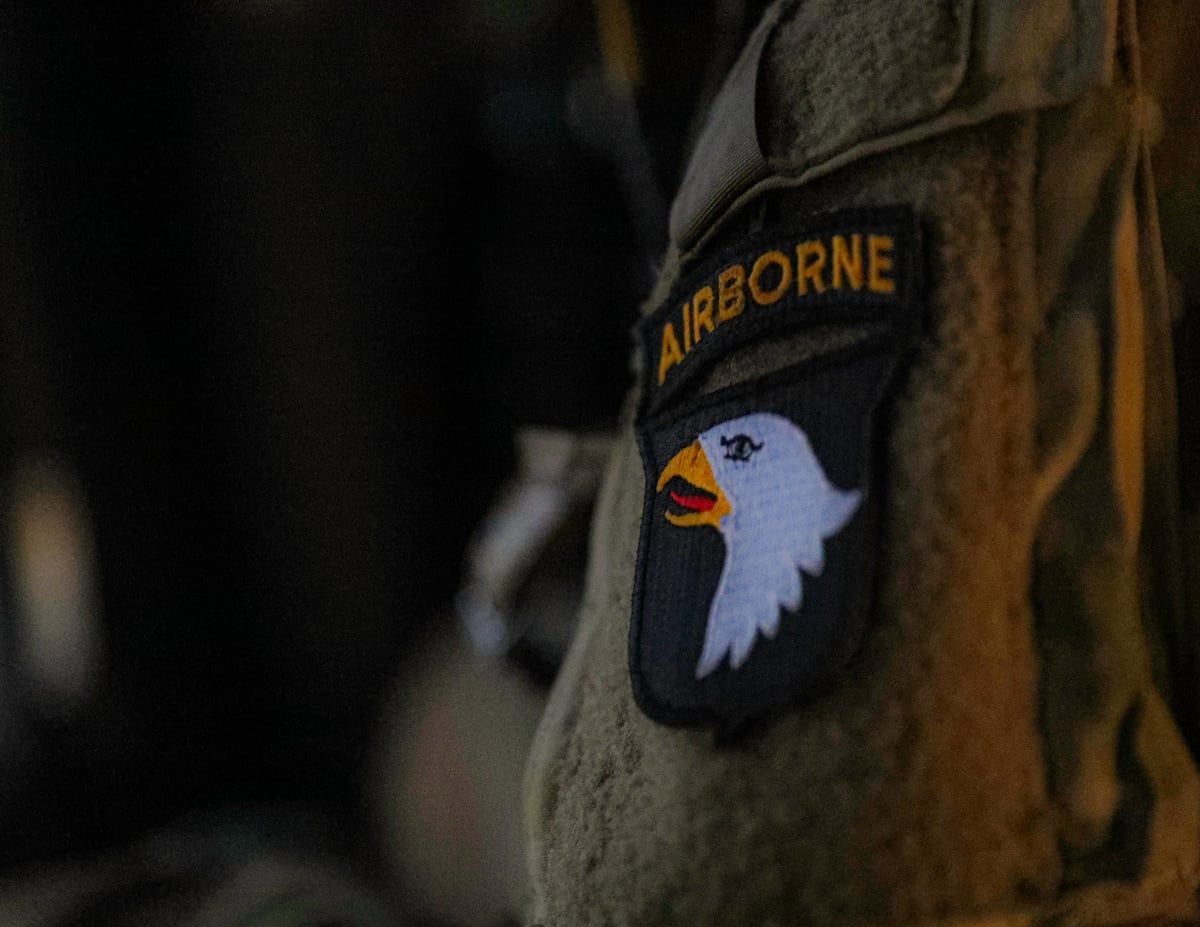
The history of the 101st Airborne Division is steeped in remarkable stories, with one particular tale standing out: that of Old Abe, a bald eagle who became a symbol of courage during the American Civil War. This division has played a crucial role in every major conflict involving the United States, from the D-Day landings in World War II to more recent engagements in Vietnam, Iraq, and Afghanistan. The division’s insignia, featuring a screaming eagle on a black shield, is among the most recognizable symbols in the U.S. Army, yet the story behind it is less widely known.
Old Abe’s journey began in 1861 when he was captured as a young eaglet by Ahgamahwegezhig, also known as Chief Big Sky, from the Lac du Flambeau Band of the Lake Superior Ojibwe. Shortly thereafter, the bird was sold to Daniel McCann of Chippewa County, Wisconsin, for a bushel of corn. Initially a family pet, Old Abe’s size and appetite prompted McCann to sell him to passing military units preparing for service at Camp Randall in Madison.
Old Abe eventually found a new owner in Capt. John E. Perkins, who commanded a militia unit known as the “Eau Claire Badgers.” The eagle was named after President Abraham Lincoln and became an unofficial mascot for the 8th Wisconsin Infantry. The unit quickly earned the nickname the “Eagle Regiment” as Old Abe accompanied them into battle, perched on a black shield attached to a wooden pole.
Throughout his service, Old Abe participated in notable battles, including the sieges at Vicksburg and Corinth. He witnessed 37 engagements and became a source of morale for the troops. Col. Rufus Dawes of the 8th Wisconsin Infantry recounted how the eagle was a coveted target for enemy forces, stating, “Our eagle usually accompanied us on the bloody field, and I heard [Confederate] prisoners say they would have given more to capture the eagle of the Eighth Wisconsin than to take a whole brigade of men.”
Old Abe’s celebrity status grew during the Civil War, with Confederate General Sterling Price famously declaring, “That bird must be captured or killed at all hazards; I would rather get that eagle than capture a whole brigade or a dozen battle flags.” Despite the efforts of the enemy, Old Abe remained with his regiment, mustering out alongside them in 1864.
After the war, Old Abe was donated to the state of Wisconsin and lived in the state capitol building. He made appearances at various political, social, and cultural events. However, his living conditions deteriorated over time. The Wisconsin Historical Society notes that he suffered from exhaustion and malnutrition during his time in captivity.
In 1881, a fire broke out in the basement of the capitol building. Although Old Abe survived the flames, he succumbed to smoke inhalation shortly thereafter. His death marked the end of an era, but his legacy endured. In 1921, Old Abe was officially adopted as the insignia of the 101st Airborne Division, cementing his status as a symbol of airborne and air assault combat capabilities.
Today, the 101st Airborne Division honors the memory of Old Abe, whose story reflects the bravery and resilience of the soldiers who have served under its banner. The division continues to embody the spirit of this legendary eagle, reminding us of the profound connection between history and the present-day military.