
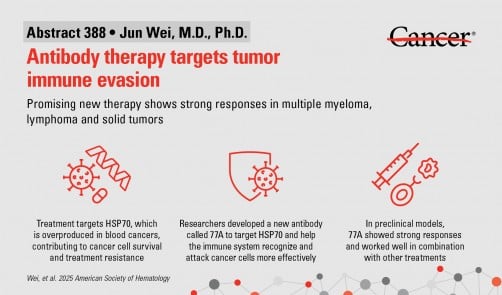
Researchers at The University of Texas MD Anderson Cancer Center have developed a groundbreaking antibody therapy named 77A, which has demonstrated significant potential in treating resistant blood cancers and solid tumors. This innovative treatment targets the heat shock protein HSP70, a protein often exploited by tumors to evade the immune system. The findings were presented on December 6, 2025, at the 67th American Society of Hematology (ASH) Annual Meeting and Exposition.
The study, led by Jun Wei, M.D., Ph.D., an assistant professor of Lymphoma & Myeloma, and principal investigator Robert Z. Orlowski, M.D., Ph.D., showcased how 77A activates T cells and natural killer (NK) cells to enhance immune responses against various tumors. “There is tremendous promise in the way 77A is capable of rewiring the immune system, enabling it to respond effectively against multiple cancers,” Wei stated.
Mechanism of Action and Laboratory Findings
The 77A antibody works by converting HSP70 into a trigger for the immune system. HSP70 is often overproduced in blood cancers, such as multiple myeloma and lymphoma, as well as in solid tumors, creating an environment that suppresses immune responses. In laboratory models, 77A has shown strong antitumor effects, significantly increasing the effectiveness of existing treatments like chemotherapy, radiation therapy, and immunotherapies.
The therapy has been effective in enhancing the activity of both innate and adaptive immune cells. It improved the ability of immune cells to detect and destroy cancer cells and has shown potential for combining with adoptive T cell therapy, a cutting-edge technique that uses lab-grown immune cells to target tumors.
Future Directions and Clinical Trials
The encouraging results from preclinical studies pave the way for clinical trials of the humanized version of 77A, which is currently under development. Early tests with human immune cells indicate that 77A could enhance immune responses in healthy donors, suggesting a versatile therapeutic option for patients battling various cancer types.
“Our next step is to advance a humanized version of this antibody into clinical trials to evaluate its potential in patients across multiple cancer types,” Orlowski remarked. The study received support from Blood Cancer United, formerly known as the Leukemia & Lymphoma Society, underscoring the importance of collaboration in cancer research.
These developments in immunotherapy could reshape treatment paradigms for patients facing challenging cancers, emphasizing the need for ongoing research and clinical evaluation. A full list of collaborating authors and their disclosures can be accessed through the abstract presented at the ASH meeting.


