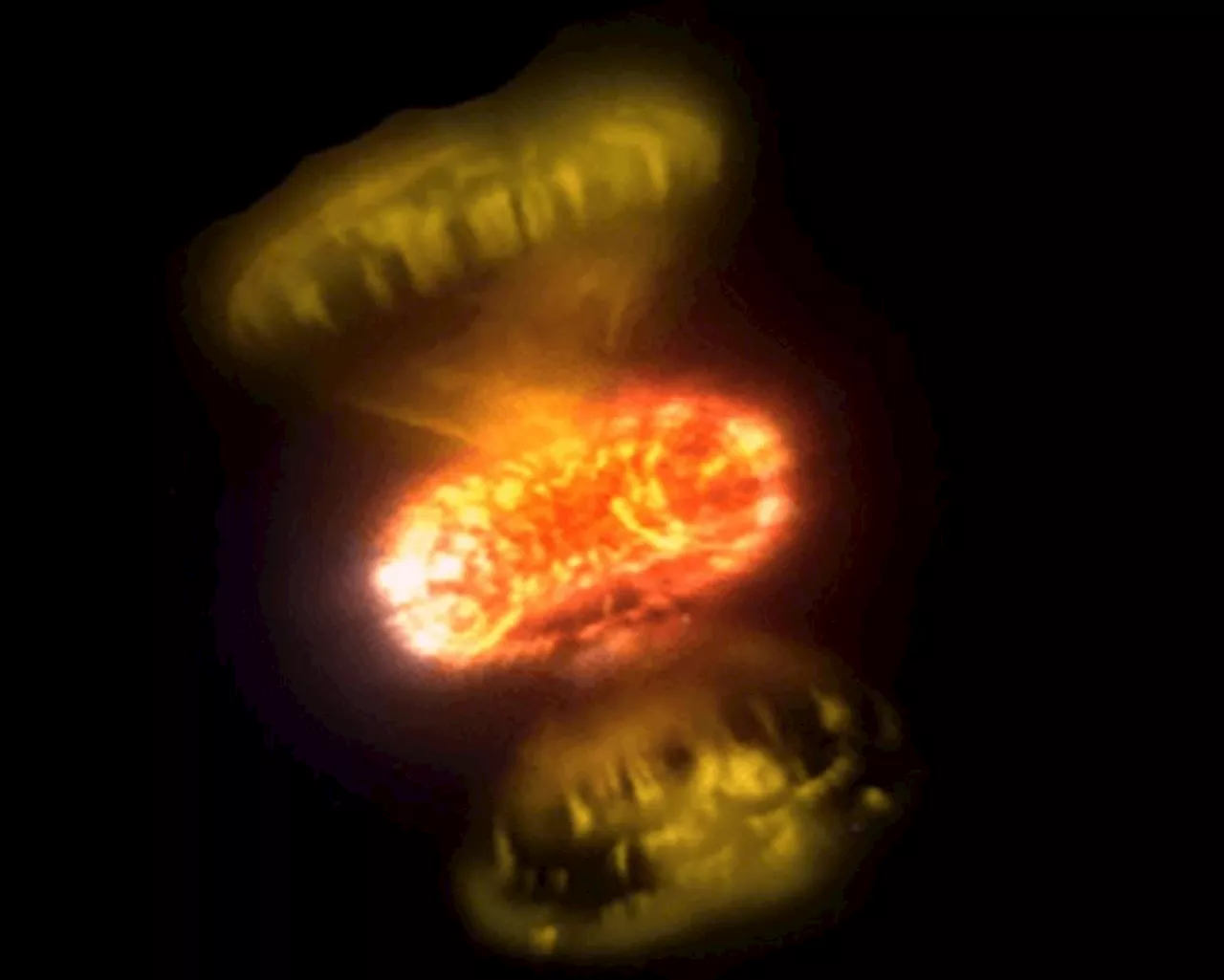
Astronomers have unveiled new images that reveal the intricate dynamics of nova explosions, showcasing a complexity that was previously unrecognized. These thermonuclear events occur on white dwarfs in binary systems, where dense remnants of stars experience multiple ejections and shock processes, leading to the emission of high-energy gamma rays. This significant research, published in the journal Nature Astronomy, provides valuable insights into these explosive stellar phenomena.
Nova explosions happen when hydrogen accumulates on the surface of a white dwarf, igniting a runaway fusion reaction. This results in powerful thermonuclear eruptions, which can vary in intensity. While some novae lead to complete destruction of the white dwarf, termed Type Ia supernovae, most eject material into space without total destruction. The latest observations have captured two distinct nova events, V1674 Her and V1405 Cas, emphasizing the diverse nature of these explosions.
Researchers utilized two advanced observational techniques to study these novae: interferometry and spectrometry. The Georgia State University CHARA Array facilitated high-resolution imaging, while spectrometry allowed scientists to identify chemical signatures in the expelled material. Lead author Elias Aydi from Texas Tech University remarked, “These observations allow us to watch a stellar explosion in real-time, something that is very complicated and has long been thought to be extremely challenging.”
The findings indicate that nova explosions are not merely single, simple events. The case of V1674 Her, a fast nova, showed evidence of two perpendicular outflows just days after the explosion. This rapid material expulsion demonstrates multiple interacting ejections. In contrast, V1405 Cas, identified as a slow nova, revealed delayed material ejection occurring over 50 days post-explosion, providing the first evidence of such a phenomenon.
According to the research, “Novae are thermonuclear eruptions on accreting white dwarfs in interacting binaries.” The authors note that although most of the accreted material is expelled, the underlying mechanisms—whether impulsive ejection, prolonged winds, or common-envelope interactions—remain uncertain.
The significance of these discoveries extends beyond theoretical astrophysics. The energetic shocks generated by nova explosions serve as natural laboratories for studying extreme physics. Professor Laura Chomiuk from Michigan State University emphasized, “Novae are more than fireworks in our galaxy—they are laboratories for extreme physics.” Understanding these complex processes aids in connecting nuclear reactions on the star’s surface to the geometry of ejected material and the high-energy radiation observed from Earth.
As scientists continue to refine their observational techniques, the understanding of nova explosions is poised to evolve further. The authors of the study concluded that expanding the sample of observed novae will help to ascertain whether delayed ejection is common across other events. This ongoing research opens a new frontier in stellar dynamics, allowing astrophysicists to explore the life cycles of stars with unprecedented depth.
Overall, the revelations from these nova explosions challenge previous assumptions and highlight the intricate nature of stellar events. As Elias Aydi noted, “This is just the beginning. With more observations like these, we can finally start answering big questions about how stars live, die, and affect their surroundings.”