A new research initiative at the University of North Dakota (UND) is set to enhance satellite communication capabilities through a state-of-the-art optical communication lab. This facility aims to support both local industry needs and the educational pursuits of university students.
Markus Allgaier, an assistant professor in physics and astrophysics, spearheaded the project, which relies on collaboration with UND Facilities and local contractors. “There’s nothing here that comes from too far away,” Allgaier noted, highlighting the local impact of the initiative.
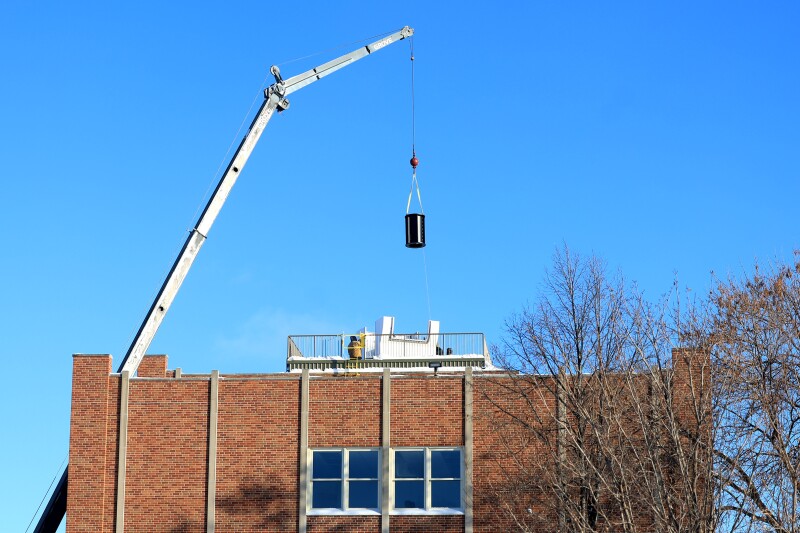
The Free-Space Optical Communication Lab is divided between the roof and basement of Witmer Hall. The rooftop will house an observatory equipped with a telescope designed to direct lasers at satellites. This setup will enable the collection of laser light data from these satellites, a process Allgaier described as the most challenging aspect of the technology.
Initially scheduled for installation on December 9, 2023, the observatory’s setup was delayed due to inclement weather, ultimately taking place the following day. Despite the challenges posed by wind and snow flurries, the installation was completed by 1 p.m. Allgaier expressed mixed feelings about the culmination of a two-and-a-half-year planning process. “I’ve not had a project ever in my career where you’re planning for two and a half years and then it comes down to one day,” he said.
In the basement of Witmer Hall, a standard laser lab is being established, which will connect to the observatory via optical fibers. This lab is designed to be temperature stable and includes laser tables that minimize vibrations during experiments. Allgaier emphasized that the project serves dual purposes: creating a fully operational facility for laser communication and addressing significant research inquiries.
The initiative also aligns with local workforce needs. “The Space Development Agency will be operating their satellite from partially Grand Forks Air Force Base, and some of the contractors that do the day-to-day satellite link operations and build the ground stations are recruiting out of UND,” Allgaier explained. This connection allows the university to train students for careers that require specialized skills in the region.
Funding for the lab was secured through a request made by UND prior to the 2023 legislative session. The university received $5 million for the project, which, according to Allgaier, was reinvested into the local economy through the hiring of contractors, including Sand Steel from Emerado and AE2S.
Students have already begun utilizing the basement lab for their experiments. Among Allgaier’s students are three PhD candidates, one master’s student, and several undergraduates engaged in senior projects. He is also considering introducing an upper-level elective course related to optics and another focused on lasers. The facility will be accessible to all students at UND.
“Anyone at UND can use the facility,” Allgaier stated. He is currently developing a framework for collaboration and determining how the lab can best serve the diverse needs of its users.
Allgaier’s work on this project began even before he relocated to Grand Forks for his position at UND. He officially started on campus in January 2024, having signed his contract in March 2023. During the summer and fall preceding his move, he engaged with contractors to assess the project’s technical feasibility within the allocated budget.
Having previously built three other optics labs, Allgaier described this project as unique, allowing him to create a “wish list” of desired features and technologies. He noted that developing this type of ground station presents a classic “chicken and egg” problem. “It’s one of the first ground stations of its kind, following behind the SDA’s first ground station,” he said.
Historically, the concept of laser communication has faced skepticism, as potential users often cite a lack of existing missions to justify the need for ground stations. Conversely, when missions are proposed, the necessary infrastructure is deemed absent. “You need to overcome by putting a little bit of faith in that, that this will be a technology that will be used,” Allgaier commented.
The lab is expected to be fully equipped by the end of spring 2026, although Allgaier cautioned that assembling the equipment will require additional time. As the project progresses, it promises to contribute significantly to both local research and student training in the rapidly evolving field of satellite communications.