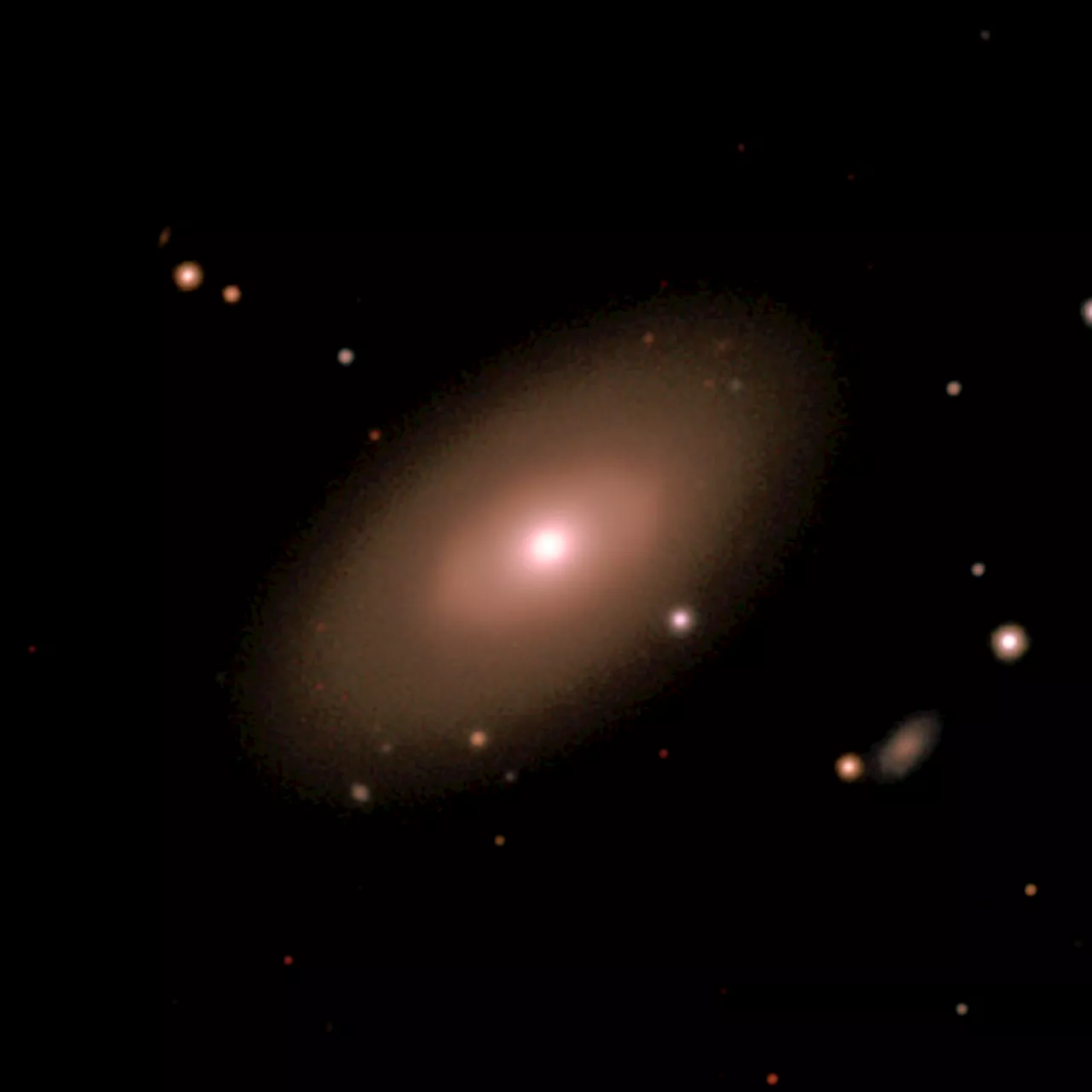
Research conducted with NASA’s Chandra X-ray Observatory suggests that most smaller galaxies do not contain supermassive black holes at their centers. This finding challenges the prevalent notion that nearly all galaxies harbor these giant cosmic entities. The study, which analyzed over 1,600 galaxies over a period of more than two decades, has been detailed in a paper published in The Astrophysical Journal.
The research team, led by Fan Zou from the University of Michigan, focused on the presence of supermassive black holes in both large and small galaxies. Among the galaxies examined, NGC 6278, comparable in size to the Milky Way, and PGC 039620, a smaller galaxy, exemplify the varied findings. The study’s results indicate that the frequency of supermassive black holes is significantly lower in smaller galaxies compared to their larger counterparts.
The analysis utilized X-ray signatures to identify black holes, as the intense gravitational pull of these entities heats surrounding material, producing X-rays detectable by Chandra. The researchers found that over 90% of massive galaxies, including those similar to the Milky Way, show evidence of supermassive black holes. In contrast, smaller galaxies, particularly those with masses below three billion solar masses, such as the Large Magellanic Cloud, typically lacked the distinctive X-ray signatures associated with black holes.
Zou emphasized the importance of accurately counting black holes in smaller galaxies, noting that this research not only contributes to our understanding of black hole formation but also aids in identifying future observational targets for upcoming telescopes. “Our study gives clues about how supermassive black holes are born,” he stated.
The researchers contemplated two potential reasons for the absence of X-ray sources in smaller galaxies. One possibility is that these galaxies genuinely have fewer black holes. The other is that any X-rays produced by matter falling onto these black holes may be too faint for Chandra to detect. Co-author Elena Gallo, also from the University of Michigan, expressed confidence that their analysis supports the idea of a lower prevalence of black holes in smaller galaxies.
The study’s findings highlight a broader trend regarding the relationship between galaxy size and the presence of supermassive black holes. Smaller galaxies are expected to attract less gas, leading to fainter X-ray emissions, which aligns with the researchers’ observations. They discovered that the reduced number of X-ray sources in less massive galaxies exceeded what could be explained by decreased gas inflow. This suggests that many low-mass galaxies may simply lack central black holes.
These insights could have significant implications for our understanding of black hole formation theories. One prevalent theory posits that supermassive black holes originate from massive gas clouds collapsing directly into them. In contrast, another theory suggests they arise from smaller black holes formed by the collapse of massive stars. Co-author Anil Seth from the University of Utah pointed out that if the latter theory were accurate, smaller galaxies should exhibit a similar fraction of black holes as larger ones.
The study supports the theory that giant black holes are formed with a significant initial mass. If the alternate theory were correct, the expectation would be for smaller galaxies to house a comparable number of black holes as larger galaxies, an outcome not observed in this research.
The findings also hold implications for future studies on black hole mergers, particularly concerning gravitational waves. A lower number of black holes in smaller galaxies would likely result in fewer sources of gravitational waves detectable by the Laser Interferometer Space Antenna. Additionally, the number of black holes disrupting stars in dwarf galaxies is expected to be smaller than previously thought.
NASA’s Marshall Space Flight Center in Huntsville, Alabama, oversees the Chandra program, while the Smithsonian Astrophysical Observatory’s Chandra X-ray Center manages scientific operations from Cambridge, Massachusetts, and flight operations from Burlington, Massachusetts.
This research paves the way for a deeper understanding of the universe’s structure and the role of black holes within it, providing valuable insights for future astronomical observations and theories.