In a thought-provoking exploration of life’s origins and the intersection of science and religion, John Klimenok Jr. presents a compelling argument on the limitations of scientific inquiry and religious belief. He emphasizes that while science excels at gathering evidence and forming conclusions, it does not fully address existential questions about the origins of life, the purpose of existence, or what follows death.
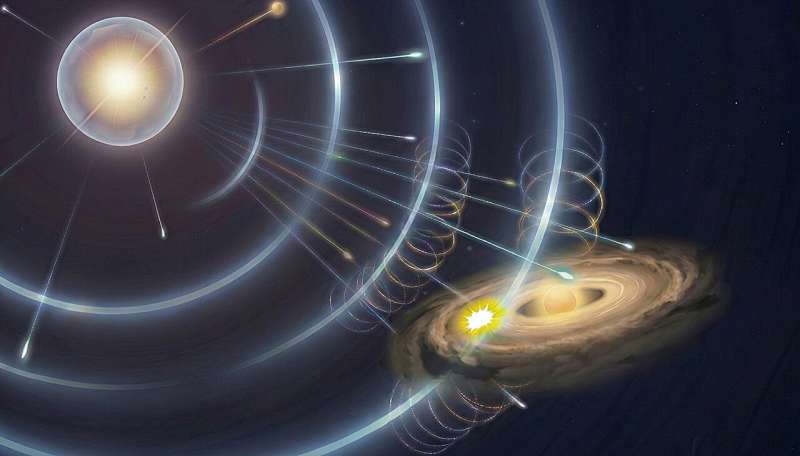
Klimenok cites Tom McKone’s assertion that “science is all about evidence, asking questions, collecting objective information, and drawing conclusions.” He notes that while science has made significant strides, notably through Albert Einstein’s theory of relativity, it stops short of explaining the ultimate source of life and the universe. According to scientists, the universe began as a singularity, bursting into existence approximately 13.7 billion years ago through a process known as the Big Bang. Following this monumental event, light, matter, space, and time emerged, leading to the vast cosmos we inhabit today.
The vastness of the universe raises intriguing questions about its fine-tuning. Klimenok references the anthropic principle, which posits that certain physical constants in our universe appear precisely calibrated to support life. He points out that if these constants were even slightly different, the universe might not support carbon-based life forms. Yet, he argues that rather than the universe being tailored for humanity, it is humanity that has adapted to the universe’s conditions.
Klimenok also considers the implications of our existence in the context of time. He highlights that it took approximately 9 billion years for the sun and Earth to form, followed by another billion years for life to emerge. Humans have existed for less than 0.01% of Earth’s history, leading him to question the perceived purpose behind such a lengthy process.
The conversation shifts to mortality and what lies beyond. Klimenok notes that neuroscientific research has made significant discoveries regarding brain function, particularly in areas responsible for decision-making and sensory perception. He argues that once the brain ceases to function, the body begins to decompose, suggesting a finality to human existence.
This leads to a critical examination of religious beliefs regarding life after death, particularly within Christianity. Klimenok mentions the resurrection of Jesus as a foundational hope for many Christians. He points out that the earliest Gospel, Mark, written approximately 40 years after Jesus’ death, does not mention the resurrection. Later Gospels, including Matthew and Luke, introduced resurrection narratives to satisfy followers’ expectations.
Klimenok raises further questions about Jesus’ promise of return, noting that all those who heard him speak are now deceased, and his anticipated second coming has yet to materialize. He cites 2 Peter—a document widely regarded by scholars as inauthentic—where the author attempts to reconcile the delay of Jesus’ return by suggesting that divine time differs from human time.
In conclusion, Klimenok reflects on his personal beliefs regarding existence and death. He expresses a desire for his body to return to the earth after death, acknowledging the inevitability of his nonexistence. While he remains hopeful for future scientific discoveries, he encourages living life fully and contributing positively to the world.
John Klimenok Jr., a resident of Plainfield, emphasizes that regardless of differing perspectives on science and religion, the pursuit of knowledge and the desire to improve the world can unite humanity in meaningful ways.