Recent findings from two significant experiments have provided new insights into the fundamental question of why matter exists in the universe. The research, conducted by the NOvA collaboration at Fermilab in Illinois and the T2K experiment in Japan, reveals the behavior of neutrinos, elusive particles that could hold the key to understanding the matter-antimatter imbalance in the cosmos. The combined results were published in the journal Nature in October 2023.
Unlocking the Mystery of Neutrinos
Theoretical physics suggests that during the Big Bang, matter and antimatter were created in equal amounts. In theory, this would lead to their complete annihilation, leaving behind only energy. Yet, the universe is predominantly made of matter, indicating that some matter must have survived. Researchers now propose that neutrinos could provide a critical explanation for this phenomenon.
Tricia Vahle, a professor of physics at William & Mary and co-spokesperson for the NOvA collaboration, reflected on her introduction to neutrinos during her high school years. She noted that early scientists labeled them as anomalies due to the unexpected scarcity of detected neutrinos produced by the sun. This inconsistency has spurred decades of investigation into the properties and behavior of these particles.
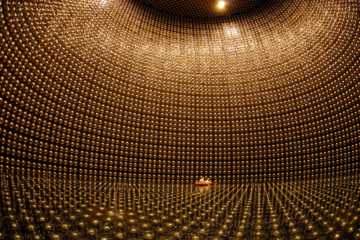
The two experiments focus on a phenomenon known as neutrino oscillation, where neutrinos can change their identity as they travel. By firing intense beams of neutrinos over long distances, researchers aim to gain a better understanding of their properties. The NOvA experiment sends neutrinos from Fermilab through the Earth to a 14,000-ton detector in Ash River, Minnesota, while T2K sends neutrinos 295 kilometers from Tokai to the Super-Kamiokande detector.
Significant Findings and Future Directions
The collaboration between the NOvA and T2K teams represents a first in neutrino research, merging their datasets to strengthen the conclusions drawn from their observations. Vahle emphasized the importance of this joint analysis, stating, “When we combine our results, we can make a stronger statement about neutrinos than we could separately.”
Preliminary results from this collaboration have provided the most precise measurement to date of the differences in the masses of two types of neutrinos. The implications of these findings are profound, potentially pointing to two scenarios regarding neutrino mass ordering. If neutrinos follow an inverted mass ordering, it could break a fundamental principle known as charge-parity symmetry, offering a possible explanation for the dominance of matter over antimatter. Conversely, if they follow a normal mass ordering, the connection remains unclear.
With six years of data from NOvA and eight years from T2K, the researchers anticipate continued collaboration as they collect new data and engage in forthcoming neutrino experiments. Vahle expressed optimism about the future of this research, stating, “Nature is revealing that our current models of nature are lacking. We are learning something new, something that we got wrong, and that will lead us to think about the problem in different ways and come up with new solutions.”
As these experiments advance, they hold the potential to reshape our understanding of the universe and the fundamental principles governing it.