Scientists have made groundbreaking observations of the Sun, revealing massive magnetic structures referred to as “tadpoles.” The findings come from the Parker Solar Probe, which conducted its closest approach to the Sun in December 2024, approximately 4 million miles from its surface. This proximity allowed the probe to capture unprecedented images and data about solar phenomena, marking a significant advancement in heliophysics.
The paper detailing these discoveries, published in The Astrophysical Journal Letters, features work from Angelos Vourlidas of Johns Hopkins University and his co-authors. During the probe’s 22nd perihelion, it observed intriguing magnetic “inflow swarms,” a term used to describe dark, tadpole-like shapes seen in magnetic loops. These structures are formed when parts of a magnetic loop break and redirect energy back toward the Sun, resembling a tadpole’s head and tail. This is the first time such inflow swarms have been detected with this level of resolution, even capturing structures that are about twice the diameter of Earth.
The discoveries don’t end there. The Parker Solar Probe also observed a phenomenon known as the tearing-mode instability of the Heliospheric Current Sheet (HCS). This electrical sheet separates the Sun’s north and south magnetic fields, and researchers witnessed it being stretched and torn apart. The event produced a massive tadpole expanding at a remarkable 5,000 km/minute for over two hours, highlighting the dynamic nature of solar activity.
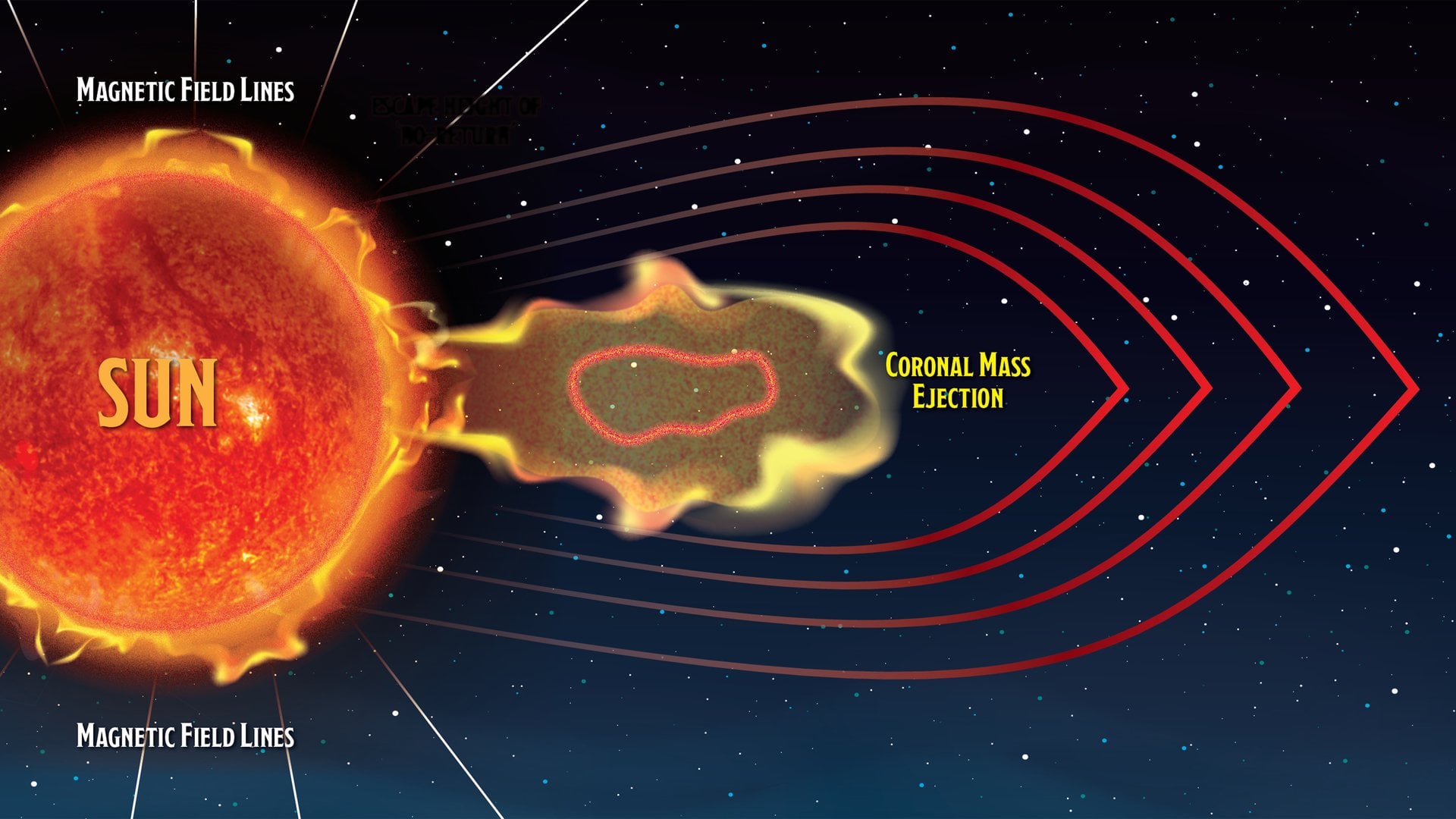
Perhaps the most significant finding was the observation of “in/out pairs,” where a single magnetic structure in the Sun’s corona was pinched in the middle, splitting into two distinct parts. One segment was pulled back toward the Sun, while the other shot away at an astonishing speed of 560 km/s. This process is crucial for understanding the mechanics behind solar storms, as it may explain how potentially hazardous particles are released during coronal mass ejections (CMEs).
The detailed imagery captured by the Parker Solar Probe will greatly enhance scientists’ ability to update their models of solar behavior, particularly in light of the unexpected speed observed during this event. The probe’s primary mission concluded in June, but it will continue to orbit the Sun, reaching perihelion approximately four times a year until its fuel is depleted.
These findings not only represent a major leap in solar research but also serve as a testament to human ingenuity in space exploration. As the Parker Solar Probe continues its mission, it promises to deliver more vivid and detailed pictures of our solar neighbor, enriching our understanding of the Sun and its impact on Earth’s space weather.