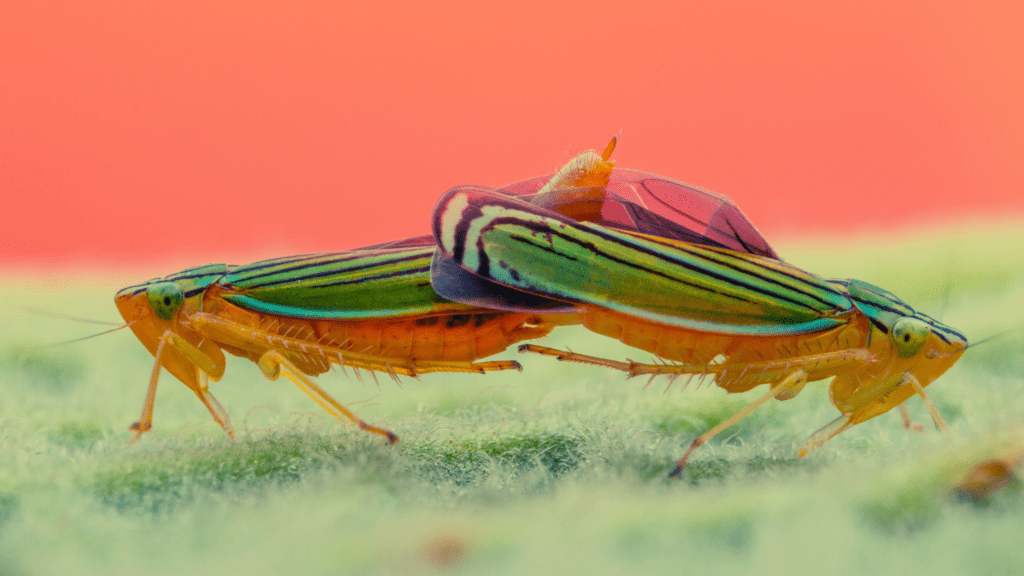
BREAKING: Scientists at Penn State University have successfully replicated the remarkable ability of leafhoppers to become nearly invisible. This groundbreaking research, published in ACS Nano, reveals how these common insects use specialized particles to reduce glare and evade predators.
Leafhoppers, small green insects often unnoticed due to their exceptional camouflage, utilize microscopic structures called brochosomes to scatter light efficiently. The Penn State team has now developed a method to replicate this effect, potentially transforming various industries.
In their study, the researchers demonstrate that these engineered brochosomes can decrease reflected glare by a staggering 80 to 96 percent across visible and ultraviolet light spectrums. This significant reduction in visibility could revolutionize applications from energy devices to military camouflage.
The innovative chemical approach used by the team involved creating a microfluidic system that generates microscopic droplets containing dissolved polymers. As the solvent evaporates, the polymers form hollow spheres with precisely patterned pores, closely mimicking the natural structures found on leafhoppers.
This method can produce over 100,000 particles per second, dramatically outpacing traditional nanoscale manufacturing techniques. The ability to quickly generate these particles hints at widespread applications beyond laboratory settings.
The research highlights five distinct brochosome designs, reflecting variations seen in different leafhopper species, with sizes ranging from a few hundred nanometers to about two micrometers. The implications of this study extend to numerous fields, including optical materials and biomedical solutions, although further testing is necessary for practical applications.
The potential for military camouflage is particularly intriguing, with researchers emphasizing the need for further exploration to validate these applications. The study also opens doors for biomedical uses, such as drug delivery, leveraging the unique shape and surface properties of the replicated particles.
This achievement not only showcases the ingenuity of scientists but also underscores the extraordinary capabilities of ordinary insects. As researchers continue to explore the implications of this work, the possibilities for practical applications are expanding rapidly.
Stay tuned for more updates as this story develops and discover the impact of this innovative research on our understanding of nature and technology.