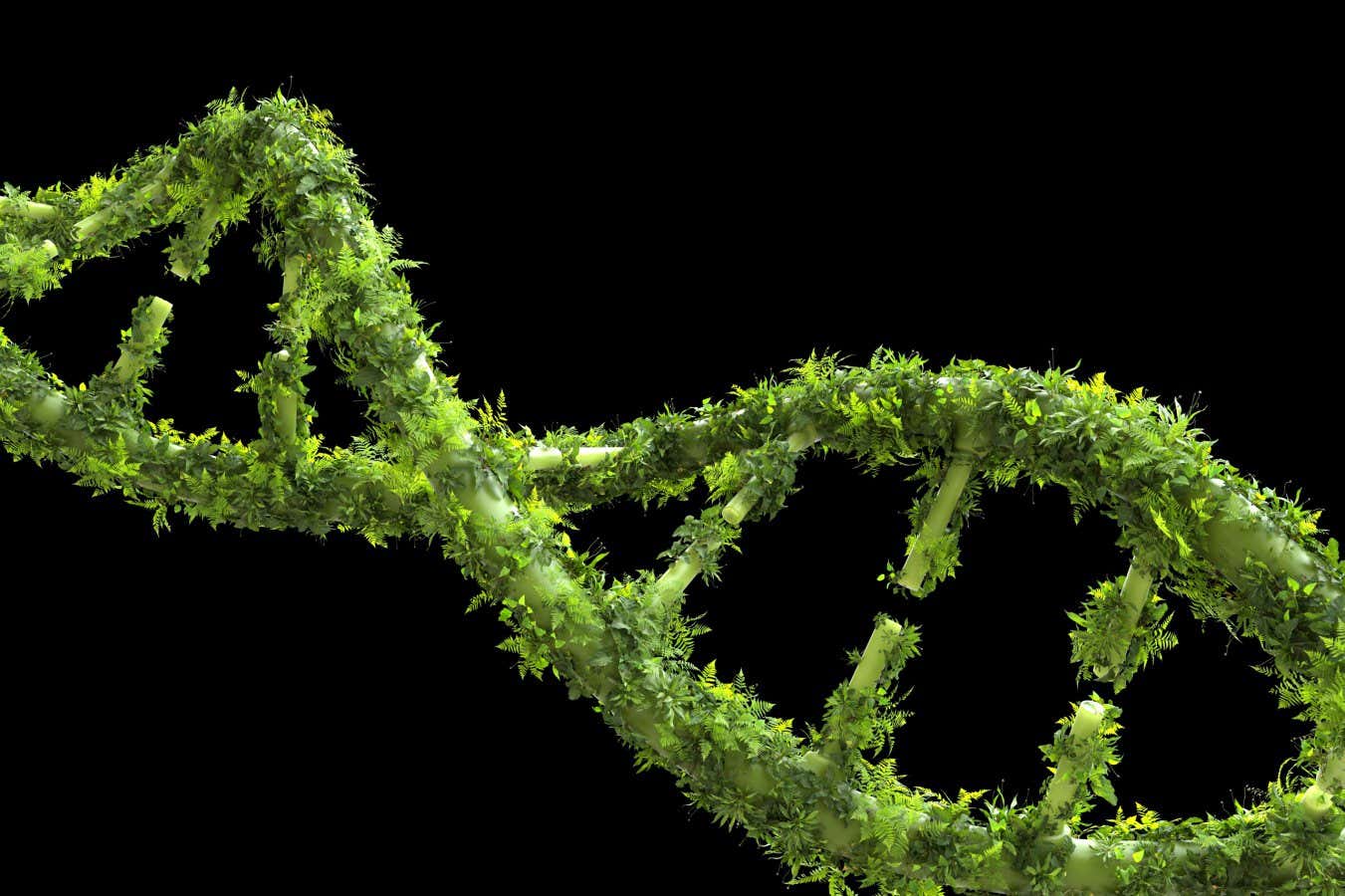
Research involving human cells containing plant DNA has provided new insights into the nature of non-coding regions within the human genome. A study, led by scientists from the University of Auckland in New Zealand, examined cells that incorporated substantial portions of DNA from the plant species Arabidopsis thaliana. This investigation suggests that much of the genomic activity previously thought to hold significance may actually be mere background noise.
Historically, the function of the human genome has been a topic of considerable debate. While some argue that the majority of DNA must serve an important purpose due to its activity, others contend that even random DNA can exhibit high levels of activity. The recent findings indicate that the plant DNA demonstrated activity levels comparable to human DNA, reinforcing a growing body of evidence that a significant portion of the human genome may be classified as “junk.”
“A large amount can simply be explained by background noise,” stated Brett Adey, a researcher involved in the study. This perspective aligns with the concept of junk DNA, which posits that vast stretches of the genome do not contribute to essential biological functions.
The primary role of DNA is to encode the instructions for protein synthesis, which are vital to cellular function. Initially, it was believed that nearly all DNA served this purpose. However, current understanding reveals that only about 1.2 percent of the human genome actively codes for proteins. The remaining DNA, often referred to as non-coding DNA, raises questions about its purpose.
Research from the 1960s suggested that much of this non-coding DNA might be redundant. A 2011 study highlighted that only around 5 percent of the genome has been conserved throughout evolutionary history, implying that the majority of non-coding DNA has little evolutionary significance. This observation has led to further inquiries into why certain species possess vastly different genome sizes—an onion, for example, has five times more DNA than a human, while a lungfish has thirty times more.
The debate intensified with the release of the ENCODE project in 2012, which claimed over 80 percent of the human genome is active. This led to the emergence of the term “dark DNA,” referring to the non-coding regions that may serve vital functions yet remain poorly understood. In response to these claims, Sean Eddy from Harvard University proposed a unique approach to testing these assertions by introducing random synthetic DNA into human cells.
The recent study by Adey and his colleague Austen Ganley capitalized on a breakthrough made by researchers in Japan, who successfully created hybrid cells containing approximately 35 million base pairs of plant DNA. This innovative approach represents one of the largest random genome projects to date, allowing for a more comprehensive analysis of DNA activity.
After confirming that the plant DNA was effectively random in the context of human cells, the researchers measured the frequency of RNA transcription start sites per 1,000 base pairs of non-coding DNA. If active DNA signifies function, one would expect minimal transcription from the plant DNA. Surprisingly, the results indicated that the plant DNA showed around 80 percent of the transcriptional activity observed in human non-coding DNA.
“This strongly suggests that almost all the activity seen by ENCODE is noise,” commented Chris Ponting from the University of Edinburgh. The implications of this finding are profound, as they challenge the notion that non-coding DNA must have an important function.
The study’s results have garnered support from other experts in the field. Dan Graur from the University of Houston stated, “This very elegant study was needed. It offers yet more experimental evidence confirming what has been obvious for years: most of the human genome is junk.”
Despite the compelling nature of these findings, the research team acknowledges that not all genomic activity can be dismissed as noise. The study revealed that human DNA exhibited 25 percent more activity than the plant DNA, a factor that requires further investigation. The researchers plan to employ machine learning techniques to differentiate potentially meaningful activity from random background noise.
As this research continues to evolve, it promises to reshape our understanding of the human genome and the role of non-coding DNA, paving the way for future studies that may uncover additional complexities within our genetic makeup. The findings are set to be published in a forthcoming paper, although specific details have yet to be finalized.