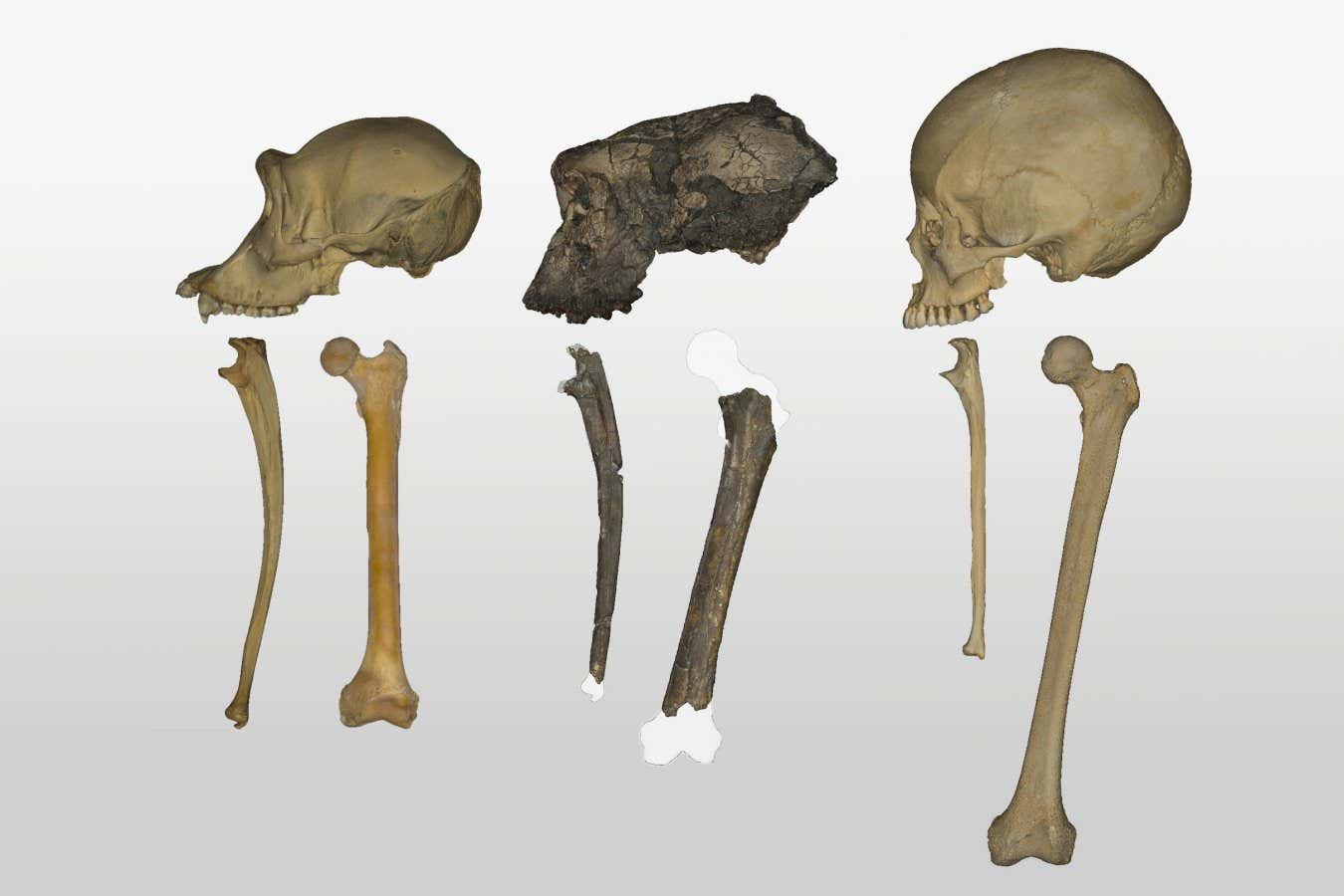
A long-standing scientific debate regarding the locomotion of our earliest known ancestor, Sahelanthropus tchadensis, has resurfaced with new findings from researchers at New York University. The team, led by Scott Williams, asserts that a reanalysis of fossil remains provides compelling evidence that this ancient hominin walked upright rather than exhibiting a knuckle-dragging gait similar to that of modern chimpanzees.
The fossils of Sahelanthropus tchadensis, estimated to be around 7 million years old, were first uncovered in Chad’s desert region in 2002. Initial examinations revealed a pronounced brow ridge and small canine teeth, distinguishing it from great apes. Subsequent analyses of the skull indicated that its positioning likely resembled that of other bipedal hominins, suggesting an upright posture.
In 2004, additional bones, including a femur and an ulna, were identified as belonging to Sahelanthropus. However, a comprehensive understanding of its locomotion was not reached until recent analysis published in 2020. This research proposed that the shape of the femur suggested a non-bipedal gait, leading to ongoing disputes among researchers.
The debate intensified in 2022 when a team from the University of Poitiers, including Franck Guy and Guillaume Daver, argued that certain features of the femur indicated bipedality. In contrast, in 2024, Clément Zanolli from the University of Bordeaux countered that the traits cited by Guy and Daver could also be found in non-bipedal great apes.
In the latest study, Williams and his colleagues examined the femur’s attachment point for the gluteus maximus muscle. They found it resembled those seen in hominins rather than in non-bipedal species. They also assessed the size and proportion of both the femur and ulna. Despite being similar in size to corresponding bones in chimpanzees, the proportions more closely matched those of known bipedal hominins. A notable feature, the “femoral tubercle,” was identified as a critical adaptation for bipedalism, serving as an attachment point for a significant ligament crucial for upright posture and movement.
Despite this new analysis, Williams expressed caution regarding the finality of the debate. He stated, “We’re fairly convinced that Sahelanthropus was an early bipedal hominin at this point, but I’d be foolish to think we ended the debate.”
In response to the recent findings, Guy and Daver issued a statement acknowledging the new evidence while reiterating their view that it supports their earlier assertions of bipedality. They emphasized the need for further discoveries to conclusively resolve the question of Sahelanthropus‘s locomotion.
John Hawks, an anthropologist at the University of Wisconsin-Madison, concurs with the findings presented by Williams’ team, suggesting that they illuminate the complex evolutionary path of hominins. “Our evolution started as a fuzzy, gradual set of changes towards more upright posture and movement,” Hawks remarked, highlighting the nuanced nature of early hominin evolution.
Zanolli, who has consistently argued against the bipedality of Sahelanthropus, maintains that the recent study does not adequately differentiate between hominin and great ape characteristics. He stated, “In my view, this new study simply confirms that Sahelanthropus long bones resemble those of the African great apes and that it was probably behaving in ways that could range anywhere in between those of a chimpanzee and a gorilla.”
As the debate continues, the quest for understanding our evolutionary roots remains a compelling journey, with each new discovery bringing us closer to comprehending the intricate history of human ancestry. The question of whether Sahelanthropus tchadensis walked upright or not represents not just a scientific inquiry but a fundamental exploration of what it means to be human.