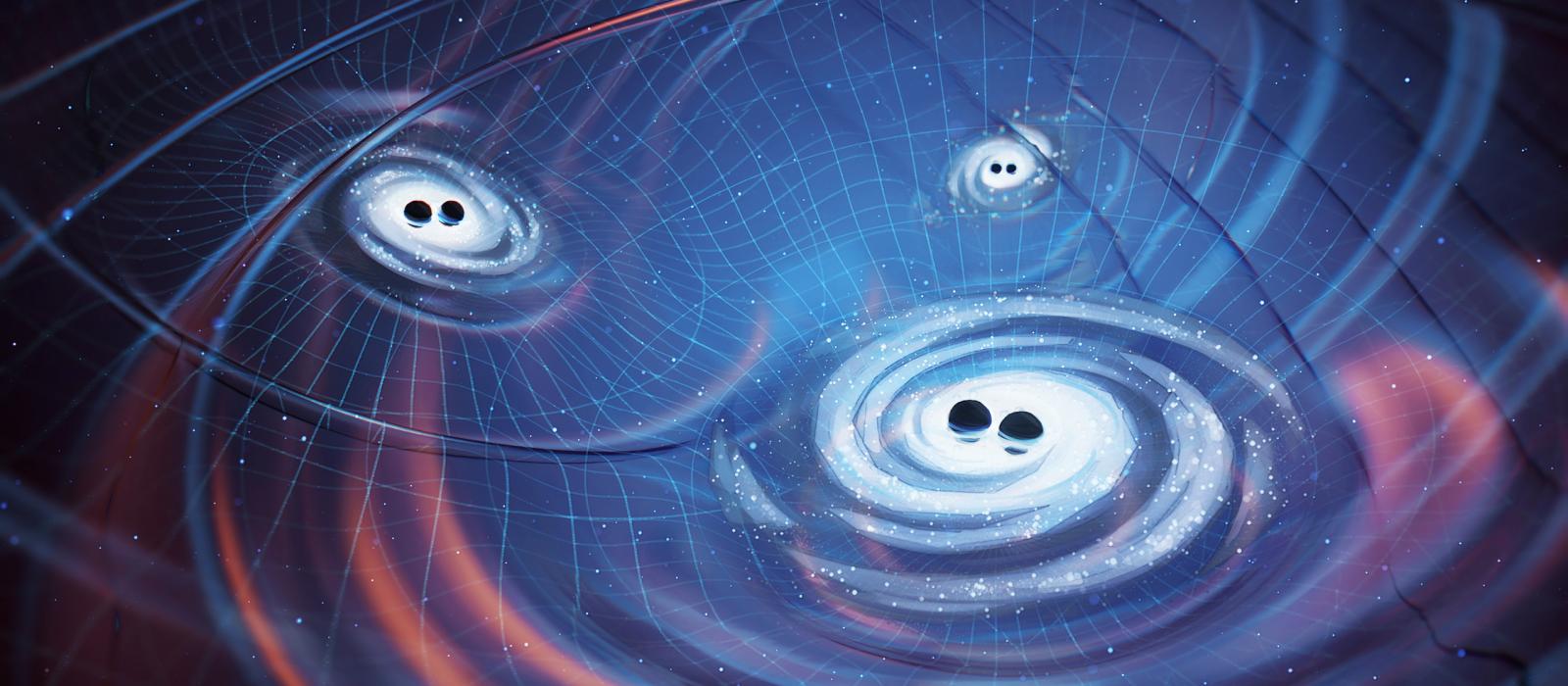
The University of Amsterdam has made significant strides in astrophysics by proposing a groundbreaking method for investigating dark matter through the analysis of gravitational waves (GWs). This research, published in the journal Physical Review Letters, suggests that GWs generated by black hole mergers could reveal important insights into the elusive nature of dark matter, a component believed to constitute about 65% of the universe’s mass.
In 2015, the detection of gravitational waves confirmed a prediction from Albert Einstein‘s Theory of General Relativity, marking a pivotal moment in astronomy. The waves arise from the merger of massive objects, such as black holes and neutron stars, creating ripples in spacetime that can be detected across vast cosmic distances. The new research from the Institute of Physics (IoP) and the Gravitation & Astroparticle Physics Amsterdam (GRAPPA) center expands on this foundational discovery.
New Framework for Understanding Gravitational Waves
Led by researchers Rodrigo Vicente, Theophanes K. Karydas, and Gianfranco Bertone, the study introduces a robust framework for modeling the interactions between gravitational waves and dark matter. By focusing on the dynamics of extreme mass-ratio inspirals (EMRIs), where binary black holes or neutron stars spiral inward, the team has developed a comprehensive approach using General Relativity instead of the previously employed Newtonian physics.
The study examines how dark matter concentrations, or “spikes,” surrounding massive black holes could affect the gravitational waves produced during mergers. By analyzing these interactions, scientists aim to detect unique signatures in GW signals that indicate the presence of dark matter. This research is part of a broader effort to optimize how astronomers interpret gravitational wave data.
Future Observations and Implications
Looking ahead, the European Space Agency (ESA) plans to launch the Laser Interferometer Space Antenna (LISA) in approximately a decade. This pioneering space-based observatory will be equipped with three spacecraft utilizing six lasers to measure spacetime ripples. It is anticipated that LISA will record over 10,000 gravitational wave signals during its operational lifetime.
The implications of this research extend beyond mere detection. It offers a glimpse into the potential for gravitational waves to map the distribution of dark matter throughout the universe, shedding light on its composition and characteristics. This aligns with ongoing efforts by existing detectors, such as the Laser Interferometer Gravitational Wave Observatory (LIGO), the Virgo Collaboration, and the Kamioka Gravitational-wave Detector (KAGRA), to explore the mysteries of the universe.
The findings from the University of Amsterdam represent a significant advancement in the field of astrophysics, providing a pathway for future investigations into dark matter and its role in cosmic evolution. As the scientific community prepares for the next generation of gravitational wave detectors, the potential to uncover the secrets of dark matter becomes increasingly tangible.