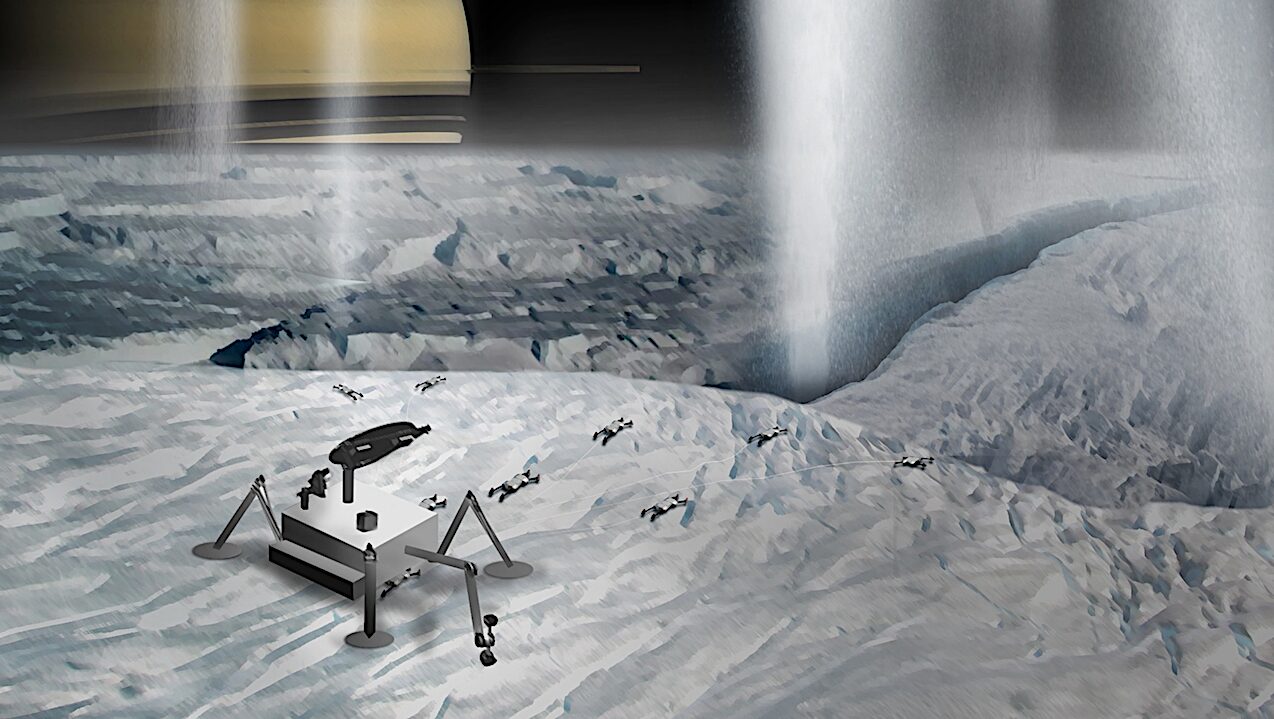
A recent paper outlines essential hypotheses intended to direct future missions to Enceladus, one of the most promising targets in the search for extraterrestrial life. This celestial body has garnered significant attention due to its possession of the three fundamental components for life: organic materials, a liquid solvent, and an energy source. The National Academies of Sciences, Engineering, and Medicine has identified Enceladus as a high-priority location in its 2023–2032 Planetary Science and Astrobiology Decadal Survey, recommending it for a NASA New Frontiers class mission. Furthermore, the survey designates an Enceladus Orbilander mission as the second priority Flagship mission for exploration.
In 2021, a team focused on the Enceladus Vent Explorer concept, funded by NASA’s Innovative Advanced Concepts program, convened three workshops to identify high-priority scientific questions regarding Enceladus. These discussions culminated in a list of investigations aimed at addressing two principal science goals:
1. “How has the thermal evolution of Enceladus impacted the moon’s ability to sustain a liquid ocean and recycle nutrients?”
2. “How has the astrobiological potential of Enceladus changed over time?”
The paper elaborates on the scientific context and proposed hypotheses for each investigation, offering a thorough examination of the physical parameters involved.
Innovative Approaches to Astrobiology
Additionally, the authors introduce a groundbreaking methodology for describing the organic state of planetary bodies. This approach is designed to aid in the formulation of hypotheses related to the origins of life and to provide context for potential biosignatures observed on Enceladus. By integrating these new techniques, researchers hope to enhance the understanding of how life might arise in environments beyond Earth.
The implications of these findings extend beyond mere scientific curiosity. Understanding the processes that have shaped Enceladus over time could provide critical insights into the conditions necessary for life. The exploration of this ocean world is not only vital for planetary science but could also redefine humanity’s understanding of life in the universe.
Recommendations for Further Research
The paper concludes with recommendations for advancing technology and research related to ocean world exploration. As missions to Enceladus become more feasible, developing innovative instruments and methodologies will be crucial for uncovering the mysteries hidden beneath its icy surface.
The exploration of Enceladus represents a significant step in the ongoing quest to explore the potential for life beyond our planet. As interest grows, the scientific community anticipates that the next decade will yield groundbreaking discoveries that may reshape our understanding of life’s existence in the cosmos.