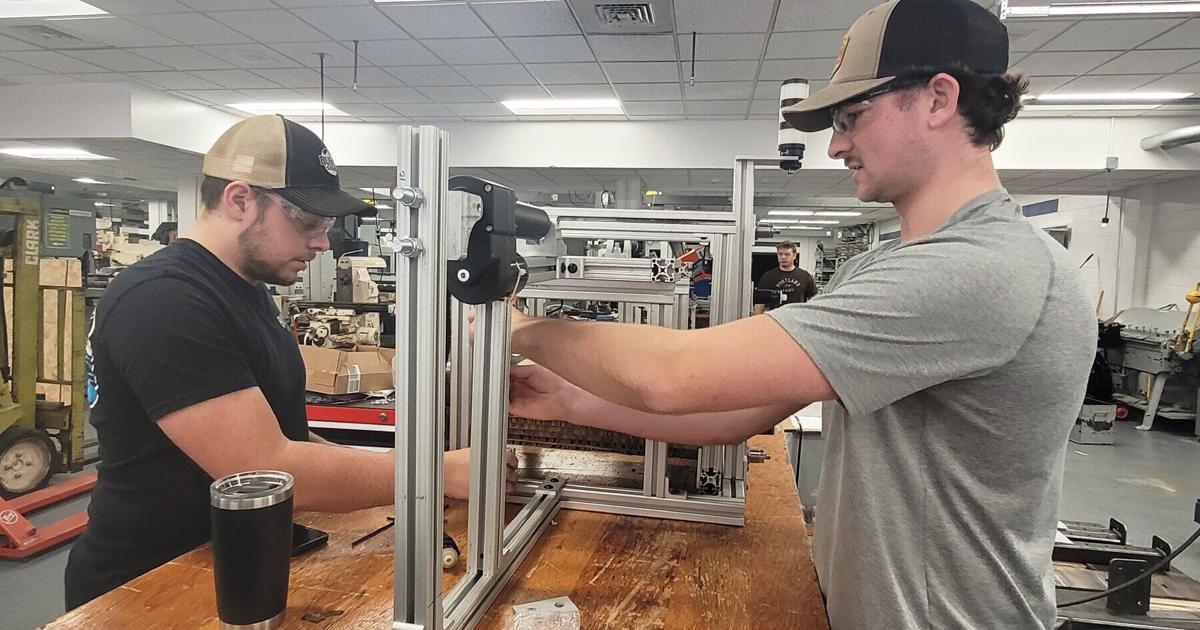
Students at the University of Wisconsin-Stout have successfully developed a prototype of a nonstandard pallet stacker, thanks to the support of Ashley Furniture. The engineering seniors, including key contributors Chase Rodewald and Riley Stiehl, collaborated on this project aimed at enhancing material handling efficiency in furniture manufacturing.
The initiative, which falls under the university’s engineering program, demonstrates the practical application of classroom knowledge in real-world scenarios. By utilizing advanced design software like SolidWorks, the students created a digital model of the pallet stacker, optimizing its features before moving on to physical assembly. This prototype is designed to improve the way pallets are stacked and transported, addressing specific logistical challenges faced by Ashley Furniture.
Collaboration Yields Innovative Solutions
The project not only highlights the technical skills of the students but also underscores the importance of industry partnerships in education. According to Zachary Morgan and Luke Mertens, who also contributed to the project, the collaboration provided invaluable insights into the furniture manufacturing process. “Working with Ashley Furniture allowed us to understand the real needs of the industry,” Morgan stated. “We were able to design something that would truly make a difference.”
The nonstandard pallet stacker prototype offers several enhancements compared to existing solutions. Its design focuses on flexibility and adaptability, allowing it to accommodate various pallet sizes and configurations. This versatility is crucial for a company like Ashley Furniture, which handles a wide range of products in its supply chain.
Future Implications and Industry Impact
The successful completion of this project not only benefits Ashley Furniture but also serves as a testament to the capabilities of the engineering program at UW-Stout. As the demand for more efficient manufacturing processes increases, innovations like this prototype could play a significant role in shaping the future of the industry.
By bridging the gap between academic learning and practical application, UW-Stout’s engineering students are not just creating prototypes; they are preparing to enter a workforce that increasingly values innovation and efficiency. The collaborative effort has paved the way for potential future projects, aiming to further enhance productivity in manufacturing settings.
As this prototype moves toward further testing and refinement, both the students and Ashley Furniture remain optimistic about its potential impact on the industry. The project exemplifies how student ingenuity, when combined with industry expertise, can lead to groundbreaking advancements in manufacturing technology.