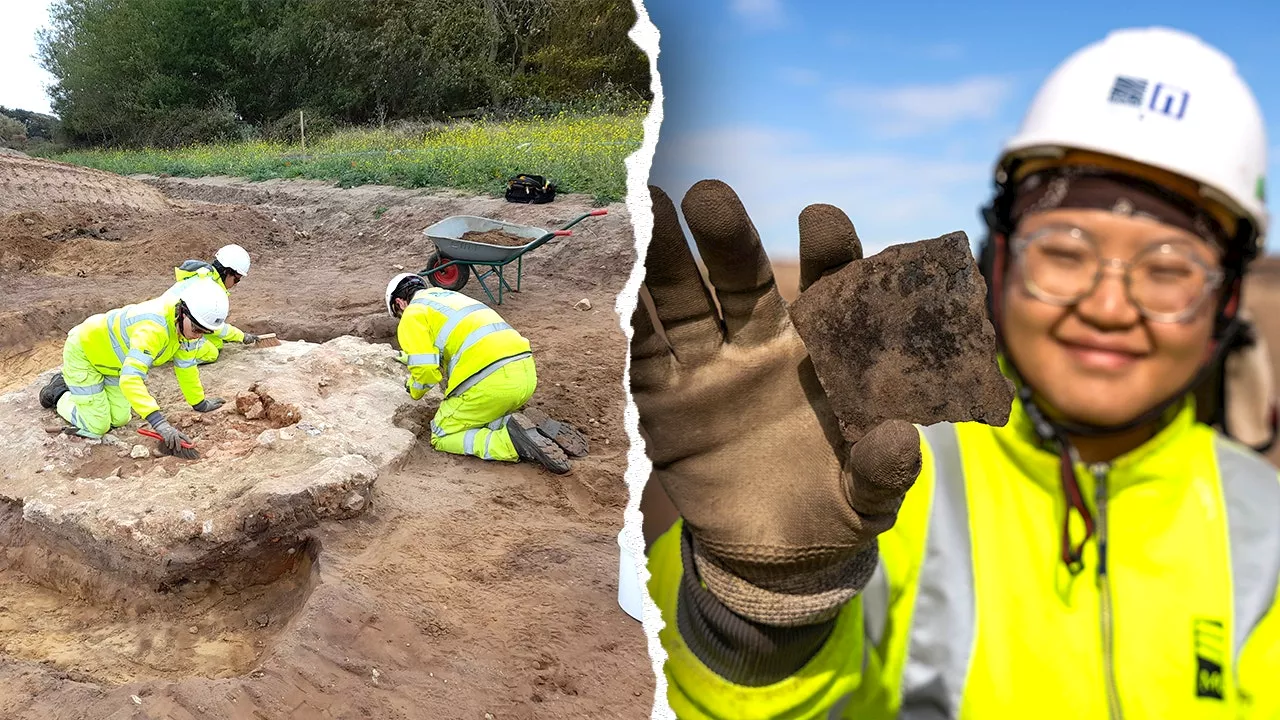
Archaeologists have uncovered the remains of an Anglo-Saxon village during excavations for an offshore wind farm project near Friston, a village in East Suffolk, England. The discovery, announced on December 9, 2023, by Wessex Archaeology, reveals a previously unknown settlement that dates back to the Anglo-Saxon period, featuring wooden longhouses and a variety of artifacts including flint tools and pottery fragments.
The excavation is part of the preparatory work for the East Anglia TWO and ONE North Projects, which are being developed by ScottishPower Renewables. The archaeological efforts are being conducted in collaboration with the Museum of London Archaeology (MOLA).
According to the press release from Wessex Archaeology, the settlement consisted of a small community living in wooden longhouses. These structures not only served as living spaces but also functioned as social hubs, with central hearths used for cooking and warmth. Despite the wooden buildings having decayed over the centuries, the remains of post holes indicate that they were substantial structures, measuring up to 19 meters long and 6 meters wide.
Pictures from the site show archaeologists handling several ancient artifacts, including flint tools and fragments of pottery. Among the items unearthed is an arrowhead, estimated to have been crafted between 4,000 and 6,000 years ago. The design of this arrowhead was intended for long-distance hunting, featuring sharp edges and a delicate point, making its preservation a rare achievement.
Matthew Ginnever, senior project manager at MOLA-Wessex Archaeology, noted that some of the most intriguing finds included medieval kilns and fragile flint artifacts such as arrowheads and an axe head. He added that the alignment of a modern public right of way with the early medieval buildings suggests that this footpath has been in use since the Anglo-Saxon period, possibly even earlier.
The settlement was believed to have been abandoned in the 1300s, although the reasons for its decline remain uncertain. Ginnever stated that excavations are ongoing at key points where there are onshore development areas and substations, with further analysis planned to shed light on the village’s history.
“We hope to share more insights during the post-excavation analysis phase,” he said. A webinar detailing additional findings is scheduled for January 23, 2024.
This discovery adds to a growing list of historical artifacts uncovered during modern construction projects in Europe. Notably, last year, archaeologists found a trove of 1,000-year-old treasure at a construction site for a nuclear power plant in Suffolk. Additionally, Czech excavators recently unearthed multiple military graves linked to the Austro-Prussian wars during highway construction.
As archaeological methods continue to advance, the synergy between modern infrastructure development and historical exploration highlights the rich tapestry of human history that lies beneath the surface.