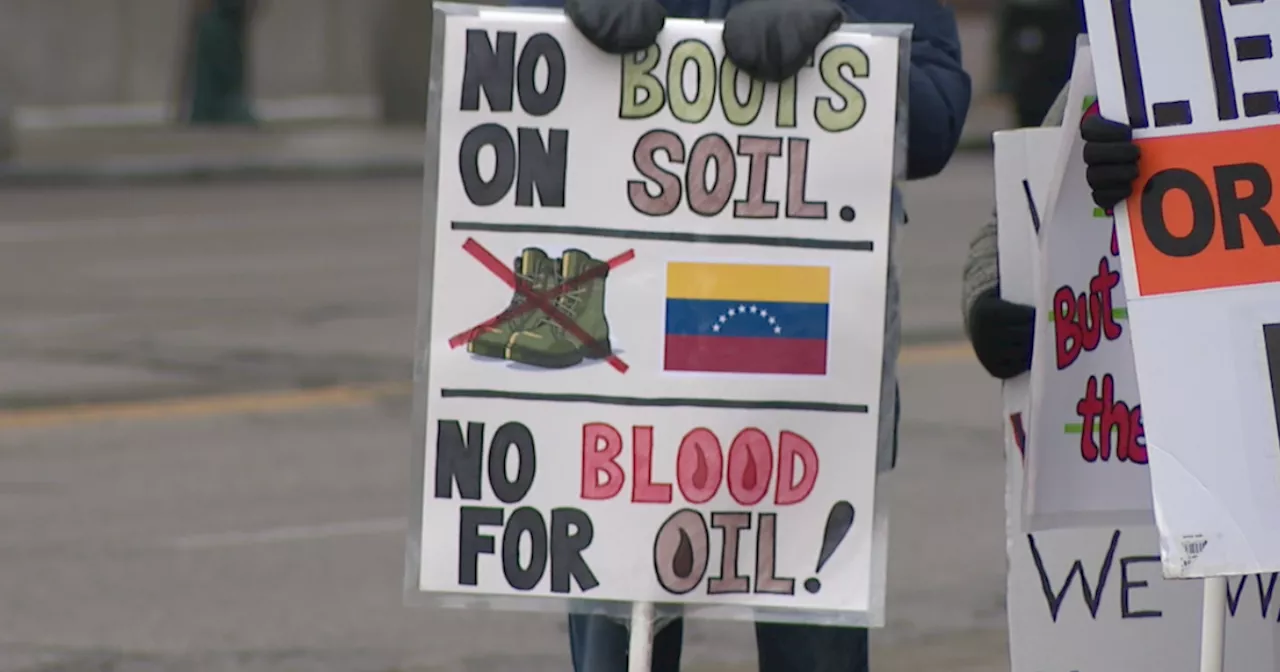
As tensions rise over the recent U.S. military operation targeting Venezuelan leader Nicolas Maduro, residents of Northeast Ohio gathered in Cleveland to voice their opposition. The protests occurred outside the Celebrezze Federal Building at the intersection of Lakeside and East 9th Street, reflecting growing concerns about the implications of U.S. intervention in Venezuela.
Following the weekend arrest of Maduro and his wife on charges of narco-terrorism, demonstrators expressed their discontent with the military action. Among them, Wendy During from Cleveland described the operation as a blatant attempt to seize Venezuela’s oil resources. “Yes, there are problems in Venezuela, but we don’t need oil; we have plenty of oil,” she stated. “You’re just creating more chaos.”
Another protester, Ellen Franks from Shaker Heights, questioned the administration’s long-term strategy. “What’s the play with Venezuela?” she asked. “Is this another Iraq and Afghanistan? Where is this going to end, and how does it really help Americans at this point?” Franks emphasized that her concerns were not about defending Maduro’s actions but rather the legality and consequences of U.S. military involvement.
Political Responses to the Military Operation
The protests coincided with remarks from Senator Bernie Moreno, who attended a meeting at Mar-a-Lago where the military operation was announced. He defended the president’s actions, asserting that the military operation was fully authorized under Article II of the Constitution. “Congress must declare war; we’re not at war with Venezuela,” Moreno stated.
Moreno dismissed comparisons to U.S. involvement in Iraq and Afghanistan, calling them “patently idiotic.” He stressed that the operation was primarily a law enforcement exercise aimed at capturing a drug cartel member. “We went in and captured an indicted drug cartel member, who, by the way, Joe Biden had put a $25 million bounty on his head,” Moreno explained. “The difference is President Trump doesn’t bark; he actually does what he says he’s going to do.”
While Moreno articulated support for the operation, he acknowledged the need for a careful approach to avoid becoming entangled in Venezuela’s internal affairs. He suggested that the U.S. should supervise the country’s recovery and assist in the transition to a democratically elected government using Venezuela’s own resources.
Impact on Regional Relations
The senator also pointed out that the operation could have broader implications for regional dynamics, particularly regarding Cuba. He noted that Cuba had previously relied heavily on Venezuelan oil, stating, “Cuba had taken over Venezuela. Their takeover of Venezuela was about feeding the communist dictatorship in Cuba and now they have no money.” Moreno believes this situation could lead to significant changes in Cuba’s political landscape.
In light of these developments, the protests in Cleveland highlight a significant divide in public opinion regarding U.S. foreign policy in Latin America. While some advocate for military intervention to address issues of governance and human rights, others raise concerns about the long-term effects on both the U.S. and the countries involved.
The ongoing debate emphasizes the complexities of international relations and the challenge of balancing national interests with humanitarian concerns. As discussions continue in Washington, the voices of those in Northeast Ohio reflect a growing apprehension about the future of U.S. military engagements abroad.