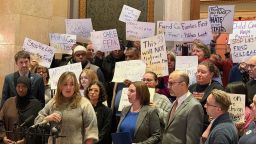
A recent House Oversight Committee hearing in the US Capitol revealed explosive allegations regarding fraud in Minnesota’s child care assistance program. Republican lawmakers testified that significant amounts of taxpayer funds earmarked for child care have been misappropriated to finance luxury homes, cars, and even international properties. The scandal has escalated into a national political issue, attracting the attention of former President Donald Trump and igniting heated exchanges between lawmakers.
Tensions escalated quickly during the hearing, which was scheduled on short notice. Lawmakers traded accusations of negligence and misconduct. The environment was charged, with discussions often straying from the substantive issues at hand, leading to moments where decorum was notably lacking. Accusations of partisanship dominated the dialogue, overshadowing clear communication about the alleged fraud.
In a separate incident far from the hearing, an ICE agent shot and killed a 37-year-old woman in Minneapolis. The Department of Homeland Security Secretary Kristi Noem claimed the woman had attacked the officers, while Minneapolis Mayor Jacob Frey challenged this characterization. During the hearing, Rep. Robert Garcia, a Democrat from California, described the incident as a “horrific killing” and called for a thorough investigation.
Allegations of State-Level Complicity
Three Republican members from the Minnesota House—Kristin Robbins, Walter Hudson, and Marion Rarick—provided testimony asserting that Governor Tim Walz knowingly failed to investigate the fraud. Robbins specifically pointed to credible reports dating back to 2011, stating that the Walz administration “has utterly failed to protect Minnesota taxpayers and vulnerable citizens.”
Hudson went further, claiming that Walz ignored these concerns partly due to the political implications, suggesting that the Somali American community’s significance to the Democratic voter base contributed to a culture of silence around the issue. Rarick echoed these sentiments, arguing that if Walz had been serious about addressing the fraud, he would have acted sooner. Notably, Walz recently withdrew his bid for a third term amid the escalating scandal.
Political Incentives and Community Reactions
Robbins also highlighted whistleblower allegations regarding millions of dollars in fraud tied to Feeding Our Future, a nonprofit accused of falsely claiming to provide meals during the COVID-19 pandemic. The fallout has seen numerous indictments since 2022, primarily affecting individuals of Somali descent. The discussion during the hearing often centered on how these allegations relate to wider issues of accountability and governance.
Some lawmakers went as far as to suggest that the Walz administration had political motivations for overlooking the fraud. During questioning, Rep. Brandon Gill of Texas asked the Minnesota lawmakers whether they believed the Democrats had intentionally ignored the fraud for political gain. All three witnesses affirmed this assertion, citing various whistleblower reports.
Democratic representatives expressed concerns over the potential for racism and xenophobia to distort the investigation. Rep. Rashida Tlaib urged her colleagues to avoid framing the actions of individuals in the Somali community as representative of the community as a whole. She emphasized the importance of conducting investigations without perpetuating harmful stereotypes that could endanger vulnerable populations.
The hearing, marked by sharp exchanges, highlighted broader issues surrounding race, politics, and accountability. As tension reached a boiling point, Rep. Summer Lee accused Republicans of “cherry-picking” allegations to demonize the Somali community, while Rep. James Comer, the Oversight Committee Chairman, defended the committee’s efforts.
The backdrop of recent allegations against the Somali community has fueled the ongoing debate. The Trump administration has seized upon these claims to bolster calls for increased federal scrutiny in Minnesota, a state with the largest Somali population in the United States. Public interest in the allegations surged following the emergence of a viral video by YouTube content creator Nick Shirley, who made unsubstantiated claims of widespread fraud.
As investigations continue and political tensions mount, the implications of these allegations extend far beyond Minnesota, touching on issues of governance, accountability, and community representation. The committee’s next steps will be crucial in determining not only the fate of those involved but also the broader narrative surrounding fraud in social service programs at a national level.