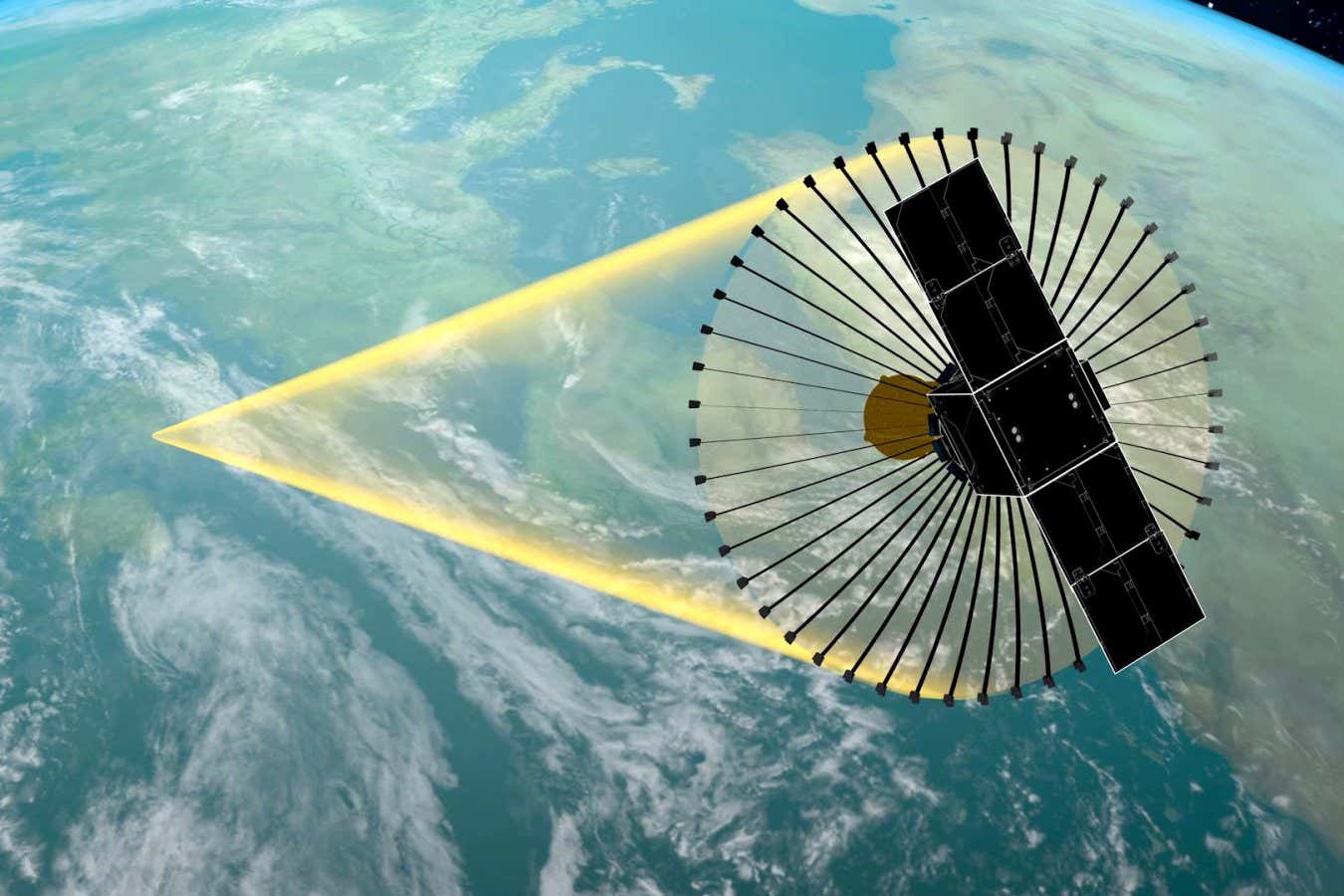
A pioneering satellite named CarbSAR is set to launch from the UK on March 3, 2024, marking a significant advancement in Earth observation technology. This innovative satellite features a unique mesh radar antenna created using techniques typically found in textiles manufacturing. The initiative aims to deliver high-resolution images of the Earth’s surface, with potential applications ranging from environmental monitoring to military intelligence.
Innovative Design and Manufacturing Techniques
Developed by Oxford Space Systems (OSS), CarbSAR utilizes a knitting machine commonly used for producing garments. According to Amool Raina, production lead at OSS, the machine has been enhanced to accommodate special yarns made from ultra-fine tungsten wire coated in gold. “It’s a very standard, off-the-shelf industrial machine used for knitting jumpers. All we’ve done is add some bells and whistles to let it stitch our special yarns,” Raina explained.
The mesh antenna is manufactured into sheets that can be cut and assembled to create a parabolic dish, essential for effective radar imaging. The design involves stretching these sheets tightly over 48 carbon-fibre ribs, allowing the entire structure to collapse to a compact diameter of just 75 cm for launch. This innovation significantly reduces the satellite’s required volume on the launch vehicle, which weighs approximately 140 kilograms.
Once in orbit, the carbon fibres will return to their original shape, unfolding the mesh into the intended parabolic configuration. Sean Sutcliffe, chief executive of OSS, emphasized the importance of precision in this process, stating, “For the imaging we want to do, we also need to unfurl with precision – to get that perfect parabolic shape.” Testing has indicated that the mesh sheets remain within a millimetre of the ideal design, a critical factor for effective imaging.
Strategic Importance and Future Prospects
The launch of CarbSAR comes at a time when demand for Earth observation satellites is surging. Their capability to capture images in all weather conditions and during nighttime has attracted interest from various sectors, particularly military organizations. In the context of the ongoing Russia-Ukraine war, the data provided by radar satellites has become invaluable for strategic planning and intelligence gathering.
Despite the UK’s early leadership in developing space radar technology during the 1990s, it has faced increasing competition from other nations. The launch of CarbSAR, along with the planned Oberon constellation for the British Ministry of Defence, represents a critical opportunity for the UK to reestablish its position in the aerospace sector. This broader program, known as ISTARI, aims to enhance the UK’s capabilities in space.
Andrew Cawthorne, managing director of Surrey Satellite Technology Limited (SSTL), noted the growing interest from foreign governments in the UK’s radar technology. “Obviously, the first thing we need to do is deploy this antenna and prove we can take an image,” he stated, underscoring the importance of the upcoming launch.
The anticipation surrounding CarbSAR is palpable, particularly within UK Space Command, which is managed by the Royal Air Force. Major General Paul Tedman expressed excitement about the project, stating, “CarbSAR is a testament to the innovation and collaboration of one of the UK’s most forward-thinking space companies.” He also mentioned the potential for integrating CarbSAR’s advanced instruments into the Oberon satellite network and the wider ISTARI program.
As the launch date approaches, the focus will be on the successful deployment of the antenna and its ability to capture detailed images of objects down to 50 cm in size, sufficient to identify vehicles and aircraft. The successful operation of CarbSAR could pave the way for a new era of satellite technology in the UK, combining innovation with practical applications in both civilian and military contexts.