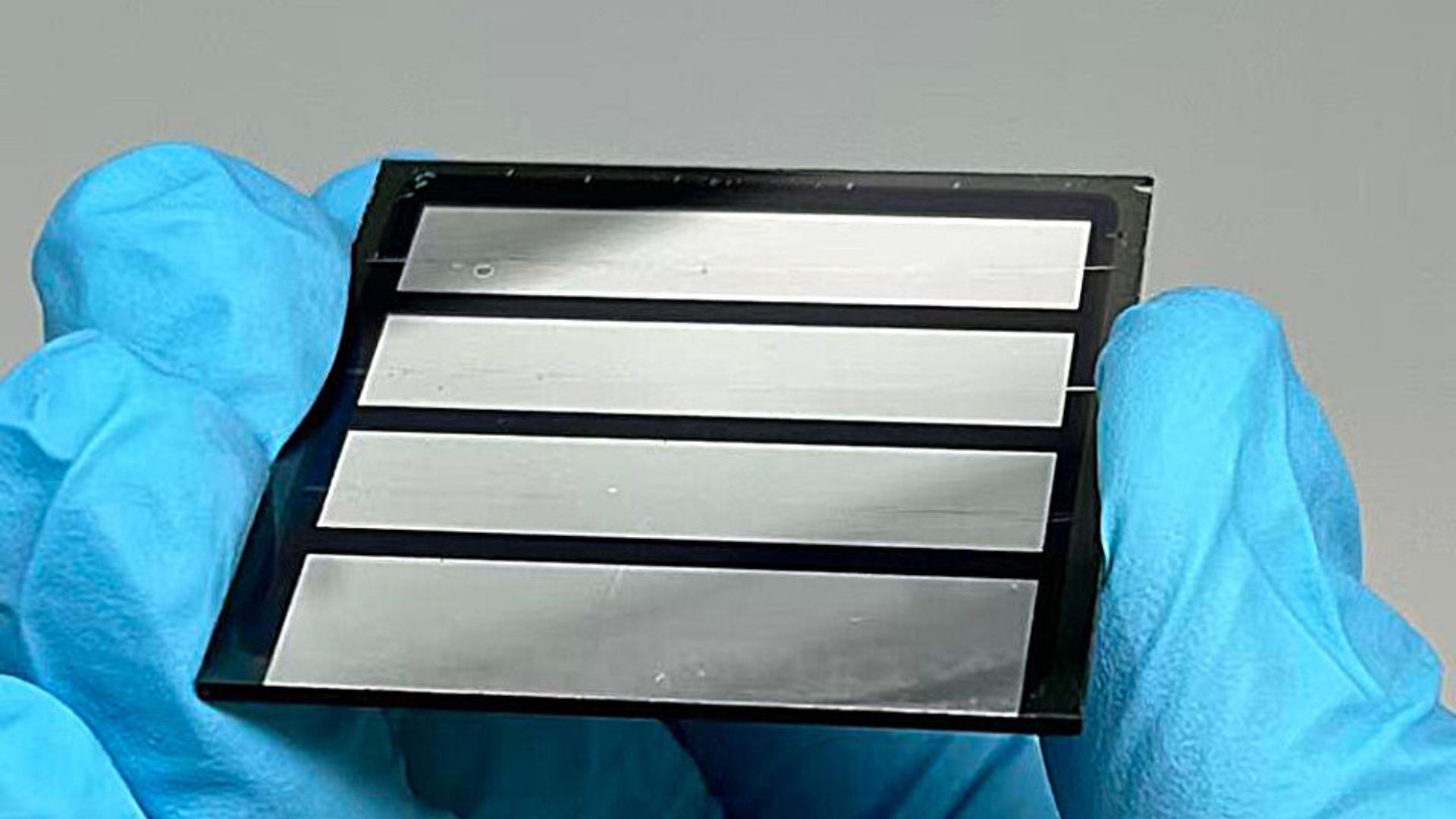
Researchers at the University of Manchester have developed a new type of perovskite solar cell that retains over 95% of its performance after extensive testing. This breakthrough, led by Professor Thomas Anthopoulos, addresses longstanding issues that have hindered the widespread adoption of this promising yet fragile technology. The innovative cells achieve a power conversion efficiency of 25.4% and maintain stability even in extreme heat conditions.
Historically, perovskite solar cells have captivated the renewable energy sector due to their lightweight and flexible nature, offering a compelling alternative to traditional silicon panels. However, earlier iterations faced rapid degradation, limiting their commercial viability. The challenge was to create a stable product that could endure the rigors of real-world applications.
The research team tackled this problem by designing a new molecular glue that enhances the cells’ structural integrity. This unique solution smooths the surface of the perovskite material, eliminating microscopic defects that cause energy loss and material breakdown. Professor Anthopoulos remarked, “Current state-of-the-art perovskite materials are known to be unstable under heat or light.” The new molecular glue functions by forming a protective layer that directs the growth of stable perovskite structures, thereby improving both performance and longevity.
Innovative Design Overcomes Stability Challenges
In rigorous tests, the newly stabilized solar cells exhibited remarkable resilience, retaining their power conversion efficiency even after 1,100 hours of continuous use at temperatures reaching 85°C (185 degrees Fahrenheit). This level of durability marks a significant advancement over earlier models, which often failed under similar conditions. The enhanced performance of these cells opens new avenues for their application in various settings, including on flexible surfaces such as curved windows and portable devices.
The implications of this research extend beyond efficiency. The ability to print perovskite solar cells onto lightweight materials can revolutionize how solar technology is integrated into everyday products, from camping gear to clothing fabrics. “The amidinium ligands we’ve developed, and the new knowledge gained, allow the controlled growth of high-quality, stable perovskite layers,” said Professor Anthopoulos. This innovation is seen as a crucial step toward overcoming one of the last significant hurdles in the commercialization of perovskite technology.
Accelerating the Path to Commercialization
The race to bring perovskite technology to the market has intensified in recent years. Researchers in China have also made strides in this area, recently introducing a three-dimensional electrical imaging technique. This method enables direct observation of charge-carrier migration in perovskite films, allowing scientists to create detailed maps of internal electrical behavior. Such advancements could facilitate the identification and elimination of hidden defects, further enhancing material performance.
The findings from the University of Manchester were published in the journal Science on January 8, 2025. As the renewable energy sector continues to evolve, the successful stabilization of perovskite solar cells stands as a hopeful indicator of the potential for innovative technologies to play a transformative role in combating global energy challenges. This research not only reinforces the viability of perovskite as a mainstream solar material but also underscores the ongoing commitment to sustainable energy solutions.