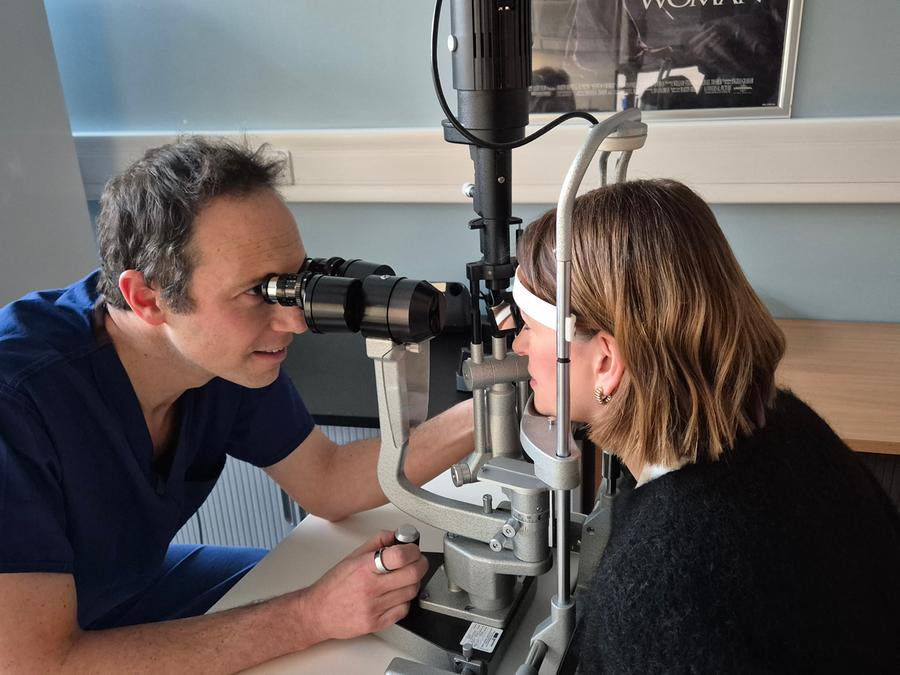
A groundbreaking treatment developed by Consultant Ophthalmologist Dr. Harry Petrushkin at Moorfields Eye Hospital has successfully restored vision for patients suffering from hypotony, a condition previously deemed untreatable. The pioneering method has notably benefited Nicki Guy, a 47-year-old patient, who had faced severe eyesight issues stemming from her condition.
Hypotony results in abnormally low pressure within the eyeball, causing it to collapse and potentially leading to blindness. Traditionally, this condition was considered end-stage eye disease with no available interventions. Dr. Petrushkin, who specializes in inflammatory eye conditions, expressed his astonishment at the treatment’s success, stating, “It’s a fantastic result. More than I ever could have hoped for.”
Nicki Guy first visited Dr. Petrushkin in 2019, after experiencing significant vision loss following a routine cataract surgery. She had already been prescribed eye drops by other ophthalmologists, but her condition worsened dramatically, leading to blindness in one eye. Dr. Petrushkin described the moment her eye “just deflated,” which prompted him to seek alternative solutions for her second eye.
In a bid to save her sight, Dr. Petrushkin and his team devised a new treatment protocol, injecting a gel known as hydroxypropyl methylcellulose (HPMC) into Guy’s eye every couple of weeks over a ten-month period. This innovative approach aimed to restore the shape of the eyeball, akin to reinflating a flat tire. Dr. Petrushkin noted, “The way that we chose to do it… with a target in mind, is the new thing about this research.”
The results have been promising, with seven out of eight patients at Moorfields responding positively to the treatment. Dr. Petrushkin emphasized the importance of not giving up on patients with hypotony, advocating for a shift in the conventional wisdom surrounding the condition. “What I hope is that there’s a paradigm shift in the conventional wisdom of when an eye is beyond hope,” he remarked.
Guy described the treatment as “life-changing,” saying it has allowed her to witness her child grow up. “I’ve gone from counting fingers and everything being really blurry to being able to see,” she shared in an interview with the BBC.
Dr. Petrushkin estimates that the treatment could benefit between 500 and 1,000 patients annually. He acknowledged the rewarding nature of his field, stating, “One of the great things about ophthalmology is that you constantly have patients come up to you and say, ‘You changed my life. I was blind, and now I can see.’”
As the medical community takes notice, Dr. Petrushkin hopes his findings will inspire further research and innovation in treating previously hopeless cases. His work stands as a testament to the potential for breakthroughs in ophthalmology, underscoring the need to keep an open mind about treatment possibilities.