Researchers at the University of Konstanz have introduced an innovative, contact-free technique to effectively remove liquids from delicate microstructures. This method, published in the journal Proceedings of the National Academy of Sciences, harnesses vapor condensation to create surface currents that gently transport droplets away from microscopic surfaces.
Modern technologies increasingly rely on microscopic components, such as the microchips found in smartphones and computers. The manufacturing of these components often involves various liquids that must be meticulously removed after processing. Led by physicist Stefan Karpitschka, the research team has developed a solution that utilizes the principles of surface tension to facilitate this removal without damaging the sensitive materials involved.
Understanding Surface Tension in Microstructures
Each liquid possesses a unique surface tension that can affect how it interacts with other materials. For instance, water’s surface tension enables small insects, like the water strider, to walk on its surface. In the context of microstructures, even minimal surface tension can lead to significant damage. The process to manufacture microchips, which involves numerous delicate steps, often requires wet processing.
Karpitschka explains, “For example, in converting thin silicon disks, known as silicon wafers, into microchips, several steps necessitate the presence of liquids.” He highlights that processes like etching transistors in acid baths require subsequent drying. Unfortunately, traditional methods such as wiping or boiling are inadequate, as they can leave behind contaminants that compromise the integrity of the microstructure.
A New Approach: Marangoni Force
In their quest to develop a safer method for liquid removal, the research team focused on the Marangoni force, which arises from differences in surface tension. Karpitschka describes this phenomenon as a “tug-of-war” where areas with higher surface tension displace those with lower tension.
To generate the necessary surface tension differences, the researchers introduced additional liquid. In one experiment, they evaporated alcohol, which has a lower surface tension than water. The vapor condenses on the existing liquid, creating the desired tension differential. Karpitschka adds, “We direct the resulting currents across the surface to coalesce small amounts of remaining liquid into larger droplets.”
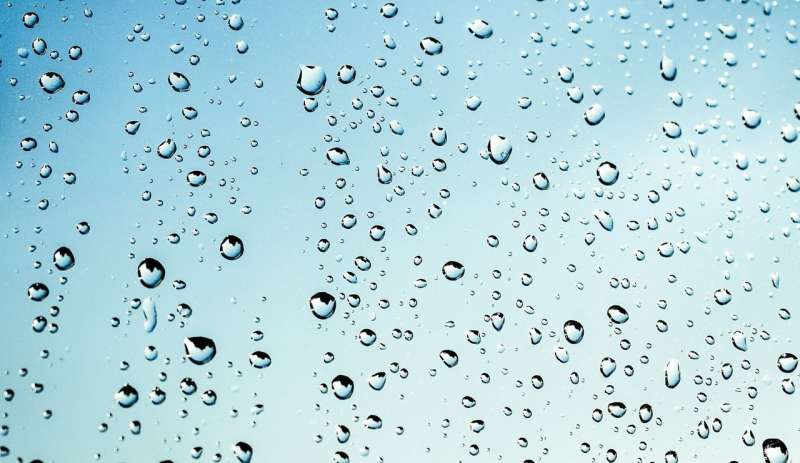
This process mirrors the way raindrops collect on a windowpane, except in this case, the researchers have control over the droplets’ movement. The innovative method opens up new possibilities for various fields that utilize micropatterned surfaces, allowing for efficient drying of small structures without the risk of damage.
The findings from this research, led by Ze Xu and colleagues, hold promise for enhancing the production of micro- and nanomaterials across multiple industries. By providing a gentler alternative for liquid removal, this technique could significantly improve manufacturing processes while maintaining the integrity of delicate microstructures.