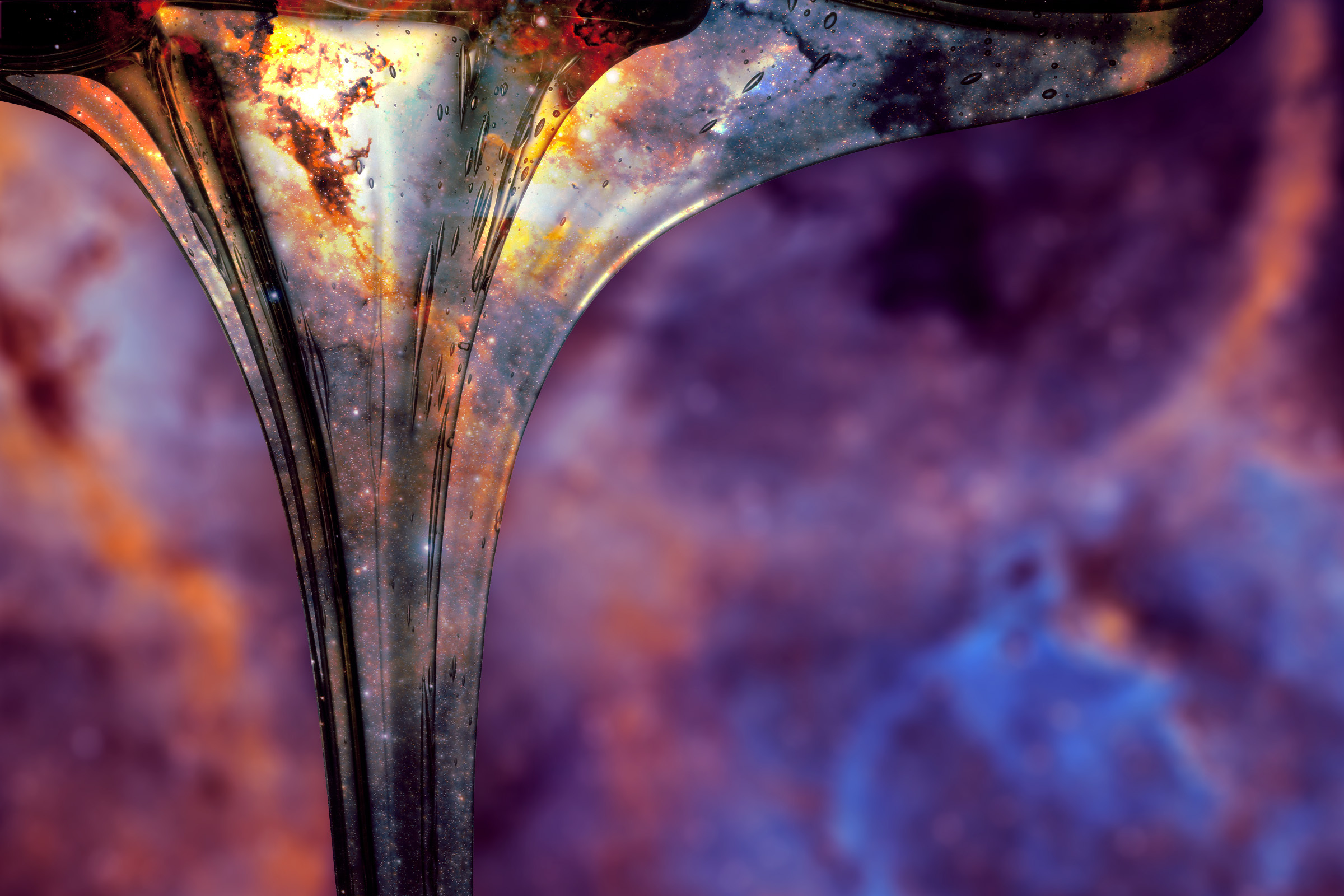
A new research paper proposes a radical idea: outer space might behave like a viscous fluid. This theory, presented by researcher Muhammad Ghulam Khuwajah Khan from the Indian Institute of Technology in Jodhpur, challenges existing models that describe the universe’s structure and expansion. The paper, which has yet to undergo peer review, was highlighted by Live Science and offers potential explanations for persistent discrepancies observed in cosmological data.
Currently, astronomers primarily rely on the Lambda Cold Dark Matter Model (often referred to as the ΛCDM model) to understand cosmological phenomena, including the Big Bang and the roles of dark matter and dark energy. The model treats the energy density of space, represented by the cosmological constant (Λ), as a stable and unchanging aspect of the universe. Yet, findings from the Dark Energy Spectroscopic Instrument (DESI) in Arizona and the Dark Energy Survey in Chile have highlighted inconsistencies between observational data and the predictions made by the ΛCDM model.
These discrepancies suggest that dark energy, once assumed to be constant, may actually vary as the universe ages and expands. Khan’s hypothesis aims to address this issue by conceptualizing space as a viscous fluid, akin to thick honey. He introduces the notion of “spatial phonons,” which are vibrations produced by atoms that generate tension waves throughout space.
The theory posits that while dark energy drives the expansion of the universe, these phonons exert a subtle counterforce, resulting in a non-uniform expansion. By integrating this concept with the observations noted by DESI, Khan believes it is possible to reconcile the differences observed in the ΛCDM model.
Khan’s approach preserves the notion of dark energy as a driving force behind cosmic expansion while adding a layer of complexity that could help explain unusual astronomical observations. He emphasizes that further data from ongoing dark energy surveys will be crucial to validating or refuting this theory.
As the scientific community examines these findings, the implications of Khan’s research could reshape our understanding of the cosmos. The exploration of space remains an ever-evolving field, and new theories like this one invite intense scrutiny and debate within the cosmological community. Future studies will determine whether this innovative idea gains traction or fades into obscurity.
The quest to understand the universe continues, with researchers eagerly awaiting new data to further illuminate the mysteries of dark energy and the fundamental nature of outer space.