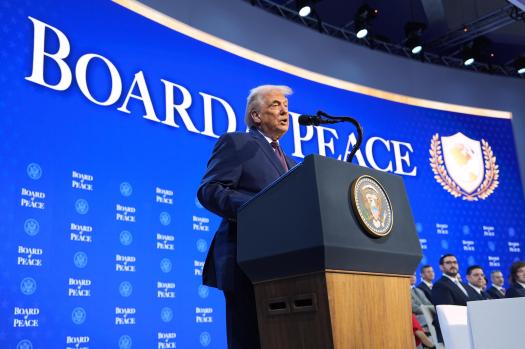
President Donald Trump introduced his “Board of Peace” on January 22, 2026, during the World Economic Forum in Davos, Switzerland. This initiative aims to lead efforts in maintaining a ceasefire in the ongoing conflict between Israel and Hamas. Despite Trump’s assertion that “everyone wants to be a part” of this new body, many of the United States’ traditional allies have chosen not to participate.
In his address, Trump emphasized the global importance of the board, stating, “This isn’t the United States, this is for the world.” He suggested that while it focuses initially on Gaza, the board could expand its reach to address broader global issues as it gains momentum. This announcement followed a week marked by controversy, including Trump’s earlier threats regarding Greenland.
The unveiling of the Board of Peace coincided with a statement from Ali Shaath, head of the new technocratic government in Gaza, indicating that the Rafah border crossing would open in both directions next week. This development follows Israel’s announcement in December 2025 regarding the crossing, which connects Gaza and Egypt.
Initially envisioned as a select group of world leaders overseeing the ceasefire, the Board of Peace has evolved into a more ambitious organization. However, skepticism regarding its membership and mandate has caused several nations, typically aligned with Washington, to decline participation. Trump attempted to downplay the absence of key allies, noting that 59 countries had signed on. He addressed the assembled leaders, stating, “You’re the most powerful people in the world,” and acknowledged, “Every one of them is a friend of mine.”
Among those present at the announcement were Marco Rubio, the U.S. Secretary of State; special envoy Steve Witkoff; and Jared Kushner, Trump’s son-in-law and significant overseas negotiator. Other attendees included Saudi Arabia’s Foreign Minister, Prince Faisal bin Farhan; Azerbaijan’s President Ilham Aliyev; and Armenian Prime Minister Nikol Pashinyan.
Trump has suggested that the board might take on roles traditionally held by the United Nations, although he tempered this by stating, “We’ll do it in conjunction with the United Nations,” despite criticizing its effectiveness in resolving global conflicts.
Questions about participation remain significant. For example, Russia‘s President Vladimir Putin indicated his country is still consulting with “strategic partners” before making a commitment. The British Foreign Secretary, Yvette Cooper, expressed concerns about Putin’s involvement in peace discussions, given ongoing tensions in Ukraine. Other nations, including Norway, Sweden, and France, have also opted out, citing worries that the board might undermine the UN’s role.
Prime Minister Robert Golob of Slovenia stated that “the time has not yet come to accept the invitation,” highlighting concerns over the board’s broad mandate and its implications for international order based on the UN Charter. Canada, China, and members of the European Union have not yet clarified their positions regarding Trump’s invitation.
The Board of Peace concept originated from Trump’s comprehensive Gaza ceasefire plan, which received endorsement from the UN Security Council. Letters inviting world leaders to Davos indicated that the board’s work might extend beyond Gaza. Israeli Prime Minister Benjamin Netanyahu has since agreed to participate, reversing earlier criticisms of the board’s oversight committee.
As the humanitarian crisis in Gaza continues, with over 2 million Palestinians still suffering, the ceasefire remains tenuous. Key to its continuation is the disarmament of Hamas, which has consistently refused to negotiate on this front, a point Israel views as non-negotiable.
Trump asserted that the war in Gaza “is really coming to an end,” while acknowledging, “We have little fires that we’ll put out.” His administration’s strategy also includes addressing the unrest in Iran, where recent protests have resulted in significant casualties. Trump has indicated a temporary halt on military action against Iran, shifting his focus to the Board of Peace initiative.
In an expected follow-up, Trump is slated to meet with Ukrainian President Volodymyr Zelenskyy, who arrived in Davos shortly after the board’s announcement. The ongoing conflict in Ukraine is another focal point for Trump, who has expressed frustration with both Zelenskyy and Putin for their inability to reach a resolution.