Ukraine entered 2026 facing significant challenges as Russian forces continued their advances on the battlefield. Prolonged blackouts in Ukrainian cities have been attributed to relentless bombardments targeting critical infrastructure. This situation raises concerns about the sustainability of Ukrainian defenses. In January, Ukraine’s Defense Minister, Mykhailo Fedorov, revealed that approximately 200,000 soldiers are currently absent without official leave, with an additional two million men accused of evading military service.
While Ukraine grapples with these issues, Russia is not without its own challenges. The escalating costs of military operations pose a serious risk to the economic stability of the Putin regime. Despite initiating offensives throughout 2025, Russian military forces have suffered heavy casualties and achieved minimal territorial gains, capturing less than one percent of Ukraine during the year.
To exploit Russia’s vulnerabilities, Ukraine may need to prolong the conflict longer than anticipated. Increasingly, some voices advocate for Ukraine’s allies to encourage a Kremlin-friendly peace agreement. However, this perspective underestimates Ukraine’s pivotal role in a military revolution currently reshaping warfare.
Ukraine’s Military Innovation
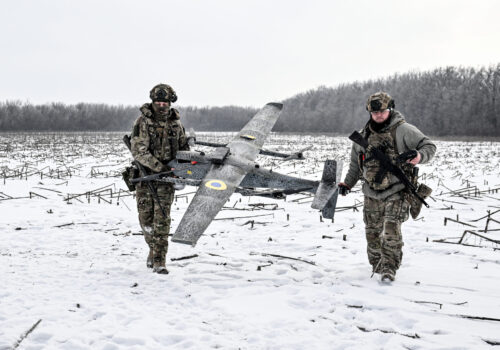
After nearly four years of full-scale war, Ukraine is emerging as a leader in the development of cost-effective and highly precise drones and cruise missiles. By fully embracing this technological revolution, Ukraine and its allies could regain the initiative on the battlefield, compelling Russia to reconsider its objectives.
Historically, the evolution of warfare has not followed a linear trajectory. Significant breakthroughs often arise from a convergence of new technology, tactics, and organizational structures. For instance, the late medieval military revolution saw disciplined infantry replace mounted knights, while the early modern era introduced cannons and fortified structures.
In more recent history, the United States has spearheaded advancements in precision-guided weaponry, which initially remained the domain of wealthier nations due to high costs and complexity. Now, Ukraine stands on the cusp of achieving a similar transformation. As the fourth anniversary of Russia’s full-scale invasion approaches, Ukraine is ramping up the production of attack drones and developing its own cruise missiles, with ambitions to enhance domestic manufacturing.
The unique circumstances of Ukraine’s current situation have fostered an environment ripe for innovation. The existential nature of the conflict has drawn in a diverse talent pool, including software engineers and entrepreneurs, all focused on finding novel solutions for national defense. This collaborative effort, supported by various ministries and international partners, has created a dynamic ecosystem that mimics the innovative atmosphere of Silicon Valley, enabling rapid development and deployment of military technologies.
International Support and Future Prospects
Ukraine’s defense sector is now producing long-range strike systems with unprecedented cost-effectiveness, democratizing access to military capabilities that were once the prerogative of major powers. By leveraging this progress, Ukraine’s allies have the opportunity to help the country regain the upper hand in its ongoing conflict with Russia. Although Ukraine currently lacks the resources for mass production of drones and cruise missiles, its defense sector possesses the capacity to increase output significantly.
Enhancing the production of long-range strike weapons could facilitate a strategically successful campaign, extending operational reach hundreds of kilometers behind enemy lines. In modern warfare, infantry and armored units become vulnerable without adequate supplies and fire support. Ukraine’s expanding arsenal of deep strike assets, particularly when combined with real-time intelligence from allied nations, presents a viable means of countering Russian advances.
Moreover, Ukraine’s long-range systems can complement international sanctions against Russia, exerting additional pressure on its overstretched wartime economy. A coordinated strategy that combines tightening sanctions on Russian energy exports with escalating Ukrainian strikes on critical infrastructure could significantly disrupt Russia’s oil and gas industry.
The military revolution that Ukraine is spearheading has already made strides in democratizing the production of advanced weaponry. With continued support from its allies, this evolution offers a potential pathway to a decisive victory over Russia on the battlefield, ultimately paving the way for a sustainable and acceptable peace agreement.