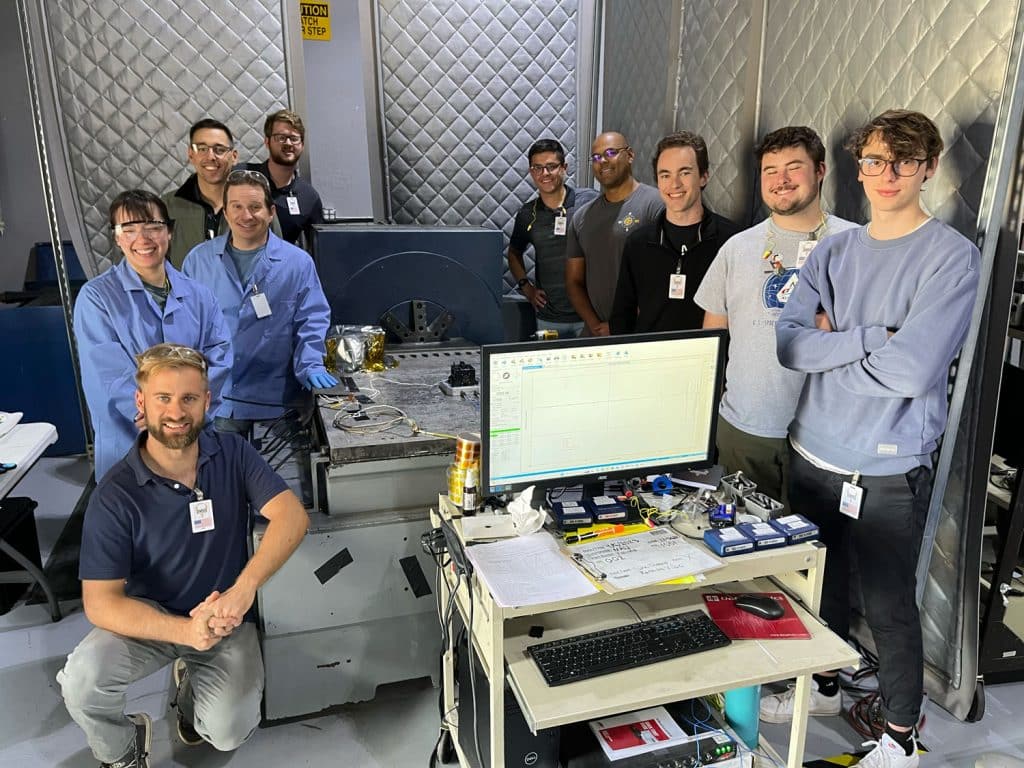
Students and faculty from Northern Arizona University (NAU) have successfully designed and built four cameras set to launch into deep space on a mission to Mars. These cameras, comprised of two traditional models and two infrared variants, will be pivotal for NASA’s ESCAPADE mission, which aims to deepen our understanding of Martian phenomena. The launch is scheduled to take place soon aboard a Blue Origin New Glenn rocket from Cape Canaveral Space Force Station in Florida.
The initiative was spearheaded by Christopher Edwards, a professor of planetary science and director of NAU’s Radiant Center for Remote Sensing. Edwards emphasized the importance of student involvement in this project, stating that hands-on collaboration with an organization like NASA offers invaluable experience for aspiring planetary scientists and engineers.
The project engaged a total of 35 NAU students over three semesters. They participated in every phase, from conception and design to testing and eventual launch. Edwards noted, “The students got to engage with NASA all the way through a project, from conception to design to testing to launch and beyond.” The challenges they faced included securing tiny electronics boards and ensuring that the cameras could withstand the harsh conditions of space without the use of fans for heat management.
Support for this ambitious project came from the Arizona Board of Regents through its Technology Research Initiative Fund. Edwards collaborated with colleagues, including professors David Trilling, Chris Haberle, and Michael Shafer, to guide the students through the intricate design and testing processes.
Once launched, the spacecraft will enter a “loitering” phase, positioned approximately 2 million miles from Earth. During this period, which may last several months, initial camera tests will be conducted prior to the mission’s journey to Mars, expected to culminate in September 2027. Edwards anticipates that it could take an additional year before the cameras will start capturing images of the Martian landscape.
The potential scientific impact of this mission is significant. Edwards explained that the cameras could provide insights into Martian auroras, similar to the northern lights experienced on Earth. He expressed optimism about capturing the aurora on Mars with their instruments. Furthermore, the infrared cameras are expected to yield new data regarding the evolution of the Martian polar caps.
The analysis phase of the mission will continue to involve students, as Edwards and his colleagues plan to recruit individuals with strong backgrounds in computing and data analysis. According to Haberle, “It’s going to be an exciting time operating an instrument around another planet and analyzing the data that are returned.”
As this groundbreaking mission progresses, the involvement of NAU students highlights the importance of education and practical experience in advancing space exploration and research. With the potential for groundbreaking discoveries on the horizon, the partnership between NAU and NASA exemplifies the exciting intersection of academia and space science.