
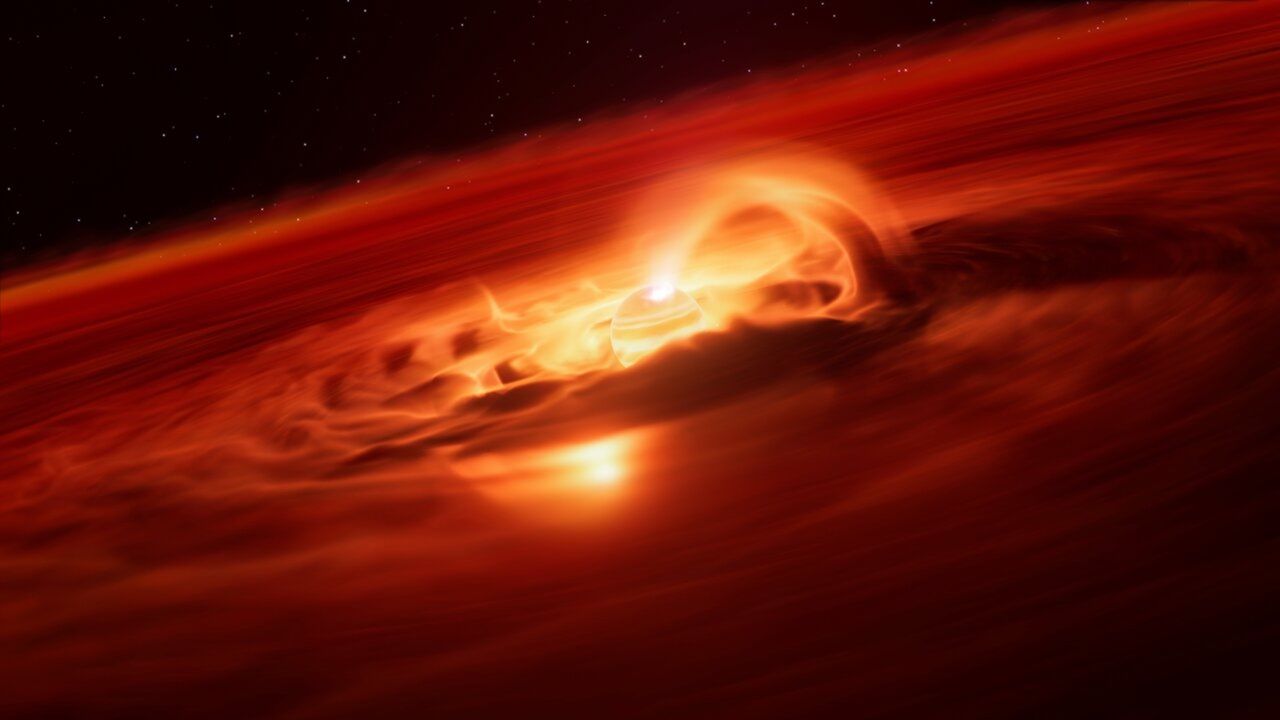
Astronomers have made a groundbreaking discovery of a rogue planet named Cha 1107-7626, which is consuming gas and dust at an astonishing rate of 6.6 billion tons (6 billion metric tons) per second. This remarkable finding not only highlights the unusual behavior of this free-floating planet, but it also raises intriguing questions about the formation of celestial bodies. Observations conducted using the European Southern Observatory’s Very Large Telescope (VLT) in Chile and the James Webb Space Telescope (JWST) revealed that Cha 1107-7626 is the fastest-growing planet of its kind ever documented.
The study, published on October 2, 2023, in The Astrophysical Journal Letters, suggests that this rapid accretion may provide insights into the differences between large planets and small stars. Lead study author Víctor Almendros-Abad, an astronomer at the Palermo Astronomical Observatory in Italy, explained the motivation behind the research: “Our main goal is to determine whether these objects are former planets expelled from their systems or if they formed independently from the gravitational collapse of molecular cloud material, similar to stars.”
Understanding Accretion Bursts
The team observed a phenomenon known as an “accretion burst,” which occurs when a planet suddenly accumulates a large amount of material from its surrounding disk of gas and dust. While Cha 1107-7626 consistently draws from this source, the study indicated that the rate of accretion fluctuates significantly. Notably, in August 2025, the planet was absorbing material at a rate eight times higher than just months prior.
Such bursts of accretion have typically been associated with young stars, suggesting that rogue planets might share similar characteristics. However, the distinction remains unclear due to the size differences between rogue planets and stars. Alexander Scholz, a professor of astrophysics at the University of St. Andrews in Scotland, commented on the historical context of these bursts: “Accretion bursts have been recognized for decades, yet their implications were not fully understood until recently.”
Implications for Celestial Research
The discovery of Cha 1107-7626 sheds light on the mechanisms behind accretion events, which are thought to be fundamental in the formation of stars and planetary systems. Scholz noted, “The remnants of such bursts may appear in the chemistry of meteorites within our own solar system.” However, the specific triggers for these bursts remain enigmatic, and the occurrence of similar events in planetary-mass objects could indicate a universal mechanism at play.
In recent years, astronomers have identified more rogue planets, with JWST recently discovering over 500 of these celestial wanderers in a trapezoidal area within the Orion Nebula, known for its active star formation. Despite advancements, detecting rogue planets remains challenging since they primarily emit infrared light, which is best observed through large telescopes like the VLT and JWST.
Almendros-Abad emphasized the importance of further investigations into these enigmatic objects. “One of our next steps is to ascertain how common these accretion events are among rogue planets,” he stated, highlighting the potential for greater understanding of their evolution and formation processes.
The research surrounding Cha 1107-7626 not only enriches our understanding of rogue planets but may also provide valuable insights into the broader processes of cosmic evolution and the formation of planetary systems throughout the universe.


