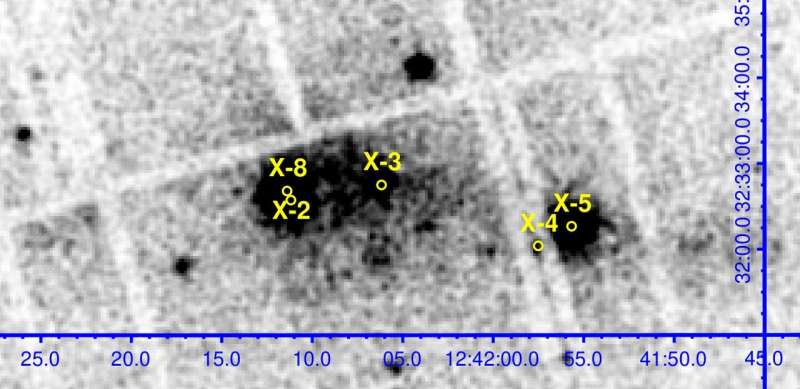
European astronomers have identified a new pulsating ultraluminous X-ray source (ULX) designated X-8 in the galaxy NGC 4631, also known as the Whale galaxy. Utilizing the European Space Agency’s XMM-Newton satellite, the research team, led by Lorenzo Ducci from the University of Tübingen, published their findings on November 6, 2025, on the arXiv preprint server.
ULXs are exceptionally bright point sources in the universe, emitting more X-ray radiation than a million suns combined. While they are less luminous than active galactic nuclei, their brightness exceeds that of any known stellar processes. Despite numerous studies, the fundamental nature of ULXs remains elusive. Some of these sources exhibit pulsations, classifying them as ultraluminous X-ray pulsars (ULXPs). Understanding these pulsating sources may be vital for advancing knowledge about accretion physics, including the mechanisms responsible for their super-Eddington luminosities.
Discovery Details and Observations
The Whale galaxy, located approximately 24.45 million light-years from Earth, is known to host at least seven ULXs. In their investigation, Ducci and his team focused on this galaxy’s unique features using XMM-Newton’s European Photon Imaging Camera (EPIC). During observations conducted in July 2025, they detected a significant signal with a periodicity of about 9.66 seconds from the newly discovered source X-8, which is located near the previously known ULX designated X-2.
The newly identified X-8 exhibited an X-ray luminosity of approximately 3.4 duodecillion erg/s, rendering it brighter than X-2. The researchers noted that X-8 has a spin period derivative of around −9.6 × 10⁻⁸ seconds/second, indicating one of the most rapid spin-up rates observed in pulsating ULXs. The team calculated that the spin-up timescale for X-8 is only 3.2 years, suggesting a combination of orbital motion and accretion torque on the neutron star could be responsible for this rapid phenomenon.
Implications for Future Research
The study revealed that the magnetic field strength of X-8 is likely between 10 and 200 trillion Gauss, which aligns with the magnetic field strengths inferred from other pulsating ULXs. The authors emphasized the significance of their discovery, noting that X-8 adds a crucial source to the limited known population of ULXPs. They concluded that this finding will facilitate future research aimed at better understanding the physical mechanisms behind super-Eddington luminosities.
In summary, the identification of the pulsating ULX X-8 represents a significant advancement in the field of astrophysics, providing new opportunities for research into the extreme conditions of these extraordinary cosmic phenomena.