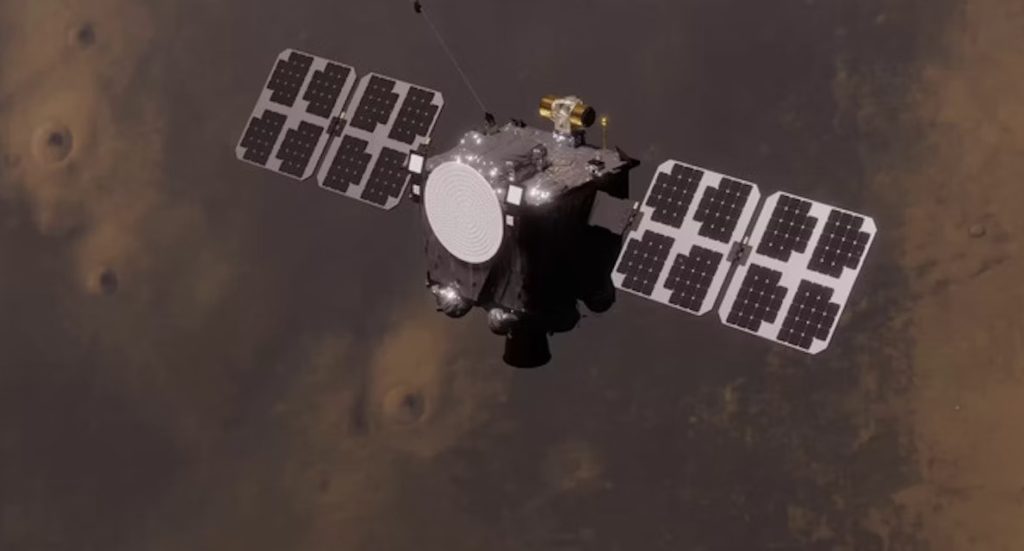
NASA has successfully launched its ESCAPADE mission, aimed at sending two low-cost orbiters to study the atmosphere of Mars. The twin spacecraft, named Blue and Gold, were launched on November 13, 2025, aboard a Blue Origin New Glenn rocket. This mission marks a significant step forward in space exploration, utilizing innovative technology to enhance our understanding of the red planet’s atmospheric history and current conditions.
Advancements in Spacecraft Technology
The ESCAPADE mission represents a shift towards smaller, more affordable spacecraft. Each orbiter is about the size of a copy machine, benefiting from ongoing miniaturization trends within the aerospace industry. This design allows for more scientific measurements while reducing the overall cost of the mission. By having two identical spacecraft operating simultaneously, researchers can obtain more reliable data. Should one spacecraft encounter issues, the other can continue to gather important information, thus providing a safety net for the mission.
Mars, billions of years ago, possessed a much thicker atmosphere that potentially supported liquid water on its surface. Understanding the loss of this atmosphere is crucial to piecing together Mars’ climatic history. The ESCAPADE mission will investigate the remnants of Mars’ ancient magnetic field and examine how the planet’s atmosphere interacts with solar wind. These findings are expected to clarify how Mars transitioned into its current cold and dry state, where surface air pressure is less than 1% of that on Earth.
Cost-Effective Space Exploration
Operating on a budget of approximately $80 million, the ESCAPADE mission exemplifies how modern technology can facilitate deep space exploration at lower costs. This budget is notably modest for a planetary mission, achieved by leveraging commercial technologies and past research investments. The GRAIL mission, which mapped the Moon’s gravity fields in 2011, serves as a precedent for ESCAPADE’s approach, demonstrating that effective scientific objectives can be met with fewer resources.
The collaboration involves prominent partners such as Rocket Lab, Advanced Space LLC, and UC Berkeley’s Space Sciences Laboratory, led by Rob Lillis. Their combined expertise aims to showcase that deep space missions can be executed with increased agility and efficiency.
For the journey to Mars, the ESCAPADE mission employs a new trajectory to reduce fuel consumption. The spacecraft will initially travel to the L2 Lagrange point, where gravitational forces between the Earth and Sun balance out. After spending about a year collecting solar data at this point, Blue and Gold will leverage Earth’s gravitational pull to enhance their trajectory, ultimately arriving at Mars approximately ten months later.
This innovative approach not only minimizes the amount of propellant needed—reducing it to about 65% of the spacecraft’s mass—but also provides greater flexibility in mission timing. Unlike traditional Mars missions, which typically launch every 26 months based on planetary alignment, this new trajectory could enable more frequent missions in the future, potentially aiding cargo and crewed trips to Mars.
The ESCAPADE mission stands as a beacon for the future of space exploration. It illustrates a collaborative model for scientific research, blending university, commercial, and government efforts to push the boundaries of what is possible in space. As the mission unfolds, it is anticipated to yield valuable insights into Mars’ atmospheric dynamics and further advance our understanding of the solar system.