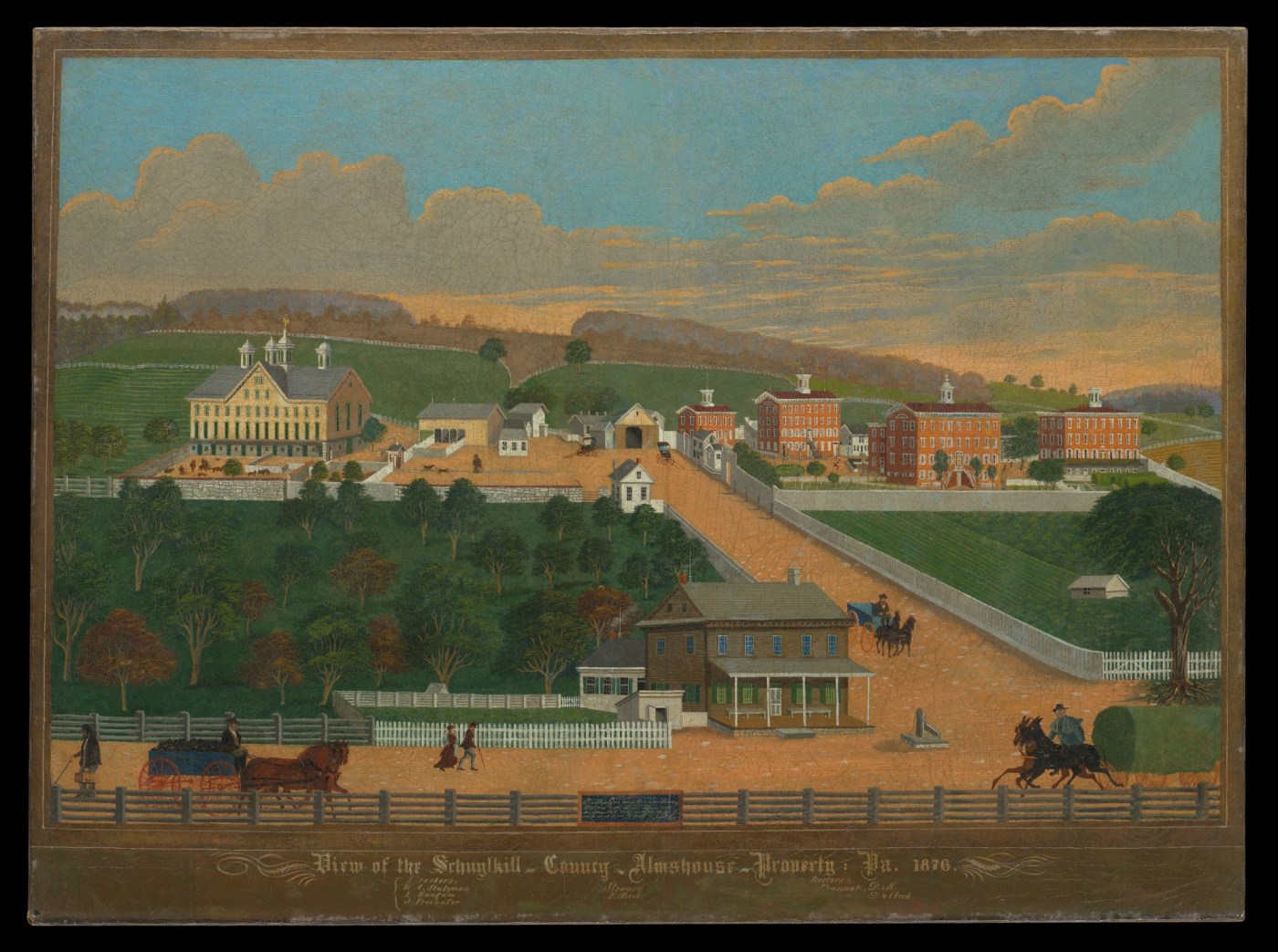
Charles C. Hofmann, a lesser-known yet significant figure in American art history, became known for his paintings created during his time as a resident of almshouses. Born in 1820 in Germany, Hofmann immigrated to the United States in 1860, eventually finding himself in various almshouses along the Schuylkill River, where he painted to sustain himself. His works, which depict almshouses and rural life, reflect both the charm and harsh realities of his circumstances.
The Role of Almshouses in American Society
The concept of almshouses dates back to the 10th century in England, where wealthy benefactors supported establishments for the poor, sick, and orphaned. Known as bede-houses, these institutions required their residents to pray for their benefactors. This practice was carried over to North America by figures like William Penn, leading to the establishment of almshouses, particularly in Philadelphia. By 1713, the Society of Friends had already created an almshouse on Walnut Street, setting a precedent for future institutions.
Over time, the almshouses evolved. In 1825, the Commonwealth of Pennsylvania mandated that each county establish one, leading to the development of complex institutions that included poorhouses, workhouses, orphanages, asylums, and hospitals. The Blockley Almshouse, opened in West Philadelphia in 1835, later transformed into Philadelphia General Hospital in 1919.
Despite their purpose, almshouses were often viewed as a last resort. In the 19th century, many homeless individuals sought refuge there during winter, trading their freedom for food and shelter. Residents were often required to work, learning skills such as shoemaking or farming. Yet, once warm weather returned, many chose to leave these institutions, seeking a better life outside.
Hofmann’s Artistic Journey
Charles C. Hofmann’s journey as an artist began when he first painted the Berks County Almshouse in Shillington in 1865. His initial recorded stay in an almshouse was in 1872, and he returned regularly until his death in 1882. Records indicate that Hofmann struggled with alcoholism, which contributed to his residency in these institutions. Despite his troubled life, he became one of the three prominent “Almshouse Painters” of his time, alongside John Rasmussen and Louis Mader.
Hofmann’s paintings are characterized by their bright colors and cheerful depictions, which often masked the harsh realities of life within the almshouse walls. His 1878 painting of the Berks County Almshouse showcases a vibrant view of the institution, surrounded by a cartouche that frames various vignettes of the buildings on the grounds. The painting presents an idyllic image that contrasts sharply with the actual conditions faced by the residents.
Today, 17 paintings attributed to Hofmann are housed at prestigious institutions, including the National Gallery of Art in Washington, D.C., and the Metropolitan Museum of Art in New York. His works are categorized as naive art, distinguished by their unrefined yet fresh perspective, devoid of formal training. Besides his depictions of almshouses, Hofmann also painted landscapes of Berks County farms.
His artistic legacy serves as a poignant reminder of the lives of those who resided in almshouses. While Hofmann painted for survival, he simultaneously documented a critical aspect of American society during his time. His ability to create engaging, colorful representations of these institutions allowed him to thrive as an artist, even amidst personal struggles.
Charles C. Hofmann’s story is not just one of hardship; it is also a narrative of resilience and creativity, showcasing how art can emerge from the most challenging circumstances. His life and work continue to inspire and resonate, highlighting the enduring human spirit in the face of adversity.