Business leaders in Boulder Valley and Northern Colorado forecast that the first quarter of 2026 will mirror conditions from recent months, with many expecting stability or slight improvements. The findings come from the first-quarter CEO Roundtable Executive Survey conducted by BizWest, which gathers insights from C-level executives on trends and challenges within their industries.
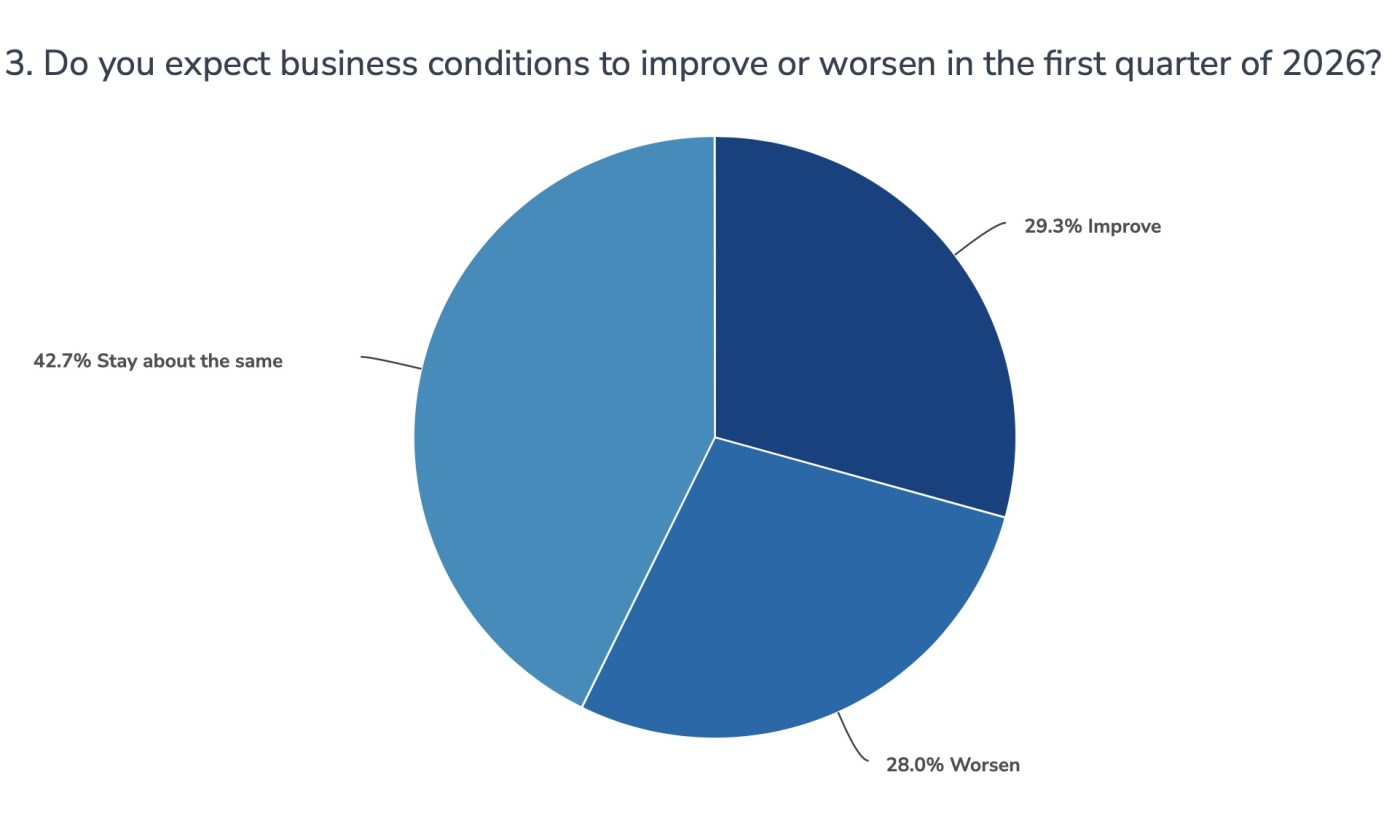
The survey revealed that nearly 43% of executives anticipate business conditions will remain unchanged in the upcoming quarter. Around 29.3% expect improvements, while 28% foresee a decline. This outlook shows a more optimistic sentiment compared to the previous quarter, where approximately 40% of respondents expected worsening economic conditions.
Despite this cautious optimism, some executives express concerns about stagnation. One commercial real estate leader noted, “Economic stagnation is a deal killer. Uncertainty and stagnation can go hand-in-hand. Overall, we are cautious and worried about the 2026 economy but hopeful that our brokers will find a way to meet our clients’ needs in this challenging economic landscape.”
In terms of recent performance, nearly 31.7% of respondents indicated that business conditions have improved over the last six months, a significant increase from 17.7% in the fourth quarter. About 37.8% reported conditions to be similar, while 30.5% experienced a decline.
Impact of Tariffs and Staffing Outlook
The survey also highlighted the negative impact of tariffs on businesses, with two-thirds of participants acknowledging detrimental effects. Specifically, 50% reported a somewhat negative impact, while 17.1% experienced a very negative impact. Only a small fraction, 4.9%, noted a somewhat positive effect from tariffs.
Regarding staffing, 64.6% of executives expect staffing levels to hold steady in the first quarter, while 8.5% anticipate a moderate decrease and 24.4% foresee a moderate increase. This reflects a stagnant job market that many executives are navigating.
Capital expenditure plans suggest a similar sentiment, with 54.9% of respondents expecting no changes. A minority, 9.8%, predicts a moderate decrease, while 25.6% expect a moderate increase.
Challenges and Opportunities Ahead
A range of considerations emerged from the survey regarding local economic factors. Approximately 76.8% of respondents reported that new minimum wage requirements have no impact on their operations. Conversely, 15.9% noted a somewhat negative effect, and 6.1% indicated a very negative impact.
Housing availability is identified as a significant concern, with nearly two-thirds of respondents stating it negatively affects their employees. 42% described the impact as somewhat negative, while 22.2% viewed it as very negative. Only 32.1% felt housing availability had no effect.
When it comes to construction needs, about 21% of executives indicated their companies might require new facilities. Among these, 3.7% have definite plans, while 79% are not likely to pursue new projects at this time.
The survey also gathered insights on what executives see as the greatest challenges and opportunities for their businesses in the first quarter. Responses varied widely, highlighting concerns about artificial intelligence integration, economic uncertainties, and the impact of increased property taxes on business operations.
One executive emphasized the dual nature of AI, stating, “The greatest challenge and opportunity are AI adoption, integration, and leverage. AI could be a threat to certain aspects of our business, but it also has the potential to be a significant accelerator for us. It all comes down to our willingness and ability to properly use the technology.”
The CEO Roundtable program is backed by sponsors including Plante Moran, Berg Hill Greenleaf Ruscitti LLP, Bank of Colorado, and Elevations Credit Union in the Boulder Valley and Northern Colorado.
With diverse representation from various industries such as agribusiness, healthcare, technology, and construction, the responses reflect a comprehensive view of the economic landscape as executives prepare for the challenges and opportunities ahead in 2026.