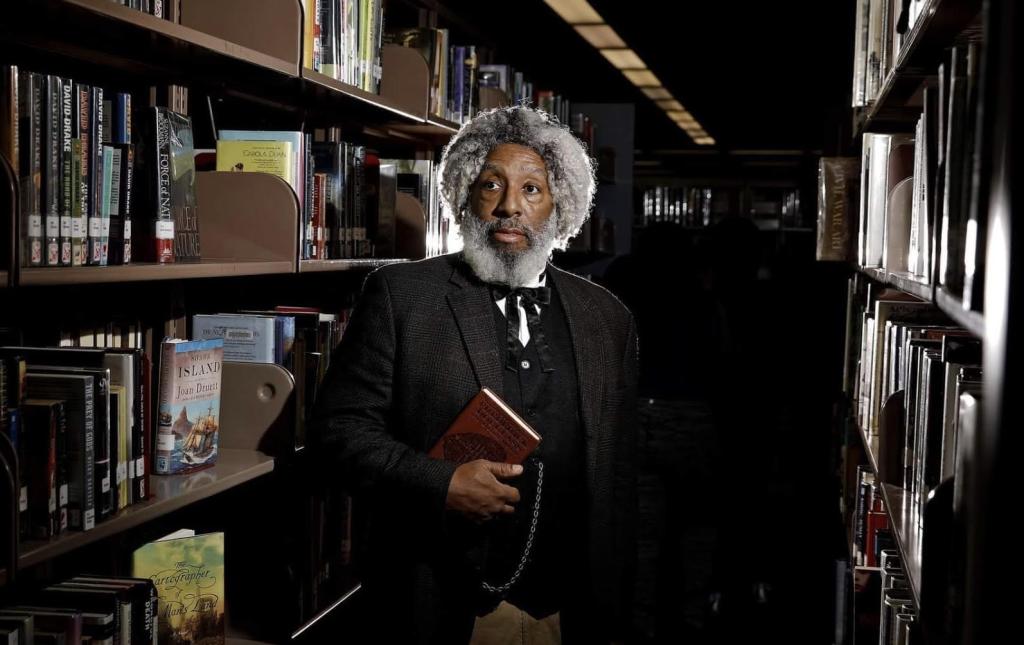
Nathan Richardson, a historical interpreter, will present his engaging portrayal of the American abolitionist Frederick Douglass next week in Hampton, Virginia. His workshop, titled “The Art of Historical Interpretation with Nathan Richardson,” is scheduled for March 25, 2024, at the Hampton History Museum starting at 18:30.
Richardson, who hails from Suffolk, Virginia, has dedicated his career to embodying Douglass, delivering performances approximately 65 times a year across the United States. He dons a frock coat and straightens the gold chain of his pocket watch as he transforms into Douglass, an influential figure in the fight against slavery.
During the workshop, Richardson will guide participants on the nuances of becoming a historical interpreter, emphasizing that this role differs from that of a reenactor. He states, “An interpreter literally has to become that person,” highlighting the depth of knowledge required to authentically represent historical figures.
Richardson’s performances typically begin with a reenactment of significant speeches or moments from Douglass’s life. However, he distinguishes his work by engaging the audience in what he refers to as the “magical part.” This interactive segment allows attendees to ask Douglass direct questions, with Richardson responding in character.
For example, if an audience member inquires about Douglass’s family, Richardson can provide accurate details, stating, “I had five children, three boys, two girls. My daughter, Annie, passed away when she was 10 years old.” This approach not only educates but also fosters a connection between the historical figure and the audience, especially for younger participants who often ask questions like, “Did you own a dog?”
Richardson, now 65 and residing in Maryland, is a 22-year Army veteran who began his journey as a historical interpreter in 2012. He chose to depict Douglass due to a profound admiration for the abolitionist’s strength, intellect, and eloquence in advocating for civil rights.
Frederick Douglass, born into slavery around 1818 in Maryland, escaped to freedom in 1838 by disguising himself as a sailor. He became a prominent abolitionist, orator, and author, best known for his memoir, “Narrative of the Life of Frederick Douglass, an American Slave,” published in 1845. Richardson asserts the importance of Douglass’s legacy, stating, “He and others in the 19th century, the abolitionists of that time, were the precursors to everything we know about civil rights in America.”
Despite his passion for historical interpretation, Richardson has observed a decline in the number of individuals entering this field over the past decade. He urges, “We need new people. We need younger people who are interested in history to bring it to life.”
The workshop at the Hampton History Museum is free for museum members and costs $5 for non-members. This initiative not only serves as a platform for Richardson to share his expertise but also aims to inspire a new generation of historical interpreters.
For more information about the event, visit the Hampton History Museum’s website.