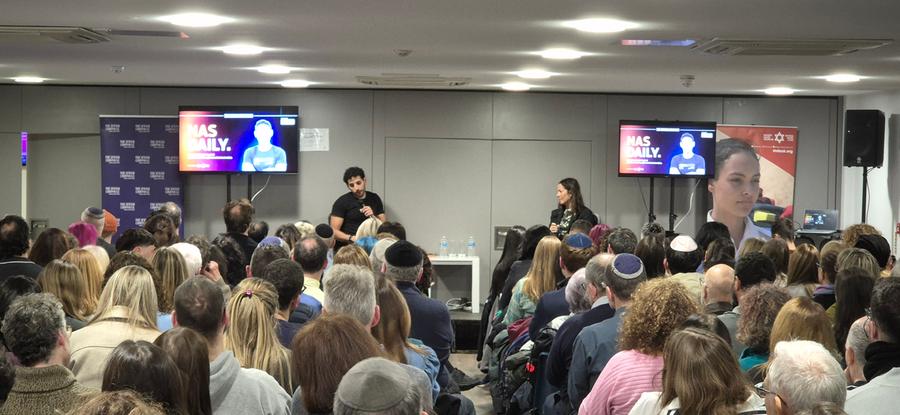
Arab-Israeli influencer and social media personality Nas Daily, whose real name is Nuseir Yassin, spoke passionately about his vision for Israel during an event at Radlett United Synagogue on a rainy evening in November 2023. The event, hosted in partnership with Magen David Adom UK, attracted a full audience eager to hear his views on Israel, Zionism, and the future of the region.
Yassin began the evening by engaging the audience in a unique format, flipping the typical speaker-audience dynamic. His charisma and ability to connect with people are evident, traits that have helped him amass over 60 million followers across various social media platforms. During a subsequent interview with journalist Nicole Lampert, Yassin reflected on his upbringing in a small town near Nazareth, the largest Arab city in Israel, where he had little interaction with Jewish peers.
Describing his childhood experience, Yassin noted, “It’s a mutual stand-off.” He explained that both Arab-Israeli and Jewish children were hesitant to socialize with each other. This perspective shifted dramatically when he received a scholarship to study at Harvard University, where he expanded his social circle and made friends from diverse backgrounds, including Jewish and Israeli peers.
“I’m so culturally Israeli,” he stated, highlighting the transformative impact of these interactions. He noted that his encounters with Jordanian Palestinians during his studies made him realize the complexities of identity, as he found he had little in common with them. This new understanding led Yassin to reassess his relationship with Israel and formulate his current mission: to advocate for a better Israel.
Yassin expressed his belief that Israel has the potential to be more prosperous and tolerant, stating, “It’s not perfect. I think Israel can be three times better, three times richer, three times more tolerant.” His pride in Israel was evident as he added, “So if that makes me a Zionist, great, let’s go!”
When discussing the sentiments of other Arab-Israelis, Yassin estimated that at least 80 percent prefer living under Israeli governance, though he acknowledged that fewer than 20 percent are willing to voice this opinion publicly. He expressed concern about the influence of Hamas, stating, “What we saw from Hamas, it’s unrecognizable.” This led to a complicated relationship with some elements of the Arab community, complicating the idea of neighborliness.
Yassin’s optimism about the future extends beyond Israel. He highlighted the advancements in artificial intelligence, which he believes will enhance human experiences by freeing people from mundane tasks. He also cited the Gulf Cooperation Council countries, such as Bahrain, Saudi Arabia, and the United Arab Emirates, as sources of hope and inspiration for positive change in the Middle East.
Conversely, Yassin’s outlook on the UK is less favorable. He remarked, “I don’t recognise Britain,” and humorously referred to British media, quipping, “We all love Al Jazeera … and I think here it’s called The BBC?”
In a bold statement regarding integration challenges in both the UK and Israel, Yassin proposed mandatory military service for all communities, including Arab-Israelis and Haredim, alongside secular Jewish citizens. He argued that without such measures, tribalism would persist, preventing true integration.
As the evening concluded, Yassin addressed questions from the audience. When asked about the purpose of life, he reflected thoughtfully, concluding, “I think the human experience is to be pressured to create something of value.”
Yassin’s engaging dialogue and forward-looking perspective resonated with attendees, affirming his role as a significant voice in discussions about identity and community in Israel and beyond.