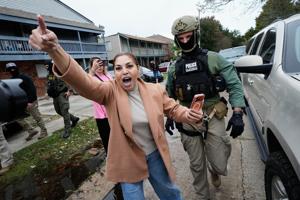
State and federal authorities are intensifying their monitoring of online discussions and protests related to the recent immigration enforcement operation in New Orleans, known as “Catahoula Crunch.” Law enforcement records reviewed by The Associated Press reveal that officials are tracking message boards and social media platforms to assess public sentiment and potential threats to agents involved in the crackdown. This operation has sparked significant controversy and calls for increased transparency from local leaders.
Concerns Over Transparency and Impact
The operation, which commenced last week, has seen numerous arrests, yet details regarding these detentions remain scarce. Local officials have expressed frustration over the lack of communication from federal authorities about the nature of the arrests. “There’s literally no information being given to the city of New Orleans whatsoever,” said J.P. Morrell, New Orleans City Council President. He questioned the stated aim of targeting violent offenders, pointing out that the statistics do not align with this goal.
According to the intelligence reports, less than one-third of the 38 individuals arrested during the initial two days of the operation had criminal records beyond minor traffic violations. The Department of Homeland Security (DHS) has characterized the arrests as focused on “criminal illegal aliens,” yet many local leaders argue that the operation appears to disproportionately target immigrants based on their appearance.
State Senator Royce Duplessis criticized the operation as creating fear within communities. He stated, “It confirms what we already knew — this was not about public safety, it’s about stoking chaos and fear and terrorizing communities.”
Federal Response and Surveillance Tactics
Despite the criticisms, the DHS maintains that the operation is necessary to ensure public safety. A spokesperson, Tricia McLaughlin, emphasized that “Americans should be able to live without fear of violent criminal illegal aliens harming them, their families or their neighbors.” However, the agency has only confirmed six arrests related to the operation, all involving individuals with documented criminal histories.
Additionally, law enforcement has been actively monitoring social media discussions to assess public reaction to the immigration enforcement actions. The Louisiana State Police confirmed their operational support for immigration authorities and warned that individuals interfering with enforcement could face legal repercussions.
Briefings shared among law enforcement indicate that discussions on platforms such as Reddit are being closely followed, with some users accusing agents of racially profiling Hispanic communities. The records also highlight the emotional impact of these operations, as videos of arrests have circulated online, leading to backlash from community members.
Organizations such as Union Migrante and Indivisible NOLA have mobilized to support affected families and challenge the crackdown. Rachel Taber, an organizer with Union Migrante, stated, “We are not doing anything illegal,” emphasizing the group’s commitment to peaceful advocacy.
As the operation continues, which is expected to extend over a two-month period with a goal of at least 5,000 arrests in the region, tensions between law enforcement and local communities remain high. Local officials are demanding clarity and accountability from federal agencies in their approach to immigration enforcement.
The unfolding situation in New Orleans highlights the complex intersection of law enforcement, community trust, and immigration policy, raising critical questions about accountability and the impact of such operations on local populations.