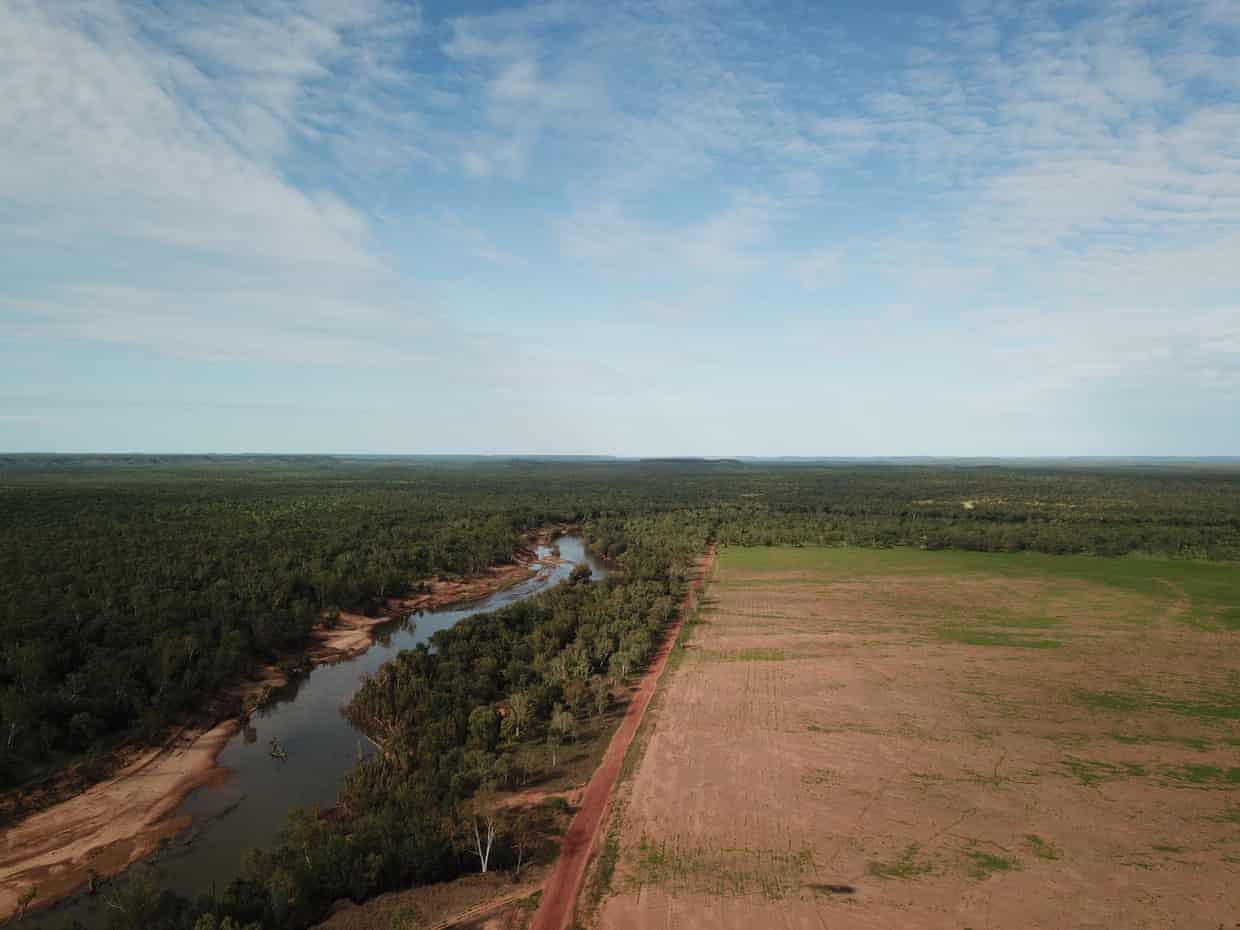
The Australian federal government has approved the clearing of nearly 2,723 hectares of tropical savanna in the Northern Territory, a decision that has drawn sharp criticism from environmentalists and scientists. The approval, granted by Environment Minister Murray Watt, allows the Top End Pastoral Company to bulldoze land on Claravale farm and station in the Daly River region for agricultural development, including crops such as sorghum and cotton. This area is significant, as it is home to vulnerable species, most notably the ghost bat, which is Australia’s largest predatory bat.
The project has raised alarms among environmental groups due to the lack of a rigorous environmental assessment under Australia’s national environmental laws. The decision, published by the federal environment department, claimed that the development is not a “controlled action,” meaning it can proceed without a thorough evaluation of its potential impact on threatened species and ecosystems. This has reignited concerns among conservationists that land-clearing activities on pastoral lands are seldom scrutinized under the Environment Protection and Biodiversity Conservation (EPBC) Act.
In response to the announcement, the Environment Centre of the NT (ECNT) expressed deep dismay. Executive Director Kirsty Howey stated, “We’re absolutely gobsmacked by this decision, which makes a mockery of Labor’s promise to fix our broken nature laws.” She emphasized that the approval effectively “green lights the destruction of likely habitat for 13 threatened species, including Gouldian finches, freshwater sawfish, pig-nosed turtles, red goshawks, and ghost bats.” Howey questioned the rationale behind the decision, asking, “If plans of this scale don’t trigger federal assessment, what does?”
The Top End Pastoral Company has outlined a three-stage development plan for its properties covering over 7,000 hectares. The recent federal approval pertains to the second stage, initially proposed to cover around 4,585 hectares. However, following government review, the clearing area was revised to 2,723 hectares to avoid impacting key wildlife corridors and habitats. The company is also conducting clearing under a separate permit from the Northern Territory government for the first stage, which spans approximately 1,200 hectares.
The federal environment department defended the minister’s decision, citing a careful examination of the combined impacts of the proposed clearing stages. A departmental spokesperson noted that considerations included the design of the proposed areas, the extent of clearing within the overall development plan, and the availability of intact habitat in the broader project area. They highlighted that the developer had made efforts to avoid and mitigate impacts on critical habitats.
Notably, Claravale Station contains caves that are known roosting sites for a large colony of ghost bats, with the area being one of only six known maternity roosts for this species in the Northern Territory. While the known roosting habitat lies outside the approved development zone, concerns remain regarding the proximity of the clearing, which could come within two kilometres of these crucial sites. Howey pointed out that approximately 18% of the ghost bat population in the Northern Territory relies on these roosting sites.
Research on the ghost bat’s foraging habits is ongoing, but the species is known to travel significant distances in search of food. Professor Euan Ritchie, a tropical savanna expert from Deakin University, warned about the irreversible consequences of large-scale land-clearing. He remarked, “Once Australia’s tropical savannas are cleared by bulldozers and chains at industrial scale, they will not return in our lifetime.”
The federal department emphasized that not all referrals under the EPBC Act are expected to result in significant impacts that require further assessment. They noted that the refinement of the project design by the developer has led to reduced potential impacts on key areas of habitat.
As this situation unfolds, environmentalists are considering legal avenues to challenge the application of national nature laws in the Northern Territory. The implications of this decision are significant, not only for the local ecosystems but also for the broader conversation about environmental protections in Australia.