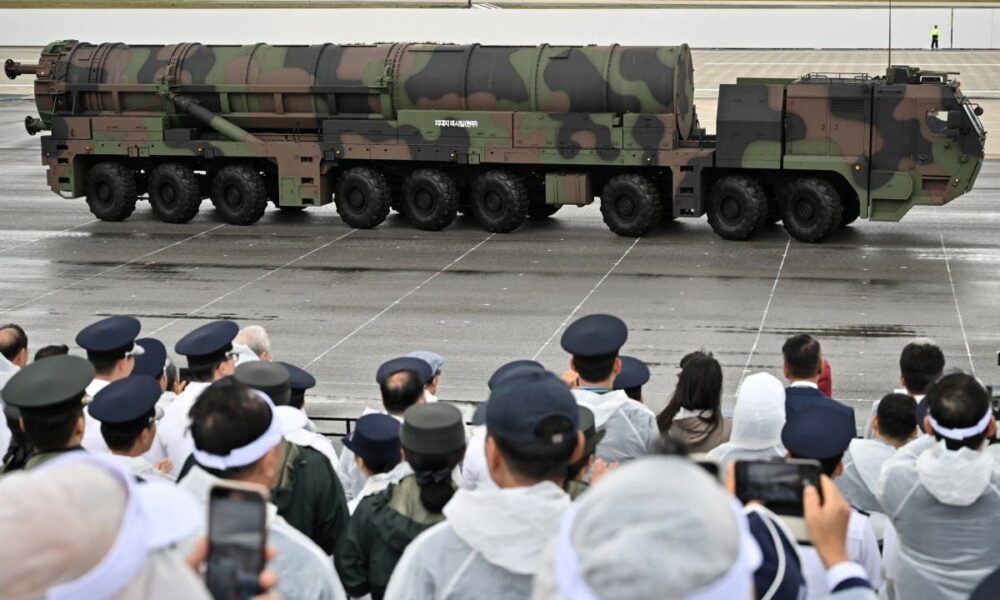
A South Korean defense official has announced plans to deploy a new ballistic missile, known as the Hyunmoo-5, to establish a “balance of terror” in response to threats from North Korea. This missile, referred to as a “monster” due to its substantial size, was publicly showcased during South Korea’s Armed Forces Day in October 2023. Designed to carry an 8-ton conventional warhead, the Hyunmoo-5 aims to target and destroy underground facilities in North Korea that may house nuclear weapons and missiles.
The timing of this announcement is significant. It follows North Korea’s recent unveiling of the Hwasong-20 intercontinental ballistic missile (ICBM), which the regime claims is its most powerful strategic weapon. This missile is believed to have the capability to deliver nuclear strikes on the continental United States. South Korea’s military strategy, underpinned by the U.S. extended nuclear deterrence, has evolved into what is known as the three-axis system. This system is designed to defend against nuclear and missile threats while enabling preemptive and retaliatory actions against North Korea’s military leadership and installations.
Ahn Gyu-back, South Korea’s Defense Minister, confirmed during an interview with the Yonhap News Agency that the Hyunmoo-5 missile is entering mass production, with aims to significantly boost output by the end of 2024. Stressing the necessity for a substantial arsenal of these missiles, Ahn stated, “As South Korea is a member of the Nuclear Non-Proliferation Treaty that cannot own nuclear arms, I firmly believe we should possess a considerable amount of Hyunmoo-5 monster missiles to achieve a balance of terror.”
The Nuclear Non-Proliferation Treaty, signed in 1968, aimed to prevent the spread of nuclear weapons and recognized five nuclear-armed states: the United States, the then-Soviet Union, the United Kingdom, France, and China. North Korea withdrew from the treaty in 2003, and since then, its nuclear arsenal has grown, with estimates suggesting it possesses around 50 nuclear warheads.
The Hyunmoo-5 missile’s specifications are noteworthy. According to Naval News, the missile has a range of between 186 and 3,106 miles, contingent on the warhead’s weight. Prior to 2021, U.S. restrictions limited South Korea’s ballistic missile development concerning range and warhead capacity. Following the lifting of these restrictions, South Korea is now authorized to develop and possess any type of ballistic missile.
Under the three-axis system, the Hyunmoo-5 missile is positioned as a critical component of South Korea’s strategy to preemptively strike North Korea. It also serves as a tool for potential retaliation against the North’s leadership. The remaining components of the system focus on air and missile defense capabilities.
Regarding North Korea’s ongoing missile development, Ahn noted that recent activities near a launch site indicate the possibility of a Hwasong-20 ICBM launch by the end of the year. North Korea last tested a similar missile in October 2023. Although North Korean ICBMs are believed to be capable of targeting the U.S. mainland, Ahn highlighted that Pyongyang currently lacks essential technologies for successful re-entry into the Earth’s atmosphere or for deploying multiple nuclear warheads.
Joseph Dempsey, a research associate for defense and military analysis at the International Institute for Strategic Studies, remarked in October 2023 that the rationale behind equipping the Hyunmoo-5 with such a large warhead is to penetrate North Korea’s most fortified targets. He added that the warhead likely incorporates advanced features to enhance its effectiveness.
As the situation on the Korean Peninsula continues to evolve, the missile race is expected to intensify. The future of South Korea’s military capabilities remains uncertain, but the urgency to counter North Korea’s growing threats is clear.