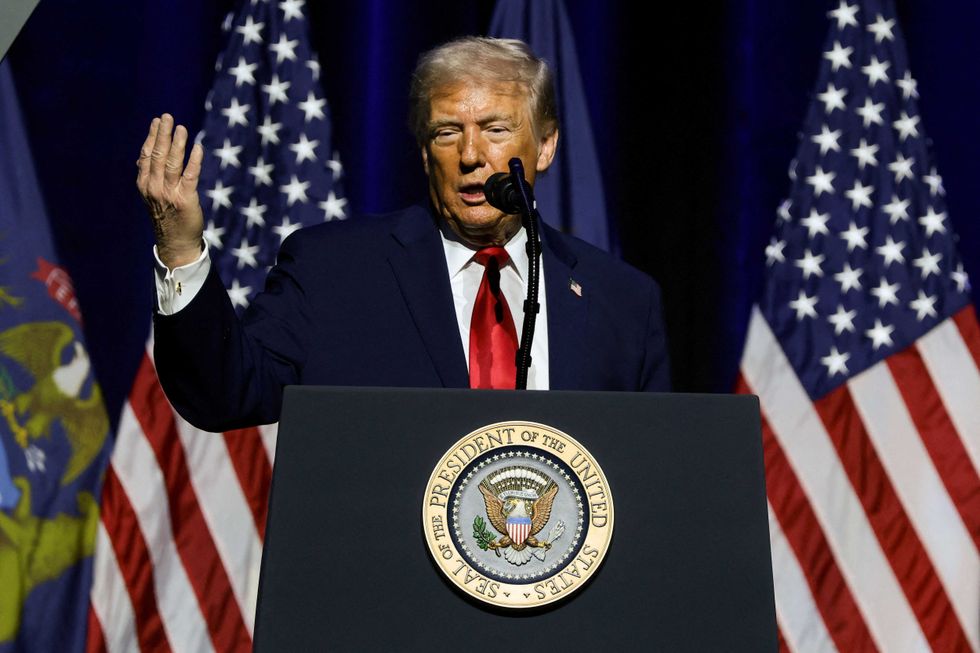
During a one-on-one interview with CBS News on March 12, 2024, in Detroit, President Donald Trump made significant comments regarding the limits of his power. While visiting the city to address the Detroit Economic Club, Trump also toured a Ford manufacturing plant and engaged with factory workers. The interview, led by anchor Tony Dokoupil, featured a moment where Trump asserted that his power would not be constrained by the courts or the Constitution.
As the conversation progressed, Dokoupil asked Trump to clarify his earlier assertion that his power was limited only by his “morality.” Trump acknowledged the Constitution but maintained, “we’ll never get to the courts, we’ll never get to the Constitution, because … I wanna see what’s good for our country.” This statement has raised eyebrows as it suggests a willingness to bypass judicial constraints in the pursuit of policy goals.
Trump’s remarks come at a pivotal time when his administration is actively involved in shaping the upcoming 2026 midterm elections. His administration has sought access to voter rolls from several states and has supported gerrymandering initiatives by Republican-controlled legislatures, actions that some analysts believe could impact the election landscape significantly.
Confrontation over Domestic Terrorism Comments
In a separate segment aired on “CBS Evening News,” Dokoupil confronted Trump about his administration’s characterization of Renee Nicole Good as a “domestic terrorist,” following her father’s emotional response to her death. This exchange highlights the ongoing tension between Trump’s policies and the sentiments of his supporters, particularly those affected by violence and crime.
The interview comes on the heels of a challenging week for Dokoupil, whose ratings reportedly suffered during his initial broadcasts as the new host of the program. His direct questioning of Trump reflects a broader effort to hold the president accountable for controversial decisions and statements.
Criticism of Federal Prosecutors
In related developments, Trump recently criticized federal prosecutors during a photoshoot at the White House with Pam Bondi, the Attorney General. According to a report from The Wall Street Journal, Trump labeled the prosecutors as “weak” for not pursuing his political adversaries more aggressively. This criticism comes amid ongoing legal battles and investigations that have drawn scrutiny from various quarters.
Additionally, a report by Slate columnist Laura Jedeed has raised alarms about recruitment practices within the Immigration and Customs Enforcement (ICE) agency. Jedeed detailed her experience of being offered a job as a deportation officer despite her vocal opposition to ICE policies. She argued that this incident underscores troubling recruitment protocols that prioritize rapid hiring over thorough vetting.
The implications of Trump’s comments and the surrounding controversies reflect a landscape where political rhetoric, legal scrutiny, and agency practices intersect, shaping the narrative leading up to the midterm elections. As the political climate evolves, the impact on both public sentiment and policy implementation remains to be seen.