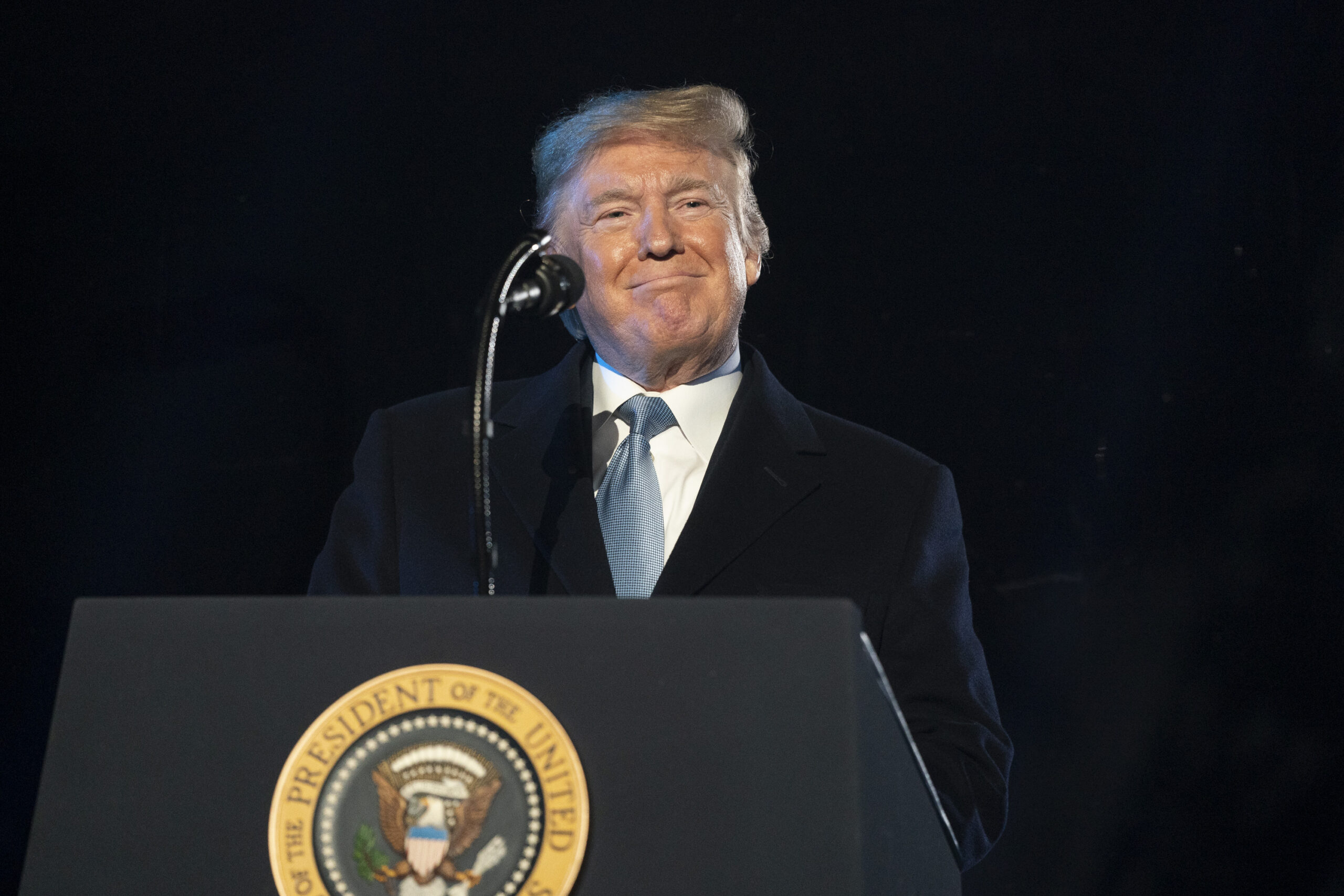
A significant military operation led by President Donald Trump unfolded in Venezuela early on Saturday, resulting in the capture of President Nicolás Maduro and his wife, Cilia Flores. Before dawn, Black Hawk helicopters descended on Caracas, targeting military installations with explosions that reverberated throughout the capital. By breakfast, Trump announced the success of the operation, describing it as a “brilliant” strike against the Venezuelan leadership, which he claims is responsible for a multitude of issues affecting the United States.
In a statement shared via his social media platform, Truth Social, Trump proclaimed, “The United States of America has successfully carried out a large-scale strike against Venezuela and its leader.” Details about the operation were to be disclosed later at a press conference scheduled for 11 a.m. at Mar-a-Lago. The announcement came just as Venezuelan authorities were still grappling with the aftermath of the attacks, which included significant explosions at the Fuerte Tiuna military complex, the largest of its kind in Venezuela.
The operation did not occur in a vacuum. For months, Trump had escalated his rhetoric against Maduro, deploying 15,000 troops to the Caribbean and conducting numerous military exercises near Venezuelan borders. Reports indicate that over the past few months, the U.S. military has conducted more than two dozen strikes against boats allegedly involved in drug trafficking, resulting in significant casualties. In a provocative move, American forces also seized an oil tanker carrying sanctioned Venezuelan-Iranian crude in late December, a tactic that Caracas labeled as “international piracy.”
On the eve of the military strike, Maduro extended an olive branch, offering to discuss drug trafficking and oil access, but Trump chose military action instead. The raid was executed by elite operators from Delta Force, a unit renowned for high-stakes missions, including the operation that killed ISIS leader Abu Bakr al-Baghdadi in 2019. The situation escalated quickly, with Venezuelan Defence Minister Vladimir Padrino López appearing on state television to denounce the invasion as “the greatest outrage the country has suffered.”
Venezuela immediately declared a state of emergency in response to the attacks. Padrino López’s statements were filled with emotion as he condemned the military operation. Meanwhile, Vice President Delcy Rodríguez demanded “proof of life” for Maduro, raising concerns about the government’s stability in the face of such unprecedented events. American officials reported no U.S. casualties, but they refrained from commenting on the potential civilian casualties in Venezuela.
International reactions to the military operation were starkly divided. In Argentina, President Javier Milei, an ally of Trump, celebrated the strikes, declaring, “FREEDOM ADVANCES! LONG LIVE FREEDOM, DAMN IT!” Contrastingly, Russia condemned the actions, branding them as “armed aggression” and criticizing the ideological motivations behind the strikes. Other Latin American countries either remained silent or condemned the military intervention, highlighting a shift in regional dynamics that reflects a departure from U.S. dominance since the Cold War.
Trump’s strategic motivations appear to hinge on three main factors: drug trafficking, migration, and oil resources. The U.S. administration has long blamed Maduro for the influx of narcotics into American communities, particularly from criminal organizations like the Tren de Aragua gang. Additionally, the ongoing migration crisis, with hundreds of thousands of Venezuelans fleeing to the north, has further strained U.S. border resources. Finally, Venezuela’s vast oil reserves, the largest in the world, have consistently attracted interest from Washington.
A complex backdrop accompanies this military action. Reports from opposition sources suggest that Maduro’s capture could have involved preliminary negotiations, hinting at a potential “negotiated exit” rather than a straightforward abduction. Neither Washington nor Caracas has confirmed any discussions prior to the operation. Trump’s administration has not clarified whether congressional approval was sought for this military endeavor, leaving political analysts questioning the operation’s endgame and the implications for regional stability.
As the dust settles in Caracas, the political landscape remains uncertain. The U.S. military operation succeeded in its immediate objectives, but the long-term consequences for Venezuela and its people are yet to be fully realized. The situation presents a dangerous vacuum, with stability in the region hanging by a thread, prompting global leaders to assess their responses in the wake of an event that has dramatically altered the geopolitical landscape in Latin America.