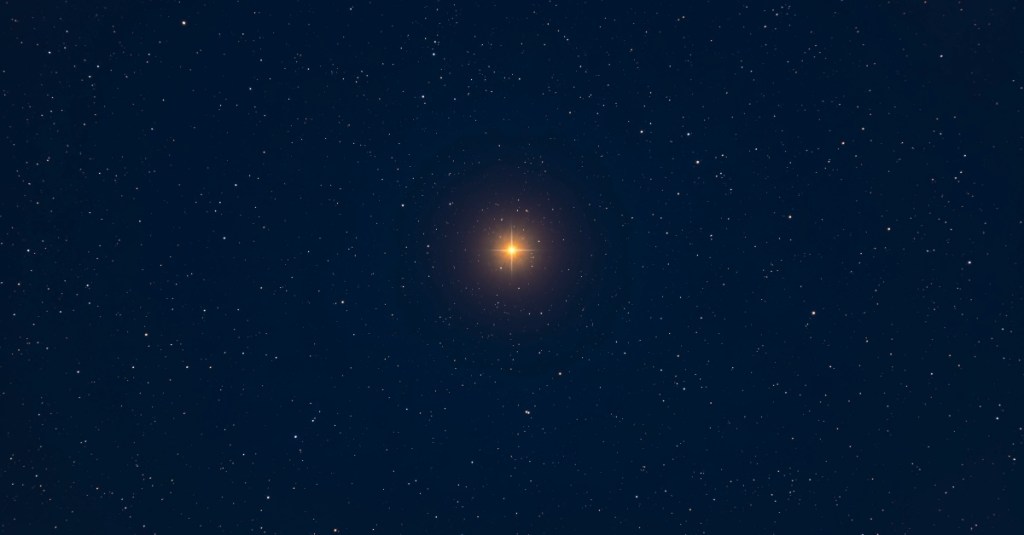
Recent astronomical research has unveiled a significant discovery regarding the red supergiant star Betelgeuse. For years, scientists have observed its brightness fluctuating, with known cycles and an unexplained long-term pattern. According to research conducted over nearly eight years, Betelgeuse has a hidden companion star, officially named Siwarha, which influences its behavior.
Betelgeuse, located approximately 640 light-years from Earth, is known for its pulsating nature, with a cycle that occurs roughly every 400 days. This fluctuation is a common characteristic of aging stars as they undergo internal changes. However, astronomers were puzzled by a second, longer cycle, occurring approximately every 2,100 days, which could not be accounted for by existing theories of stellar behavior.
The breakthrough came through observations made using the Hubble Space Telescope and ground-based observatories located in Arizona and the Canary Islands. Researchers noticed a dense trail of gas moving through Betelgeuse’s atmosphere, which they attributed to the gravitational influence of Siwarha. This “wake” is akin to a ship moving through water, creating ripples that can be detected in the star’s outer layers.
As Siwarha orbits Betelgeuse, it subtly alters the star’s ultraviolet emissions, particularly those associated with ionized iron. When Siwarha transits in front of Betelgeuse, there is a noticeable increase in brightness, followed by a decrease as the gas trail absorbs radiation. This pattern confirms the long-term cycle that had previously remained a mystery.
Lead author of the study, Andrea K. Dupree, emphasized the significance of this finding in a recent NASA release. She stated, “The companion star creates a ripple effect in Betelgeuse’s atmosphere that we can actually see in the data. For the first time, we’re seeing direct signs of this wake, or trail of gas, confirming that Betelgeuse really does have a hidden companion shaping its appearance and behavior.”
Siwarha has now moved behind Betelgeuse and will not reappear until August 2027. In the meantime, astronomers will continue to monitor the star, utilizing the knowledge gained from this discovery to further understand the complexities of stellar dynamics.
This revelation not only sheds light on the behavior of Betelgeuse but also enhances our understanding of the interactions between stars and their companions. As observations continue, the lingering questions about the universe’s mysteries only deepen, inviting further exploration and inquiry.