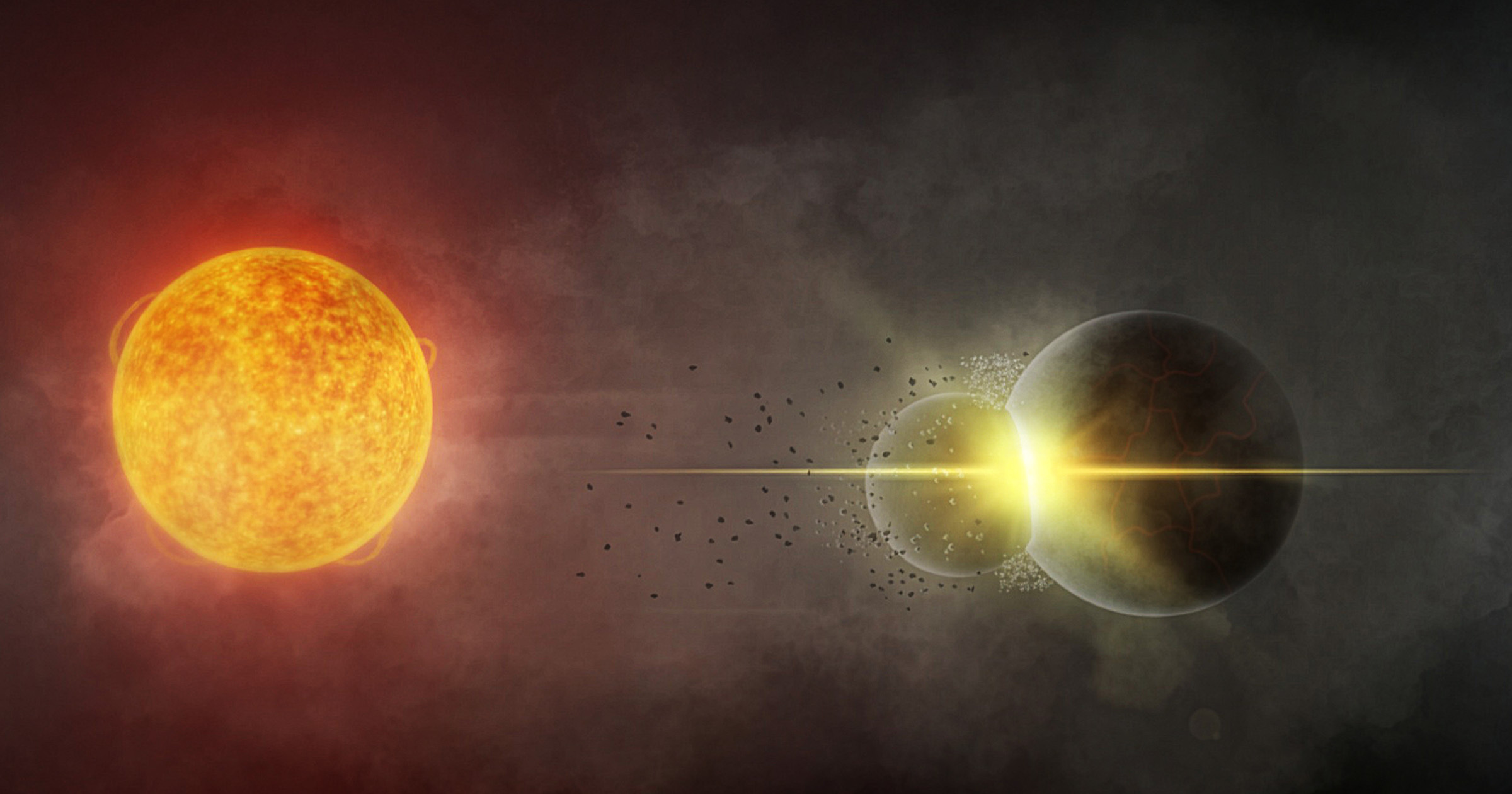
Astronomers have discovered compelling evidence of a catastrophic collision between two distant planets, a finding that could deepen our understanding of planetary formation, including the origins of the Earth and its Moon. The study, published in the journal The Astrophysical Journal Letters, reveals that a star known as Gaia20ehk experienced significant fluctuations in brightness, indicating an extraordinary cosmic event.
Initially, Gaia20ehk appeared to be an ordinary star, exhibiting a steady light output similar to that of our Sun. However, beginning in 2016, astronomers noted three significant dips in brightness. By 2021, the star’s flickering intensified dramatically, prompting a closer investigation. “The star’s light output was nice and flat, but starting in 2016 it had these three dips in brightness. And then, right around 2021, it went completely bonkers,” said Anastasios Tzanidakis, the study’s lead author and an astronomer at the University of Washington.
The fluctuations in brightness were ultimately traced back to vast clouds of rock and dust obscuring the star. These debris clouds were so substantial that they could partially block the starlight. The astronomers concluded that the most plausible explanation for this phenomenon was the aftermath of a planetary collision. Infrared observations supported this theory, revealing that while visible light from the star diminished, infrared light surged, indicating that the material blocking the star was exceptionally hot.
The extraordinary heat generated by such a collision would likely result from two massive bodies spiraling closer together, leading to a series of grazing impacts before culminating in a catastrophic collision. “At first, they had a series of grazing impacts, which wouldn’t produce a lot of infrared energy. Then, they had their big catastrophic collision, and the infrared really ramped up,” Tzanidakis explained.
This discovery is significant not only for its immediate implications but also for its potential parallels to the early history of our own solar system. Approximately 4.5 billion years ago, a hypothetical planet named Theia is believed to have collided with the Earth, leading to the formation of the Moon. The debris cloud surrounding Gaia20ehk orbits at a similar distance to that of the Earth from the Sun, suggesting the possibility of coalescing into a rocky satellite.
The implications of these findings extend to astrobiology, as the existence of a large moon is considered a key factor in making Earth a suitable environment for life. Tzanidakis noted that our Moon plays an essential role in stabilizing the Earth’s climate, producing tides, and protecting the planet from asteroids. “If collisions that lead to an outsized moon are rare, perhaps life is all the more rarer,” he remarked.
The latest observations of Gaia20ehk add to a growing body of evidence regarding planetary collisions. In a preceding study conducted in 2023, researchers documented the aftermath of a collision between two ice giants in a young star system, producing a red-hot debris cloud. The ability to observe such events in real-time is rare, making the findings surrounding Gaia20ehk particularly valuable.
As astronomers continue to study these cosmic occurrences, Tzanidakis expressed hope that further observations could help clarify the dynamics of planetary formation. “Right now, we don’t know how common these dynamics are. But if we catch more of these collisions, we’ll start to figure it out,” he stated.
The ongoing exploration of planetary collisions not only enhances our understanding of the universe but also sheds light on the processes that may have shaped our own celestial neighborhood. As scientists gather more data, the knowledge gained could have far-reaching implications for our understanding of life in the cosmos.