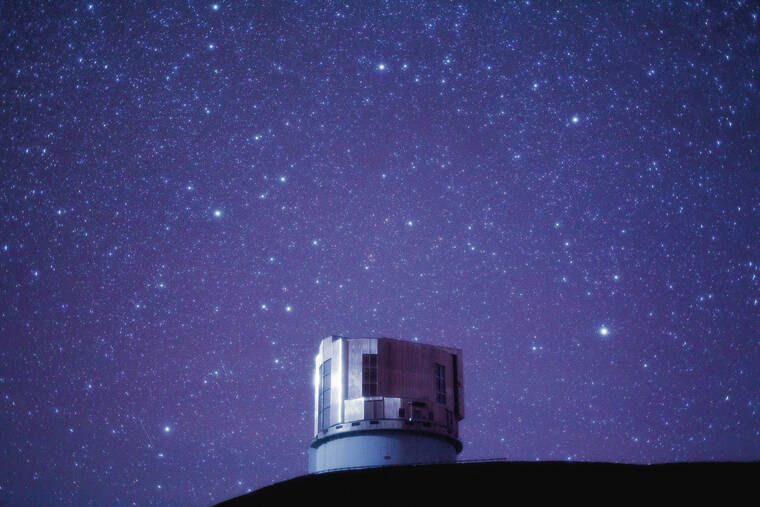
Astronomers utilizing the Subaru Telescope and the W.M. Keck Observatory on Mauna Kea have made significant discoveries, identifying a massive planet and a brown dwarf that orbit distant stars. These findings enhance our understanding of the formation and evolution of giant planets and substellar objects, marking an important milestone in astronomical research.
The discoveries are the first results from the Observing Accelerators with SCExAO Imaging Survey (OASIS) program, a large-scale initiative that merges precise stellar motion data from space missions with advanced imaging technologies available at Mauna Kea’s observatories. According to Thayne Currie, a professor at the University of Texas at San Antonio and the principal investigator of OASIS, “These discoveries may help advance our abilities to image another Earth with future space-based observatories such as NASA’s Roman Space Telescope.”
Details of the Discoveries
The first discovery, labeled HIP 71618 B, is a brown dwarf weighing approximately 60 times that of Jupiter. Located 169 light-years away in the Bootes constellation, this object is often described as a “failed star,” as it forms similarly to stars but does not accumulate enough mass to initiate nuclear fusion. Brown dwarfs are generally cooler and emit less light in visible wavelengths compared to infrared light, which can be detected using the capabilities of the Keck Observatory and the Subaru Telescope.
Data collected by the Keck/NIRC2 and Subaru/SCExAO over a span of days allowed astronomers to confirm the presence of this companion. Follow-up observations conducted within the year helped to delineate the object’s orbital path.
The second significant finding, HIP 54515 b, is an 18-Jupiter-mass planet orbiting a star 271 light-years away in the Leo constellation. Positioned at a distance from its host star akin to Neptune’s orbit around the Sun, this planet appears exceptionally close to its star from Earth’s viewpoint—resembling a football viewed from over 200 miles away. The Subaru Telescope’s SCExAO system provided the sharp imagery necessary to identify this faint giant planet alongside its bright star.
Upcoming Celestial Events and Observing Opportunities
Throughout January, the star family Kekaomakali‘i, known as the “Bailer of Makali‘i,” graces the night sky. This starline, essential for traditional Hawaiian navigation, consists of prominent stars such as Hokulei (Capella) and A‘a (Sirius). The visibility of these stars serves as a celestial guide for voyagers across the Pacific.
In addition to these stellar features, the bright constellation ‘Iwakeli‘i (Cassiopeia) can be seen, showcasing its iconic “W” shape in the winter sky. Observers may also spot Makulu (Saturn) and the brilliant cluster of stars in Makali‘i (Pleiades), which symbolizes the ongoing makahiki season in Hawaiian culture—a period dedicated to rest, reflection, and renewal.
For early risers, Jupiter (known as Ka‘awela) will remain visible in the pre-dawn western sky throughout January, serving as a brilliant guide before sunrise.
For further insights about the OASIS program and the discoveries made, visit the following resources: keckobservatory.org/accelerating-stars/ and subarutelescope.org/en/results/2025/12/03/3626.html. The ‘Imiloa Astronomy Center of Hawaii at the University of Hawaii at Hilo serves as a hub for informal science education, illuminating the intersection of astronomy and Hawaiian culture as pathways of exploration.