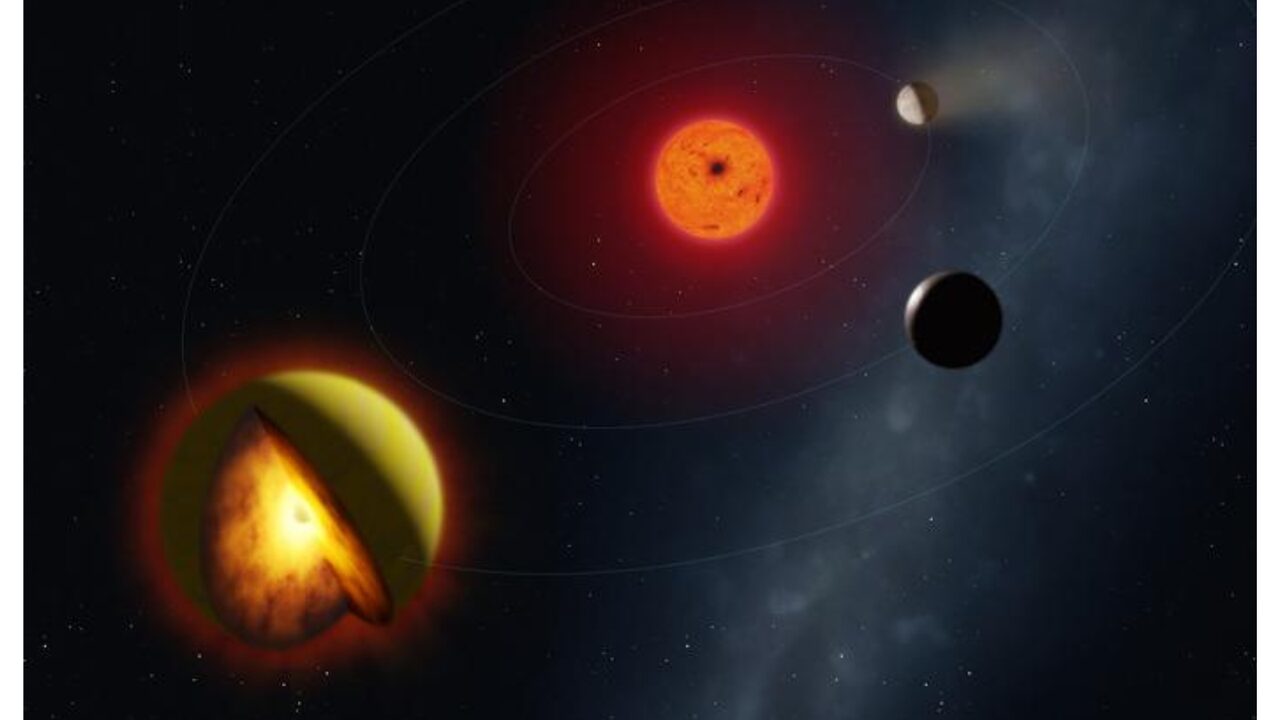
Astronomers utilizing the James Webb Space Telescope have identified a novel type of exoplanet, designated L 98-59 d, which likely emits an odor reminiscent of rotten eggs. Located approximately 35 light-years from Earth, this molten lava world challenges existing classifications and expands the understanding of planetary diversity beyond our solar system.
The team, led by Harrison Nicholls from the University of Oxford, found that L 98-59 d stands out due to its extremely low density and a composition rich in hydrogen sulfide, a compound known for its distinctive stench. Unlike typical rocky gas dwarfs or water-rich “hycean” worlds, this exoplanet necessitates a new classification due to its unique atmospheric conditions.
Unraveling the Mysteries of L 98-59 d
Using advanced computer simulations, Nicholls and his colleagues reconstructed nearly 5 billion years of L 98-59 d’s history. By aligning these models with data from both the JWST and ground-based telescopes, they painted a picture of a planet with a molten silicate mantle and a global ocean of magma. This extensive magma ocean plays a crucial role in trapping large amounts of sulfur over extended periods, contributing to the planet’s sulfur-rich atmosphere.
Significantly, the JWST detected sulfur dioxide and other sulfur-based molecules in the upper atmosphere of L 98-59 d. The presence of a magma reservoir likely helped the planet retain its hydrogen and sulfur-rich atmosphere, shielding it from atmospheric loss due to X-ray bombardment from its parent star.
Over billions of years, exchanges between the atmosphere and the planet’s interior have shaped L 98-59 d into a unique world characterized by its gas-rich, sulfurous environment. The research suggests that L 98-59 d may have initially formed with considerable volatile material and could have been a much larger sub-Neptune planet before it cooled and shrank.
New Insights into Planetary Classification
The implications of this discovery are profound. “This discovery suggests that the categories astronomers currently use to describe small planets may be too simple,” Nicholls stated. He emphasized that while L 98-59 d is unlikely to support life, it reveals the vast diversity of worlds existing beyond our solar system.
Team member Raymond Pierrehumbert echoed this sentiment, noting that computer models allow astronomers to explore the hidden interiors of distant planets that remain unreachable. “Although astronomers can only measure a planet’s size, mass, and atmospheric composition from afar, this research shows that it is possible to reconstruct the deep past of these alien worlds,” he explained.
The findings were published on March 16, 2024, in the journal Nature Astronomy. This research not only expands the catalog of known exoplanets but also raises questions about what other planetary types may await discovery, potentially reshaping the understanding of planetary formation and evolution in the universe.