A team of researchers from Canada has utilized the James Webb Space Telescope (JWST) to examine low-mass galaxies dating back 13.5 billion years. This ambitious project, known as the Canadian NIRISS Unbiased Cluster Survey (CANUCS), employs massive galaxy clusters as gravitational lenses to enhance the telescope’s observational capabilities. The findings present a significant leap in understanding galaxy formation and evolution.
The CANUCS initiative leverages the JWST’s three advanced near-infrared instruments—NIRSpec, NIRCam, and NIRISS—to capture high-quality images and spectra from thousands of galaxies. This extensive data set includes vital information such as distances, luminosities, star formation histories, metallicities, dust properties, sizes, and morphologies of the observed galaxies.
The first data release from CANUCS appeared in a paper titled “CANUCS/Technicolor Data Release 1: Imaging, Photometry, Slit Spectroscopy, and Stellar Population Parameters,” published in the Astrophysical Journal Supplement Series. Ghassan Sarrouh, a PhD candidate at York University in Toronto, Canada, served as the lead author. The authors emphasize the importance of unbiased, wide-field surveys for capturing statistical snapshots of galaxy populations across different cosmological epochs, stating, “Extragalactic deep fields offer the furthest glimpse into the past that astronomical observations can achieve.”
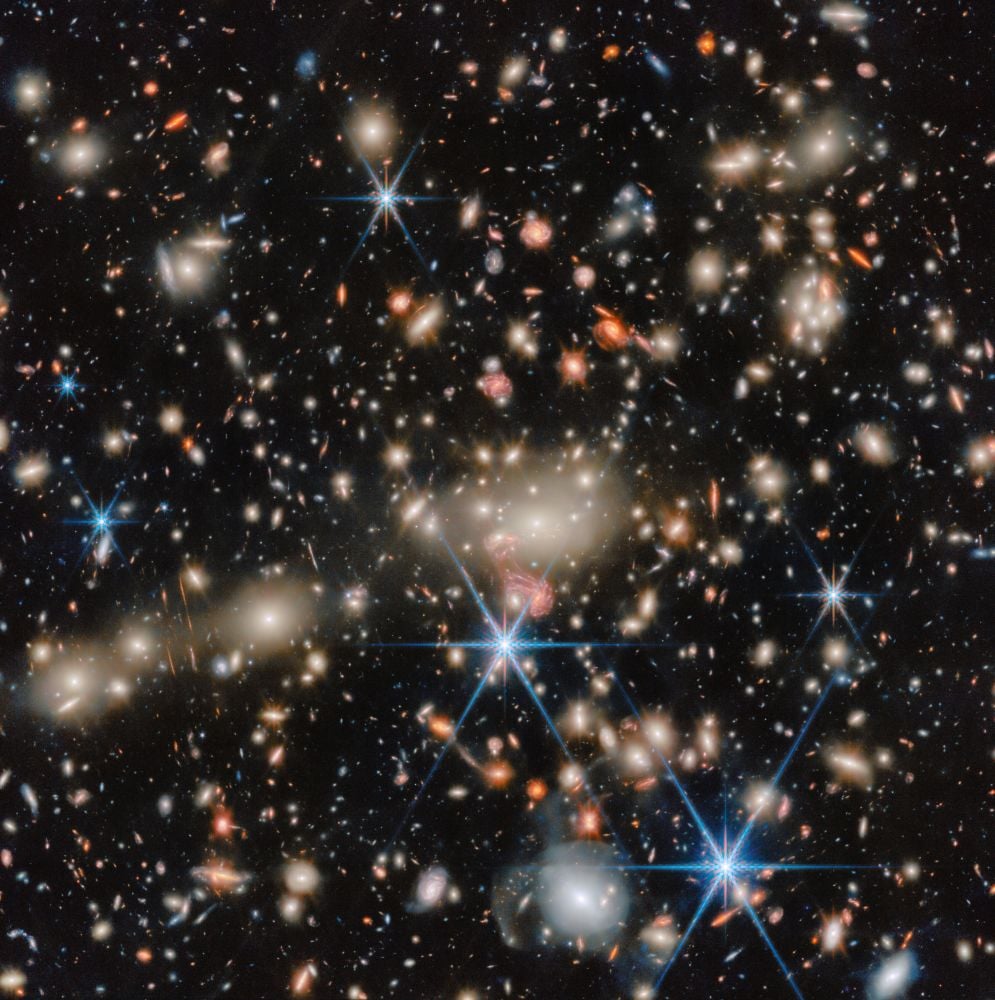
The JWST, designed for deep-space exploration, has produced remarkable images of five galaxy clusters acting as gravitational lenses. One of the featured clusters, MACS J1149, is located approximately 5 billion light-years away and contains at least 300 galaxies, with many more likely present. This cluster gained attention in 2018 for hosting Icarus, the most distant individual star detected at over 9 billion light-years. More recently, Earendel was identified as the most distant star yet, at an astounding 28 billion light-years.
Showcasing Gravitational Lensing
MACS J1149 has been recognized for its powerful gravitational lensing effects, which were previously studied by the Hubble Space Telescope during its Frontier Fields Program. Now, it has been selected as the NASA/ESA/CSA JWST Picture of the Month. The stunning imagery not only showcases the cluster but also illustrates the utility of gravitational lensing.
In the captured image, the cluster appears at the center, surrounded by bright white galaxies. The gravitational influence of the cluster distorts and magnifies the light from more distant galaxies, creating arcs and unique shapes. A reddish spiral galaxy positioned just beneath the cluster reveals the dramatic effects of this gravitational interaction, with its spiral arms warped and misshapen.
The image serves as a testament to the capabilities of the JWST and the significance of gravitational lensing in astronomical research. As the authors of the CANUCS paper note, “Lensing clusters present a unique opportunity to detect novel phenomena that would otherwise be out of reach.”
Despite challenges such as contamination from intra-cluster light (ICL), gravitational lensing remains a powerful tool in astronomy. It allows scientists to observe galaxies that would otherwise be invisible due to the accelerating expansion of the universe. The precise alignment of the foreground cluster, background galaxies, and observers is crucial for this phenomenon to occur.
Future Implications for Cosmological Research
The discoveries made through the CANUCS project have far-reaching implications for our understanding of the universe. By analyzing the properties of these distant galaxies, researchers can gain insights into the formation and evolution of galaxies over cosmic time. As more data is collected, the potential to explore previously unobservable regions of space continues to grow.
As the JWST continues its mission, the light from distant galaxies will not only illuminate our understanding of the universe’s past but also pave the way for future explorations. The ambitious goals of projects like CANUCS underscore the importance of collaboration among researchers and the capabilities of advanced telescopes in expanding our knowledge of the cosmos.