
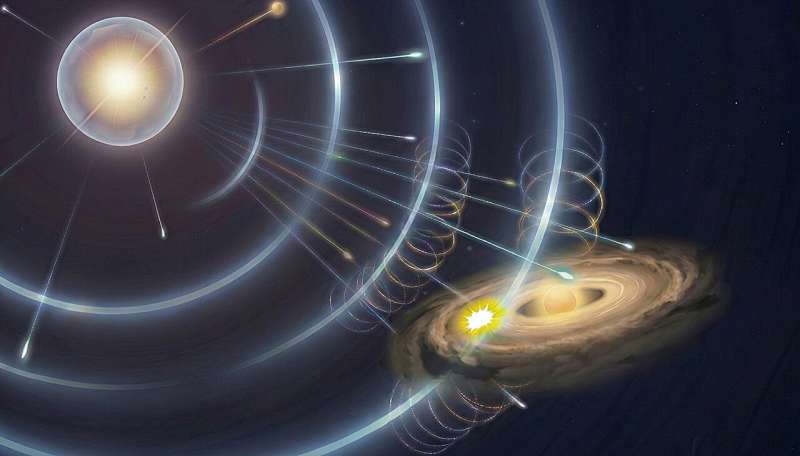
A groundbreaking study led by astrophysicist Ryo Sawada at the Institute for Cosmic Ray Research, University of Tokyo, proposes that cosmic rays from nearby supernovae may play a crucial role in the formation of Earth-like planets. Published in Science Advances on December 21, 2025, the research challenges long-standing theories about how short-lived radioactive elements, such as aluminum-26, enrich the early solar system.
For decades, scientists have posited that the formation of rocky planets like Earth was significantly influenced by material ejected from supernovae. According to traditional models, a supernova must explode at a precise distance to inject these radioactive elements into the protoplanetary disk, which surrounds a young star. This scenario suggests a highly unlikely coincidence, as the explosion must occur close enough to deliver the necessary materials without destroying the nascent planet-forming disk.
In this new study, Sawada and his colleagues re-evaluated this “injection” model, introducing an innovative perspective on the role of cosmic rays. Supernovae not only eject material but also act as powerful particle accelerators. The shock waves generated by these explosions produce vast numbers of high-energy particles—known as cosmic rays—that can extend far beyond the remnants of the explosion.
What if, the researchers wondered, the early solar system was not only enriched by supernova ejecta but also surrounded by these cosmic rays? By employing numerical simulations to model cosmic-ray acceleration and nuclear reactions, the team discovered a significant finding: when cosmic rays interact with the protosolar disk, they can initiate nuclear reactions that yield short-lived radioactive elements like aluminum-26.
The results of their study revealed that sufficient amounts of these radioactive materials could be produced at distances of approximately one parsec from a supernova, a distance commonly found in star clusters. This distance allows the protoplanetary disk to remain intact, eliminating the need for an improbable direct injection event. Instead, the young solar system could simply exist alongside a massive star that eventually goes supernova.
We refer to this newfound mechanism as a “cosmic-ray bath.” This process suggests that Earth-like conditions could arise more frequently than previously thought. Many sun-like stars form in clusters, often alongside massive stars that later explode as supernovae. If cosmic-ray baths are indeed common in such stellar environments, then the thermal histories necessary for the formation of Earth-like planets may also be widespread.
The implications of this research extend beyond just the origins of Earth. If the formation of rocky, water-depleted planets does not rely on the rare occurrence of a supernova, it opens the door to the possibility that many sun-like stars could host planets with similar conditions conducive to life.
While the study does not assert that supernovae guarantee the presence of habitable planets, it emphasizes that numerous factors influence planetary formation, including disk lifetime and stellar dynamics. The findings indicate that Earth’s formation may not hinge on an extraordinary stroke of luck.
In summary, this research underscores the interconnectedness of astrophysical phenomena. The study highlights how cosmic-ray acceleration, typically examined within high-energy astrophysics, plays a vital role in planetary science and our understanding of habitability. As Sawada noted, “sometimes, the key to understanding where we come from lies not in adding more complexity, but in noticing what we have been overlooking.”
This research not only reshapes our understanding of planetary formation but also invites further exploration into the myriad factors that contribute to the emergence of Earth-like planets in the cosmos.


