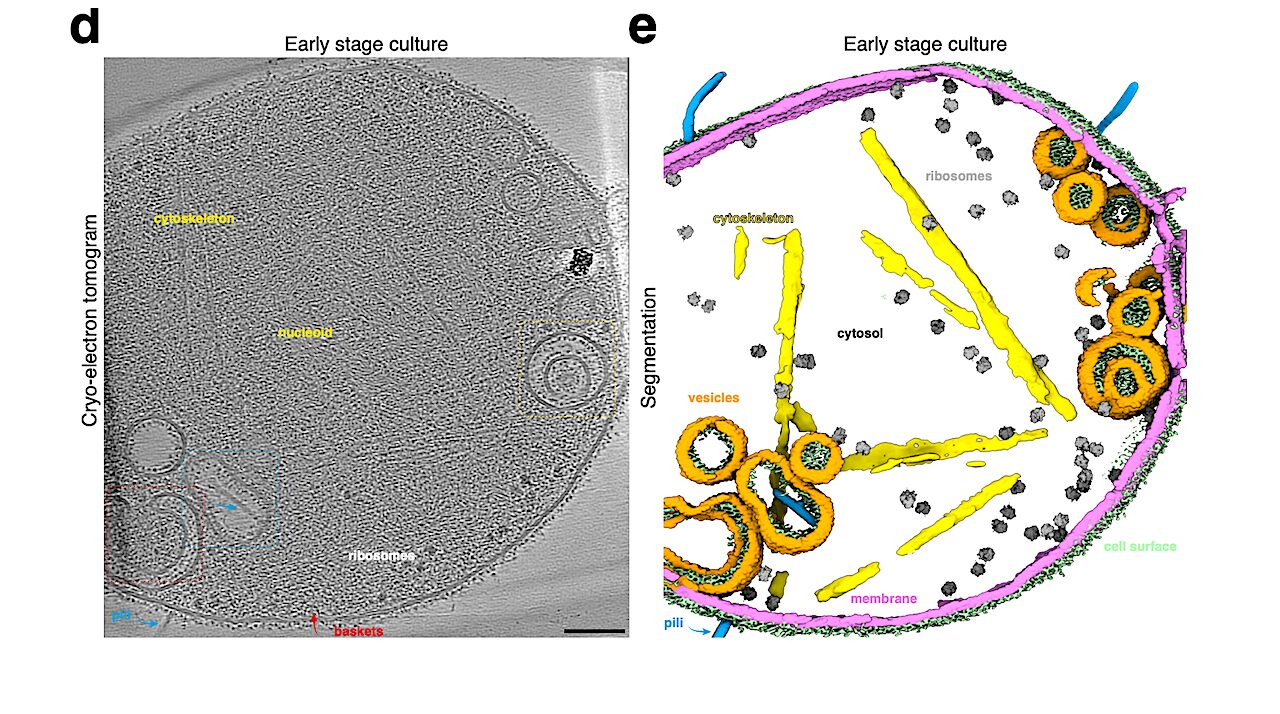
Recent research has unveiled a significant discovery in the study of cellular evolution, particularly concerning the origins of eukaryotes. A team of scientists has identified a member of the Heimdallarchaeia phylum, specifically a microorganism named Candidatus “Y. umbracryptum”, that exhibits internal membrane compartments not previously observed in close relatives of eukaryotic cells. This finding suggests new dimensions to our understanding of how complex life forms may have evolved from simpler organisms approximately two billion years ago.
Previous studies of the Asgard archaea, also known as Prometheoarchaeota, primarily focused on their structural similarities to eukaryotes, but these organisms were generally noted for lacking internal membrane-bound compartments. The absence of such structures limited insights into the development of the eukaryotic endomembrane system. The newly studied Candidatus “Y. umbracryptum”, found within enriched mixed microbial communities in Shark Bay, changes this narrative.
Key Findings on Cellular Structure
During the investigation, researchers observed that Candidatus “Y. umbracryptum” possesses a small genome encoding several homologues of eukaryotic membrane remodelling machinery. In late-stage cultures, these cells exhibited extensive cellular protrusions similar to those seen in other Asgard archaea. However, in the early stages of culture growth, the cells displayed fewer protrusions but contained numerous intracellular vesicles. Notably, the morphology of these vesicles resembled the outer coat of the plasma membrane, indicating a level of complexity previously unrecognized in archaeal relatives.
These findings significantly shift the prevailing view on eukaryogenesis by presenting a close archaeal relative of eukaryotes that possesses an endomembrane system. The variability in cellular structure based on growth stages highlights a dynamic aspect of cellular evolution that warrants further investigation.
Implications for Evolutionary Biology
The implications of this discovery extend beyond microbial biology, potentially reshaping our understanding of evolutionary processes. By identifying a member of the Heimdallarchaeia with such features, researchers can better explore the evolutionary pathways that led to the emergence of eukaryotic cells. As scientists continue to study the evolutionary history of life on Earth, the role of archaea in this narrative becomes increasingly critical.
This research was reported on biorxiv.org, providing a platform for ongoing discussions in the field. As scientists delve deeper into the complexities of microbial life, the findings on Candidatus “Y. umbracryptum” underscore the intricate connections within the tree of life, revealing that the transition from simple to complex organisms may be richer and more varied than previously understood.
The discovery not only enhances our comprehension of cellular evolution but also opens new avenues for research into the origins of life itself. As we gather more data from locations such as Shark Bay, the potential to uncover further evolutionary insights remains vast.