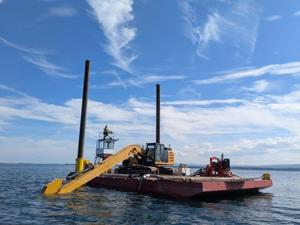
In a significant effort to enhance the habitat for lake trout, a new technique involving high-velocity jetting has been employed in Lake Erie. The project, which took place at Brocton Shoal in Chautauqua County, was executed by Seaway Marine Group in collaboration with the New York State Department of Environmental Conservation.
Innovative Approach to Habitat Restoration
The jetting process utilizes advanced power-washing technology to clear out accumulated debris and sediment from the lakebed. This innovative approach aims to restore the natural habitat necessary for the growth and survival of lake trout populations. Fish biologist Pascal Wilkins from the Lake Erie Fisheries Research Unit and fish technician Aleksandr Davis from Region 9 fisheries have been closely monitoring the project’s progress using underwater drones. Their assessments indicate that the initial results of the jetting have been promising.
Prior to the jetting, divers conducted assessments to examine the condition of the lakebed. The before-and-after imagery reveals a remarkable transformation, suggesting that the high-velocity jetting successfully removed substantial amounts of sediment. This cleanup is crucial for creating a healthier environment where lake trout can thrive.
Environmental Impact and Future Monitoring
Lake Erie, known for its biodiversity, has faced significant environmental challenges in recent years. Efforts like this jetting project are part of broader initiatives aimed at revitalizing aquatic ecosystems and improving fish habitats. The data collected during this project will be critical for ongoing monitoring and evaluation of trout populations in the region.
As the project progresses, officials remain optimistic about the potential benefits for Lake Erie’s ecosystem. The collaboration between state agencies and private contractors reflects a growing commitment to utilizing technology for environmental conservation. Future assessments will determine the long-term impacts of the jetting process on lake trout habitats and overall lake health.
For further information about environmental initiatives in Lake Erie, interested parties can reach out to climate and environment reporter Mackenzie Shuman at [email protected] or 716-715-4722.