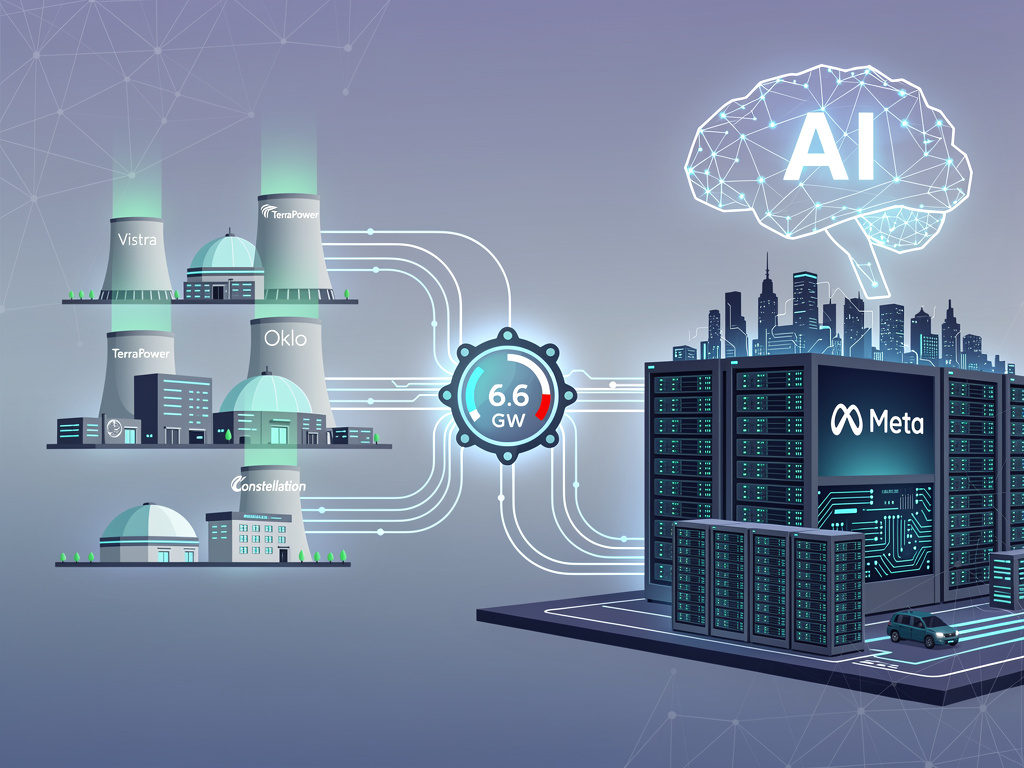
Meta Platforms Inc. has announced a groundbreaking energy procurement strategy that aims to secure up to 6.6 gigawatts of nuclear power to support its artificial intelligence infrastructure. The agreements, revealed on January 9, 2026, involve partnerships with Vistra Corp., TerraPower LLC, Oklo Inc., and Constellation Energy Corp. This initiative positions Meta as a significant player in revitalizing U.S. nuclear capacity to meet the increasing energy demands driven by AI technologies.
The agreements include long-term power purchase contracts with three existing Vistra nuclear plants located in the heart of the United States, as well as development support for advanced small modular reactors from TerraPower and Oklo. Meta’s official blog describes these contracts as “landmark agreements” that not only promise to expand plant operations but also advance nuclear technology and generate employment opportunities in American communities.
Addressing the AI Energy Challenge
The surge in energy requirements for AI training and inference has heightened the power demands of major technology firms. Meta’s upcoming Prometheus AI supercluster is designed to push the boundaries of model scale, necessitating a stable source of reliable, carbon-free baseload power that renewable energy sources alone cannot fully provide. Recent estimates suggest that U.S. data centers could account for as much as 8% of national electricity consumption by 2030. Meta’s strategy signals a shift from its previous commitments to renewable energy, opting for nuclear energy due to its density and reliability.
According to The Wall Street Journal, the agreements have the potential to supply energy equivalent to that needed for a city of five million homes. Following the announcement, Vistra’s stock surged by as much as 16%, reflecting investor optimism regarding the revival of nuclear energy.
Details of the Agreements
Meta has entered into 20-year power purchase agreements with Vistra for outputs from nuclear plants situated in Illinois, Pennsylvania, and Texas, which will extend the operational lives of these facilities. Additionally, Constellation, the largest nuclear operator in the U.S., is involved in capacity expansion, as indicated by Meta executive Joel Kaplan in posts on X, where he noted that these agreements position Meta as “one of the most significant corporate purchasers of nuclear energy in American history.”
The partnerships with TerraPower, a venture associated with Bill Gates, and Oklo, supported by Sam Altman, focus on developing next-generation reactors. These small modular designs promise faster deployment and lower costs, with Meta committing to fund site development and licensing processes, accelerating projects slated for the late 2020s.
Joel Kaplan emphasized on X, “Our agreements with Vistra, TerraPower, Oklo, and Constellation… will help power our AI future, strengthen our country’s energy infrastructure, and provide clean energy.” This statement aligns with national energy priorities and acknowledges the support from various government officials.
The agreements also reflect a larger trend as the tech industry moves away from reliance on natural gas. Nuclear energy offers consistent power generation, unaffected by weather conditions. Following the announcement, Vistra’s market capitalization increased by $10 billion in a single day, as reported by Bloomberg, demonstrating strong investor confidence in this nuclear revival.
Innovations in Nuclear Technology
The partnership with TerraPower includes the development of its Natrium reactor, which utilizes liquid sodium coolant to enhance safety and efficiency, targeting an output of 345 megawatts per unit while allowing for energy storage solutions. Oklo’s Aurora microreactors, designed to produce between 15 and 75 megawatts, aim for rapid deployment near data centers.
Meta’s involvement in these innovative technologies mitigates risks associated with regulatory and financial challenges. The nuclear fuel supply chain is tightening, with prices having doubled since 2023 due to increased demand driven by AI. Meta’s large-scale commitments could stabilize these markets, potentially incentivizing the restart of uranium mining operations in Wyoming and Utah.
Regulatory and Policy Support
Support from the Trump administration, particularly through streamlined Nuclear Regulatory Commission approvals, has facilitated these initiatives. Meta’s announcement praises the collective efforts aimed at promoting “American AI leadership & energy dominance.” Bipartisan support for nuclear energy is growing, as its emissions profile aligns with global net-zero objectives. Challenges remain, particularly around regulatory risks and waste management debates, but Meta’s substantial financial resources, including a projected $50 billion in capital expenditures for 2025, position it well to navigate these obstacles.
Competitive Landscape in Big Tech
Meta’s ambitious nuclear strategy places it ahead of rivals such as Microsoft, which is collaborating with Constellation to reactivate the Three Mile Island facility, and Google, which is pursuing small modular reactor agreements with Kairos Power. Other companies, including Amazon and Oracle, are exploring similar pathways. Meta’s procurement of 6.6 gigawatts of nuclear power is unprecedented in scale, positioning the company to secure a significant energy supply for the next decade.
Site selections focus on areas with grid constraints, such as Texas and the Midwest, to minimize transmission losses. This strategy also aligns with Meta’s commitment to a 100% renewable energy matching policy, maintaining its sustainability credentials.
Impacts on Workforce and Communities
The initiatives promise to generate thousands of high-wage jobs across construction, operations, and supply chains. Each of the Vistra plants currently employs hundreds of workers, and expansions could potentially double this number. Meta has emphasized job growth in American communities throughout its communications, highlighting the economic benefits that accompany these projects, including increased tax revenues and infrastructure upgrades.
Local opposition to nuclear power, often rooted in safety concerns, has diminished in recent years due to advancements in reactor designs. The economic advantages, combined with the promise of job creation, have bolstered community support for these initiatives.
Looking ahead, Meta’s nuclear projects could offset approximately 20 million tons of carbon dioxide emissions annually by 2035, compared to gas alternatives. This shift could significantly increase the share of nuclear energy in the U.S. energy mix, which currently stands at 19%. As competitors accelerate their own nuclear strategies, the pressure on utilities to prioritize nuclear energy over retiring coal facilities may increase.
Meta’s blueprint for integrating nuclear energy into its operations could reshape corporate energy strategies on a global scale, setting a new standard for the intersection of technology and sustainable energy.