The Nancy Grace Roman Space Telescope is poised to enhance the detection of exoplanets through gravitational microlensing surveys, significantly increasing the number of monitored events and the precision of light curves. A recent study conducted by a team of researchers, including Vito Saggese and Étienne Bachelet, explores the telescope’s capability to identify triple-lens microlensing systems. These systems occur when a foreground star with two bound exoplanets creates detectable anomalies during a microlensing event, particularly in the direction of the Galactic bulge.
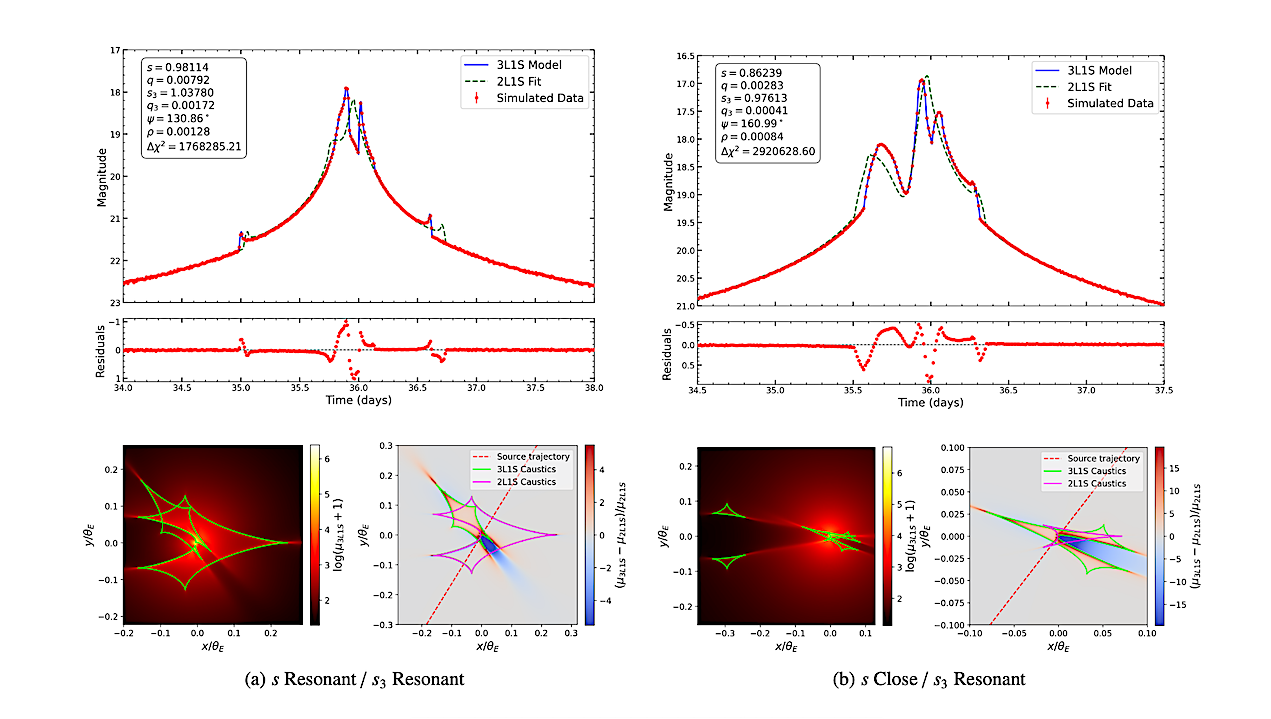
The research focuses on simulating a variety of high-magnification microlensing light curves based on the expected survey characteristics of the Roman telescope. The team applied a detection criterion that relies on a necessary improvement in the chi-squared statistic for a two-planet model. This method aims to determine the reliability of distinguishing the second planet from a simpler binary-lens model.
Key Findings on Detection Rates
Results from the simulations indicate that the majority of two-planet microlensing events would be detectable with the Roman telescope. Notably, events where both planets have relatively large masses, with planet-star mass ratios around 10-3, demonstrate a high detection efficiency of approximately 90%. This success is attributed to strong central perturbations produced during these events, which generate significant signals.
Conversely, systems featuring only low-mass planets, with mass ratios around 10-4, yield much weaker signals. These signals often fall below the detection threshold due to less favorable alignments. The research underscores that planetary mass ratios and the resulting caustic geometry are the primary factors influencing the detectability of these events.
Estimates of High-Magnification Events
Considering the anticipated frequency of planetary systems and the proportion of high-magnification microlensing events, the researchers estimate that the Roman telescope is expected to identify a high-magnification triple-lens event in about 4.5% of multi-planet microlensing events. This translates to approximately 64 events throughout the telescope’s full survey period.
This work has been documented in a study consisting of 14 pages, including 8 figures and 2 tables, submitted for review to Astronomy & Astrophysics. The findings represent a significant step forward in our understanding of exoplanetary systems and the capabilities of future astronomical instruments.
As the field of astrophysics continues to evolve, the Roman telescope stands out as a critical tool for expanding our knowledge of the universe, potentially unveiling new insights into the nature of planetary systems beyond our own.