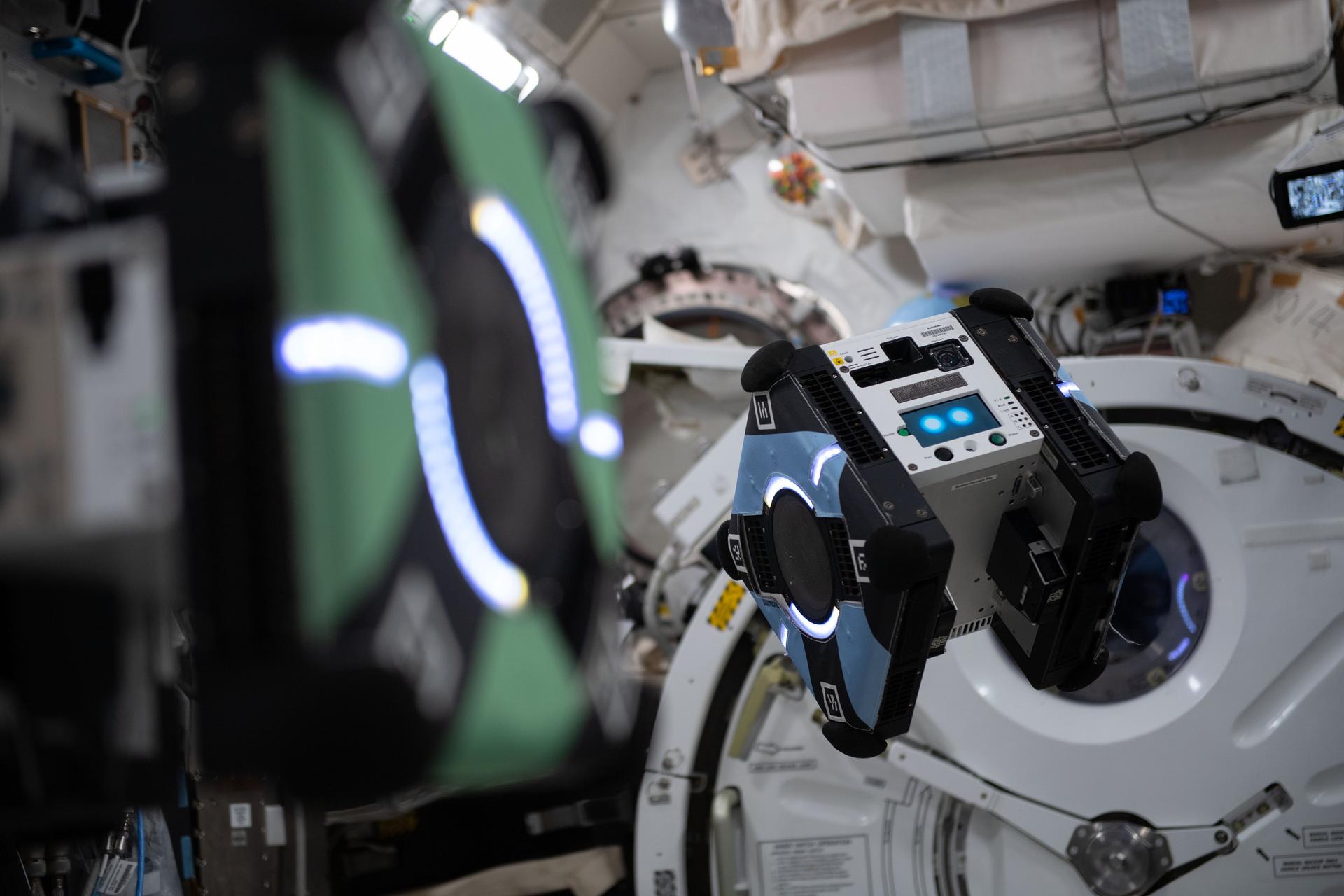
A significant breakthrough in space exploration has emerged as NASA implements innovative navigation technology to enhance the performance of its autonomous robots aboard the International Space Station (ISS). Collaborating with Professor Pyojin Kim from the Gwangju Institute of Science and Technology (GIST), NASA has developed an algorithm that reduces navigation errors in microgravity environments, allowing robots to operate with greater autonomy and efficiency.
The challenge faced by NASA’s robots, such as the free-flying Astrobee, lies in the absence of gravity. Unlike terrestrial tools, which rely on gravitational cues for orientation, these robots often lose their bearings in a microgravity environment. Traditional navigation algorithms, designed for Earth, struggle to adapt to the ISS’s conditions, leading to frequent errors and requiring astronauts to recalibrate the robots manually.
Revolutionizing Navigation with Digital Twins
To address this persistent issue, Professor Kim’s team proposed a solution utilizing digital twins, which are precise 3D replicas of physical spaces. By creating a virtual model of the ISS that excludes transient clutter, the team enabled Astrobee to compare real-time camera footage with this pristine digital representation. Professor Kim explains, “The digital twin serves as a ground truth, enabling the robot to filter out visual noise and recalibrate its position.”
This method effectively allows the robot to interpret its surroundings as a series of geometric features, using the Manhattan World Assumption to navigate. This principle posits that man-made environments consist largely of orthogonal surfaces, making the ISS an ideal candidate for this approach. As a result, the average rotational error has been reduced to just 1.43 degrees, ensuring that the robot can complete its tasks without requiring human intervention.
Beyond improving robot efficiency in space, Professor Kim believes this technology could have significant applications on Earth. The same navigation principles could guide drones and indoor robots, especially in environments where GPS is unavailable. “Orientation techniques based on these structural features are applicable not only to space stations but also to typical urban settings,” he noted.
Insights from Collaboration and Future Implications
Professor Kim’s collaboration with NASA began during his doctoral studies, when he interned at the NASA Ames Research Center. He was immersed in the development of Astrobee and witnessed firsthand the rigorous testing and innovative spirit of the agency. He expressed gratitude for his mentors and colleagues, emphasizing the importance of collaboration in achieving breakthroughs. “This research would have been impossible without the help of my mentor at the time, Dr. Brian Coltin, and my NASA colleagues,” he stated.
Throughout his time at NASA, Kim observed the agency’s unique approach to exploration and innovation. He described NASA’s willingness to embrace failure as a vital aspect of its success. “Behind every public triumph lie dozens of quiet failures,” he said, highlighting the importance of resilience in research.
As space exploration increasingly intersects with commercial interests, Professor Kim believes that the advancements made through this collaboration will play a pivotal role in shaping the future of both space and terrestrial technologies. His insights into the economic potential of space are timely, as numerous startups are emerging to explore opportunities in areas such as lunar mining and satellite assembly.
With the ongoing evolution of space exploration technologies, NASA’s successful implementation of digital twin navigation not only enhances the capabilities of its robots but also sets the stage for future innovations that can benefit both space and Earth-based applications.