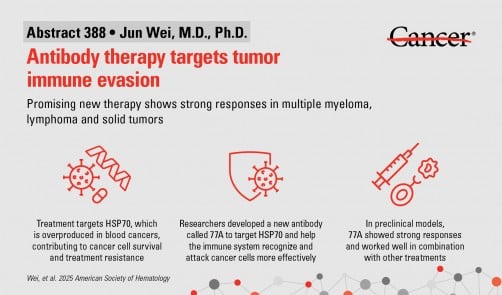
Researchers from The University of Texas MD Anderson Cancer Center have developed a promising new antibody therapy, named 77A, which significantly enhances the immune response against various blood cancers and solid tumors. This breakthrough was presented by Dr. Jun Wei, assistant professor of Lymphoma & Myeloma, during the 67th American Society of Hematology (ASH) Annual Meeting held on December 6, 2025.
The investigational therapy targets a protein known as HSP70. This protein is often overproduced in tumors, allowing cancer cells to evade the immune system. By converting HSP70 into an immune system trigger, 77A activates T cells and natural killer (NK) cells, reshaping the tumor environment to support long-lasting immune responses. In laboratory models, the therapy demonstrated enhanced effectiveness in conjunction with existing treatments, including chemotherapy, radiation therapy, and immunotherapies.
Dr. Robert Z. Orlowski, professor of Lymphoma & Myeloma and principal investigator, emphasized the significance of these findings, stating, “These results give us confidence that 77A could become a versatile immunotherapy.” The research indicates not only the potential to overcome treatment resistance in conditions like myeloma and lymphoma but also the ability to improve outcomes in solid tumors.
The mechanism of action for 77A lies in its ability to enhance the activity of both innate and adaptive immune cells. In laboratory tests, 77A significantly improved the capability of immune cells to detect and eliminate cancer cells. This antibody also shows potential compatibility with advanced treatments such as adoptive T cell therapy, where patients receive lab-modified immune cells designed to target specific cancer cells.
Looking ahead, the initial results from tests using human immune cells suggest that 77A could effectively boost immune responses in healthy donors. This positions the therapy as a strong candidate for further investigation in clinical trials. The research team is now focused on developing a humanized version of the antibody, aiming to transition into clinical testing to assess its effectiveness across various cancer types.
The study received support from Blood Cancer United, previously known as the Leukemia & Lymphoma Society. A comprehensive list of collaborating authors and their disclosures is available alongside the research abstract.
This development adds to the growing landscape of innovative cancer therapies, paving the way for enhanced treatment options that could significantly impact patient care and improve survival rates in challenging cases of cancer.