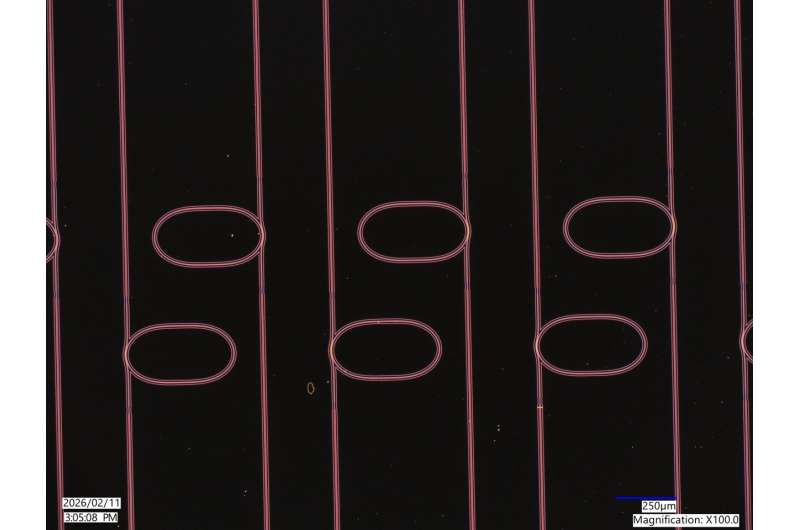
Researchers at the University of Colorado at Boulder have developed highly efficient optical microresonators that can significantly enhance sensor technologies. This breakthrough allows light to circulate longer within microscopic devices, which could lead to advancements in various applications, including navigation and chemical identification. The findings were published in the journal Applied Physics Letters on February 23, 2026.
The microresonators, which are tiny devices designed to trap light and increase its intensity, have been created by a team led by fourth-year doctoral student Bright Lu. He explained, “Our work is about using less optical power with these resonators for future uses.” The researchers focused on an innovative design known as “racetrack” resonators, which feature an elongated shape reminiscent of a running track. This design minimizes light loss through smooth curves, crucial for achieving high light intensities.
Incorporating Euler curves, which are smooth curves commonly used in road and railway design, the researchers ensured that light could travel without abrupt bends. Co-advisor Won Park, a Sheppard Professor of Electrical Engineering, emphasized the significance of this design choice, stating, “Our design choice was a key innovation of this project.” By efficiently guiding light through the resonator, the team dramatically reduced losses, allowing for enhanced interactions among photons.
The microresonators were fabricated at the COSINC clean room in Colorado, utilizing a state-of-the-art electron beam lithography system. This facility provides the precise environment necessary for creating devices at microscopic scales. Traditional lithography methods are limited by the wavelength of light, whereas electron beam lithography can achieve sub-nanometer resolution, essential for the performance of these devices.
Lu expressed enthusiasm about the fabrication process, noting, “Clean rooms are just cool. You’re working with these massive, precise machines, and then you get to see images of structures you made only microns wide.” This hands-on experience has been rewarding for the team.
A pivotal aspect of the project was the use of chalcogenides, a family of specialized semiconductor glasses known for their high transparency and nonlinearity. Park noted, “Our work represents one of the best performing devices using chalcogenides, if not the best.” These materials facilitate the passage of light at the high intensities necessary for effective microresonator operation, although they present challenges in processing.
Professor Juliet Gopinath, who has collaborated with Park for over a decade, highlighted the delicate balance required when working with chalcogenides. She stated, “Chalcogenides are difficult but rewarding materials to operate for photonic nonlinear devices.” Their research demonstrated that minimizing bending loss leads to ultra-low-loss devices comparable to cutting-edge technologies in other material platforms.
Following fabrication, the microresonators underwent rigorous testing led by James Erikson, a physics Ph.D. student specializing in laser measurements. By aligning lasers with microscopic waveguides, Erikson monitored how light behaved within the device, looking for specific “dips” that indicate resonance as photons are trapped. He explained, “The most obvious indicator of device quality is the shape of the resonances, and we want them to be deep and narrow.”
Erikson added that understanding how much light is absorbed versus transmitted is crucial for device performance, particularly as thermal effects can alter material properties under varying temperatures. As the device heats up, its characteristics can change, impacting its functionality.
Looking ahead, these microresonators could pave the way for compact microlasers and advanced chemical and biological sensors. They may also play a vital role in quantum metrology and networking. Lu emphasized the broader implications, stating, “Many photonic components from lasers, modulators, and detectors are being developed, and microresonators like ours will help tie all those pieces together.” The ultimate aim is to create scalable technology that can be manufactured en masse, potentially shaping the future of sensor technology.
The advancements presented by the team at the University of Colorado at Boulder reflect a significant step forward in optical sensor technology, with the potential to impact various fields and industries.